
1. KNX Market Trends (2025–2034)
1.1 A brief introduction to KNX
The demand for comfort and versatility in the management of heating, lighting and access control systems for a family home as well as an office complex is growing. At the same time, the efficient use of energy is becoming increasingly important. People want a comfortable, sustainable and safe place to live and work and that’s where automation jumps in.
However, more convenience and safety together with lower energy consumption can only be achieved by intelligent control and monitoring of all products involved. This is a true challenge as it implies more wiring, running from the sensors and actuators to the control and monitoring centres. For professionals, such a mass of wiring also means higher design and installation efforts, increased fire risk and soaring costs. That’s where KNX jumps in!
(Source: KNX Association)
The KNX protocol offers a future-proof, internationally recognized solution. Moreover, it brings endless flexibility and personalization to both residential and commercial space automation. In addition, through features such as a safe and secure system, rapid and easy installation, and an international community of manufacturers and integrators, therefore, KNX smart home and KNX commercial building solutions realize the dream of seamless, integrated automation.
With KNX home automation, a wide variety of devices, such as lighting, shutters, security systems, energy management, HVAC, signaling and monitoring systems, can all communicate effortlessly using the unified KNX communication protocol. As a result, this is the foundation for efficient, scalable, and future-ready smart buildings.
1.2 KNX Market Trends & Growth Insights (2025–2034)
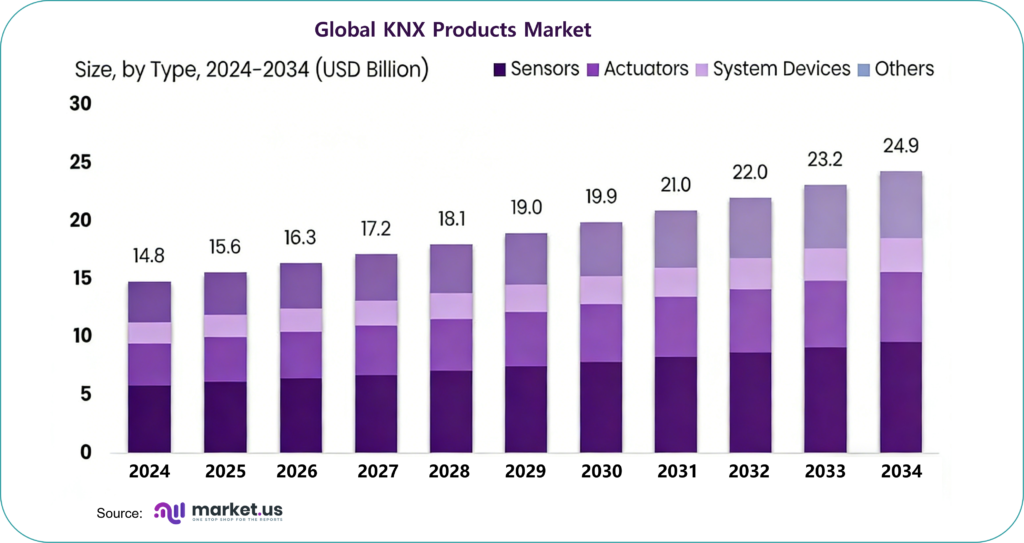
According to the latest research by market.us, the global KNX products market is projected to reach around USD 24.3 billion by 2034. It will surge from USD 14.8 billion in 2024 at a CAGR of 11%. In 2024, Europe led the market, representing over 45.4% of global share and generating revenues of USD 6.6 billion.
However, sensors and lighting hold the dominant market positions. They showed over 65% and 43% shares, respectively. Subsequently, the commercial sector is also prominent. It was accounted for more than 52% of KNX deployments worldwide.
The KNX system underpins a diverse range of smart home solutions, and it powers the integration of HVAC, lighting, shading, fire safety (KNX fire safety system solution), touch control panels (KNX touch panel supplier), and more.
Therefore, as the market shifts from isolated control towards modular and scalable platforms, the KNX smart home system delivers robust interoperability, and it also improved data security, and standardized frameworks necessary for digital transformation across construction, hospitality, healthcare, and industrial sectors.
Key Takeaways:
- The KNX system market size is projected to reach USD 24.3 Bn by 2034, up from USD 14.8 Bn in 2024, highlighting its accelerating adoption in both knx smart home and knx commercial building applications.
- Sensors, essential for knx smart home system operations and seamless knx communication protocol integration, captured more than 65.1% share of KNX products.
- Lighting control solutions led the market, taking more than 43.2% share, reflecting the growing importance of KNX lighting system technology within knx home automation.
- The commercial sector held a dominant position, with over 52.2% market share, as businesses partner with top KNX gateway supplier and implement advanced KNX fire safety system solution and KNX air conditioning system technologies.
- Europe led the global KNX products market, capturing 45.4% share (valued at approximately USD 6.6 billion), driven by strong demand for smart building solutions and the region’s focus on KNX automation and KNX smart home vs traditional wiring adoption.
A significant factor accelerating KNX adoption is tightening global regulations on energy efficiency, safety, and sustainability. Additionally, regulators increasingly promote open standards like KNX. It will reduce vendor lock-in, and enable effective cross-platform integration. In conclusion, enhanced security, lower energy consumption, and the ability to satisfy evolving compliance requirements have made KNX the system of choice for system integrators and property managers seeking scalable, future-proof solutions.
Recent advances in robotics, automation, and real-time analytics—enabled by KNX technology—are streamlining everything from smart factories to logistics supply chains (smart home supply chain), leveraging automation for rapid, cost-effective operations. The synergies of AI, adaptive material-handling, and integrated system control are setting new benchmarks in operational resilience and efficiency.
1.3 KNX Product Ecosystem & Emerging Use Cases
Driven by its wide vendor-neutral community (KNX manufacturer, KNX gateway supplier), KNX supports a rich market for innovative hardware—from lights and sensors to specialized systems like KNX air conditioning system and advanced fire and security integrations. Sectors worldwide, particularly in Europe, continue to invest in KNX automation to achieve regulatory compliance, reduced operational costs, and enhanced comfort and security.
As building owners, occupants, and developers begin to value interoperability (“KNX smart home vs traditional wiring”), adaptable solutions like KNX are recognized for creating seamless, unified smart environments—adding long-term value, scalability, and adaptability for future requirements.
2. Categories of KNX System Products
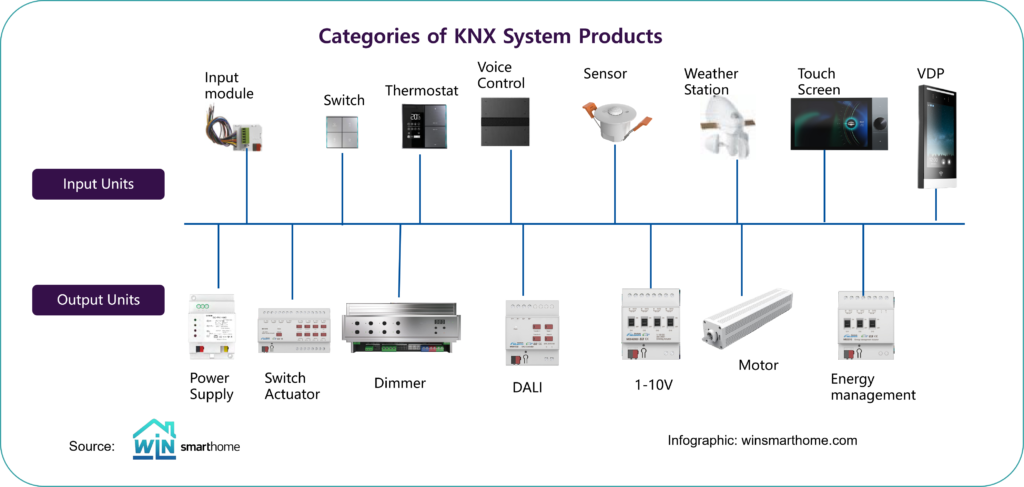
KNX system products are fundamentally classified into two main categories – input units and output units – which together enable flexible automation and efficient control in both residential and commercial buildings.
2.1 Input Units
Input units are responsible for collecting signals and transmitting real-time data to the KNX system. These include:
- Smart Switch: Simple control for lights and devices, core to smart home workflows.
- Input module: Initiates commands or processes within the KNX home automation network.
- Touch Screen: User interfaces for direct control of lighting, temperature, or scenes.
- Thermostat: Manages HVAC for consistent comfort and energy efficiency.
- Voice Control: Enables hands-free operation and advanced smart home experiences.
- Sensor: Detects motion, occupancy, temperature, or other changes for responsive automation.
- Weather stations: Modules that gather external data like sunlight or wind for automated building responses.
- VDP (Video Door Phone): Integrates access control and security into the KNX protocol ecosystem.ther external data like sunlight or wind for automated building responses.
In 2024, sensors held 65.1% of the market, highlighting their pivotal role in building automation. Thanks to input devices, KNX solutions can automatically respond to environmental changes, reducing manual intervention and increasing accuracy for energy savings and comfort. (Source: market.us)
2.2 Output Units
Output units receive instructions from the KNX system and perform designated actions. These include:
- Power Supply: Delivers stable electricity to all KNX automation devices.
- Switch Actuator: Executes switching commands to dedicated devices and circuits.
- Dimmer: Allows smooth adjustment of lighting levels for ambiance and savings.
- DALI/1-10V Modules: Controls lighting zones, efficiently managing commercial or larger environments.
- Motor: Operates blinds, curtains, or windows for automated shading and ventilation.
- Energy Management: Monitors and manages overall building consumption for peak efficiency.
By combining these input and output units, the knx smart home system achieves central control over lighting, climate, security, and access. This modular approach enables scalable solutions across homes, offices, hotels, and more, perfectly showcasing the benefits of knx automation and the versatility of the knx protocol.
2.3 By Application
KNX solutions support a broad array of building management tasks, with adoption driven by the following areas:
Lighting Control
Lighting control remained the most prominent application in 2024, capturing a 43.2% market share. With centralized management, scheduling, and brightness adjustment based on occupancy or daylight, KNX lighting control maximizes energy efficiency and comfort. Market growth in this segment is fueled by the need for smart infrastructure in both homes and business settings.
HVAC Control
KNX’s HVAC applications allow seamless integration of heating, ventilation, and air conditioning—delivering balanced climate management, lower utility costs, and improved occupant comfort.
Shutter & Blind Control
Integration with shading systems provides adaptive daylighting and heat management, enhancing building performance and user convenience.
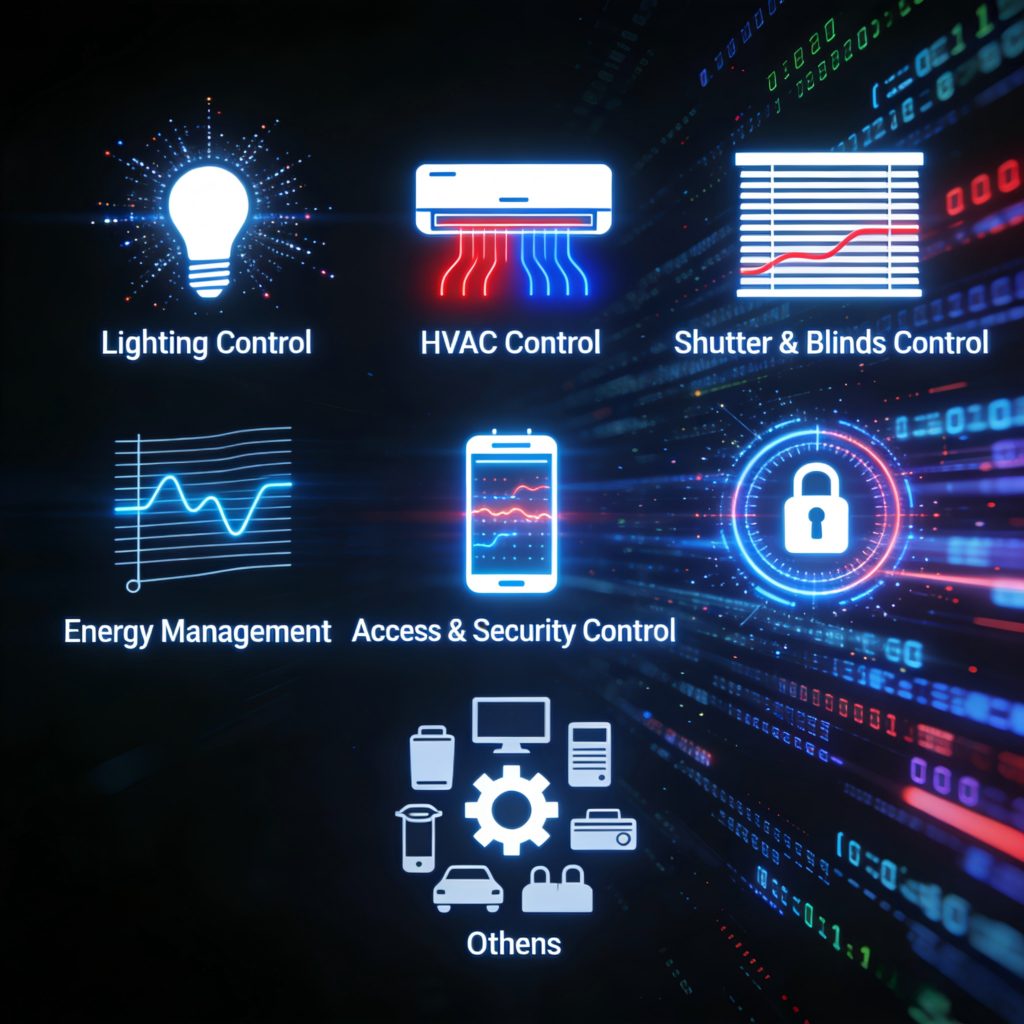
Energy Management
KNX enables real-time monitoring and automated load optimization for smarter energy usage in both residential and commercial buildings.
Access & Security Control
Access panels and sensor-based entry solutions enhance building security, streamline operations, and support multi-zone management.
Others
KNX’s modular design also supports expanding needs, from multimedia automation to integration with third-party control protocols.
3. Key Players in KNX Solutions & The Hybrid Future
3.1 Market Leaders & Competitive Landscape
The global KNX system market is highly competitive, driven by internationally renowned manufacturers and innovators. Siemens, Schneider Electric, and ABB top the list, each setting industry standards for smart building automation. Siemens is especially noted for advanced energy management, lighting, and HVAC integration, while Schneider Electric emphasizes sustainability and seamless system compatibility. ABB leverages deep experience in industrial automation to deliver robust KNX solutions for both commercial and residential sectors.
Other prominent KNX manufacturers include JUNG, G. Brück Electronic, GVS, STEINEL, Urmet, Lime International, and Hager—all expanding market share with specialized products for lighting, security, and automation. Companies like Berker, Gira, and HDL Automation are recognized for premium design and functionality in KNX smart home systems. Rising stars such as Ekinex, MDT Technologies, Zennio, and IPAS GmbH offer cost-effective, advanced KNX-compatible solutions tailored to evolving smart home and commercial needs.
Recent Developments & Innovation:
- March 2025: Siemens showcased all-in-one KNX solutions and hybrid heating at ISH 2025, targeting simpler installations and greater energy savings.
- October 2025: MDT Technologies acquired stakes in Tapko Technologies and Apricum, strengthening sensor capabilities and long-term KNX partnerships.
3.2 Protocol Convergence: KNX, Matter & Hybrid Ecosystems
For over 30 years, KNX has provided unmatched stability, scalability, and interoperability for complex building automation, covering lighting, HVAC, shading, and energy management with a distributed, standard-based approach. Yet, challenges remain—especially for retrofitting existing buildings and enabling full interoperability with consumer smart appliances.
Recently, Matter has emerged as a major connectivity standard, supported by the CSA and tech giants like Apple, Google, and Amazon. Matter aims to unify smart devices under a single protocol, simplifying installation and compatibility.
Why KNX + Matter Integration is the Future:
- Infrastructure & Ecosystem: KNX excels for wired, resilient building infrastructure; Matter connects consumer IoT devices and enables cross-platform compatibility.
- Scalability: KNX supports thousands of data points in large projects, while Matter scales easily for consumer devices.
- User Experience: KNX professional panels enable unified control; Matter adds voice assistants and mobile app integration.
- Futureproofing: KNX is certified and backward-compatible; Matter aligns with the fast-evolving consumer tech landscape.
The Hybrid Future of Building Automation:
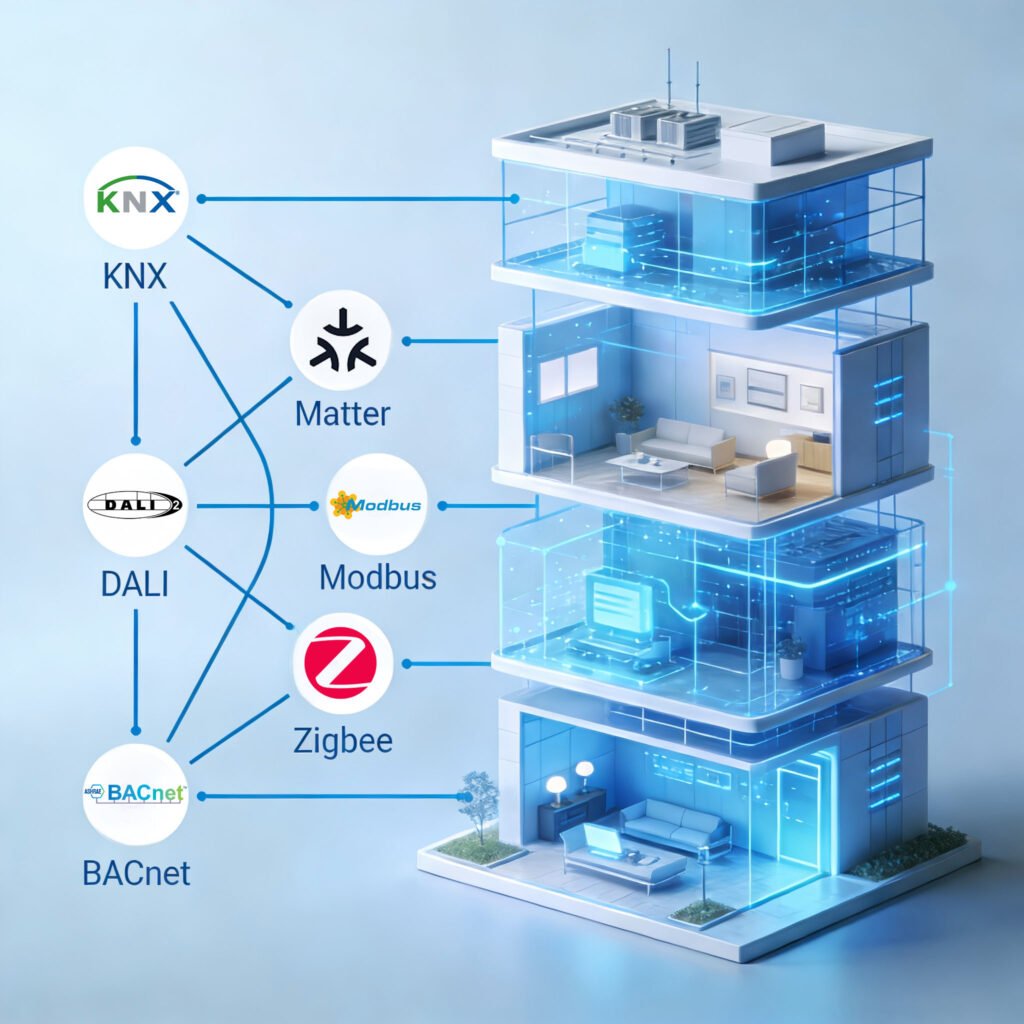
The next generation of smart buildings won’t rely on a single protocol. Hybrid infrastructures will feature KNX, Matter, Thread, DALI, Modbus, Zigbee, and BACnet—all complementing each other across layers of functionality. KNX remains the backbone for mission-critical automation, while consumer-grade standards like Matter extend reach and convenience. This approach protects investments, speeds up adoption, and creates buildings that are truly future-ready.
As the market evolves, KNX manufacturers increasingly offer Matter gateways and complementary solutions, ensuring sustained integration and relevance in a rapidly changing smart home landscape.
4. Customized KNX Solutions FAQ
5. How to Choose the Right KNX Solution Supplier?
Selecting the ideal KNX solution supplier requires considering certification, technical expertise, tailored partnership models, and your unique procurement goals to maximize long-term value and avoid costly pitfalls.
- Ensure Product Certification
Only consider KNX products certified by the official KNX Association. Although certification raises costs, it guarantees reliability and compatibility with ETS software, reducing the risk of future bugs. Non-certified products may claim KNX protocol support, but often lead to system instability and limit future expandability. - Assess Technical Support & Consultation
Choose KNX manufacturers who provide strong technical support, documentation, and integration consultation, especially for advanced applications like KNX smart home vs traditional wiring. This support is vital for complex commercial building projects. - Evaluate Product Portfolio & Innovation
A diverse and up-to-date selection—such as KNX touch panel supplier, KNX gateway supplier, and advanced KNX fire safety system solutions—shows the supplier’s capacity for innovation and ability to respond quickly to market trends and unique project requirements. - Review Project Experience & References
Suppliers with proven track records in both residential and commercial sectors inspire confidence. Ask for case studies or references to confirm expertise in energy-efficient automation and smart home supply chains. - Clarify Your Procurement Goal
If acting as a KNX manufacturer seeking OEM or ODM, partner with suppliers in China specializing exclusively in such services. This protects your brand from direct competition and streamlines market entry.
For those aiming to be brand agents or distributors, select partners with both innovative KNX product development and international certifications. Beware of suppliers who are also brand owners, as their dual role can cause channel conflicts.
6. Our Advantages in KNX Solutions
At Guangzhou Win Smart Tech Co., Ltd, we distinguish ourselves as your dedicated KNX system sourcing and integration expert. Unlike traditional resellers, we are not tied to any single brand, such as Citron, but act as an independent consultant focused on delivering tailored solutions that best match your project’s needs—whether they involve KNX home automation, Zigbee, Matter, or hybrid devices.
Why Choose Wim Smart Home?
- Global Project Experience
With more than 40 countries served, we support diverse project types—residential, commercial, hospitality, and smart-city—ensuring that every solution fits both local and international standards. - Unbiased Sourcing and Vendor-Neutral Options
Our network includes KNX manufacturers, Zigbee/Matter and security device suppliers, and OEM/ODM factories. We source directly to negotiate the best value on your behalf, presenting only certified products (KNX, CE, FCC, etc.) and avoiding channel conflicts or restrictive agreements. - Custom Fit and Integration
Having previously represented a single brand for over a decade, we recognized that no one brand—not even the largest—can fulfill all client requirements. Now, we seamlessly integrate multiple brands and protocols (as in KNX + Apple HomeKit projects), so you enjoy the ideal mix of price, feature set, and future scalability. If a part needs replacement or an upgrade, you’re free to select the most suitable device, regardless of the manufacturer, and your system remains compatible and robust (KNX smart home vs traditional wiring). - Transparent Pricing & Direct Manufacturer Access
Our strong relationships give you access to direct meetings with company principals, truly competitive pricing, and the flexibility to develop long-term relationships with suppliers, should your business require it. - Full-Scope Service Model
From unbiased supplier aggregation, price negotiation, and logistics to after-sales support, technical training, and certification guidance, WinSmartHome (our proprietary brand) is your support at every project stage. - Proven Value Proposition
Through independent sourcing and our extensive network, we bring you the most efficient, cost-effective, and innovative solutions—helping you win more projects and succeed in a rapidly evolving market.
If you have a specific project or need advice on the best KNX automation, wireless, or smart-home solution, we invite you to start a conversation. We are committed to being your flexible, unbiased, and value-focused sourcing partner.
7. Conclusion
KNX system solutions represent the gold standard in comprehensive smart home and intelligent building automation. Thanks to the open KNX protocol and seamless KNX communication protocol, these platforms enable integrated control over lighting, HVAC, blinds, and other systems—delivering greater comfort, efficiency, and safety for both residential and commercial projects.
Choosing certified KNX home automation devices and collaborating with reputable KNX manufacturers and suppliers ensures not only system reliability but also flexibility in future upgrades or integrations. Whether you require a tailored KNX smart home system in a private residence or robust scalability for a KNX commercial building, this technology offers future-proof smart building solutions designed to grow along with your needs.
Working with experienced partners, such as a KNX gateway supplier or a smart home supply chain expert, further enhances system robustness. Adopting advanced components like a KNX lighting system, KNX touch panel supplier interfaces, or KNX air conditioning system modules strengthens your automation framework, while features such as a KNX fire safety system solution help safeguard modern spaces.
The international reach and vendor-neutral nature of KNX automation mean you can compare options, mitigate risks associated with vendor lock-in, and enjoy full compatibility even as product lines evolve. Ultimately, when comparing KNX smart home vs traditional wiring or Matter vs KNX, KNX stands out for its interoperability, reliability, and strong industry backing.
Sources: