
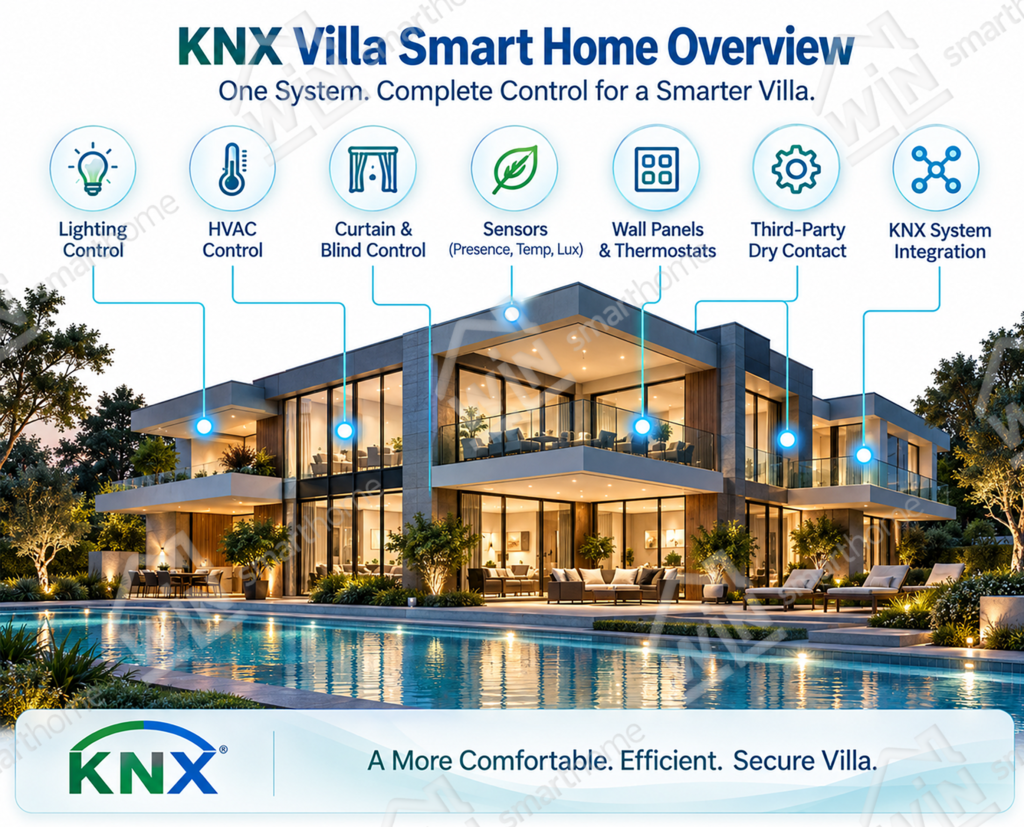
A KNX villa lighting HVAC curtain control BOM is a project-specific equipment list that defines the actuators, sensors, gateways, power supplies and control devices required for the villa. It is used to match lighting circuits, HVAC zones, curtain motors and third-party integrations with the correct KNX control channels before quotation and ordering. For system integrators, contractors and villa automation designers, a well-planned BOM helps prevent missing channels, incompatible devices and unnecessary hardware.
This guide explains how to prepare a practical bill of materials for a villa that combines lighting, climate and curtain control on KNX. It can be used during concept design, quotation comparison, sample evaluation and the final pre-order review.
Start with a room-by-room function schedule
The most accurate BOM starts with a room schedule. List every space in the villa, including bedrooms, bathrooms, living areas, kitchens, corridors, staircases, balconies, gardens, plant rooms and service areas. For each room, record the functions that the owner expects.
- Switched lighting circuits
- Dimmable lighting circuits and dimming protocol
- Curtain, sheer and blind motors
- Air-conditioning type and control points
- Underfloor heating or ventilation control
- Presence, motion, temperature and illuminance sensing
- Wall switches, thermostats and touch panels
- Scenes, schedules and central functions
- Third-party device dry-contact inputs
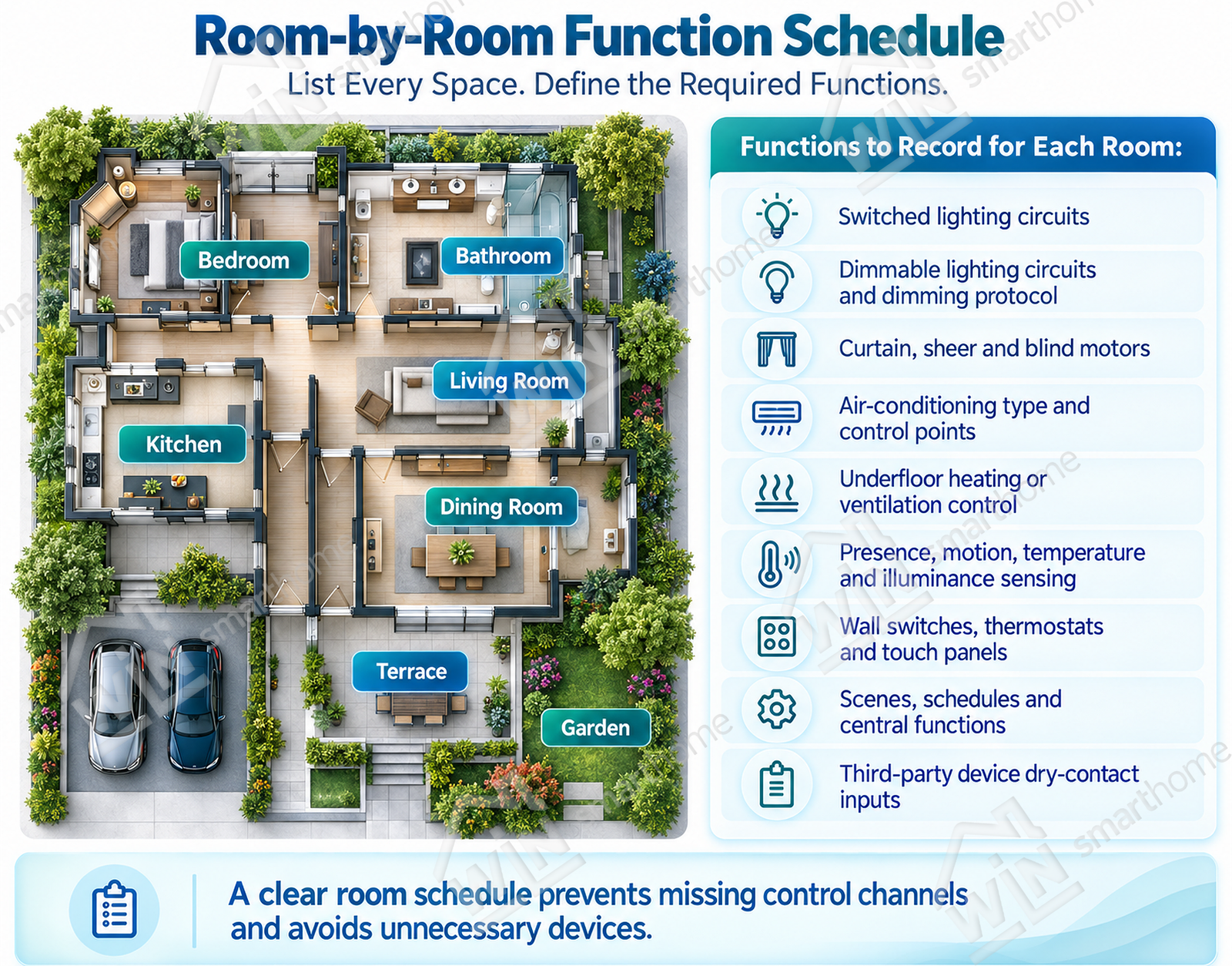
This schedule prevents two common problems: missing control channels and ordering devices with functions that the project does not need.
Lighting control BOM
Count lighting loads by circuit rather than by room. A single room may have several independently controlled circuits for downlights, decorative lights, strip lights, wall lights and outdoor lighting. Record the voltage, load type, rated power, driver type and required control method for every circuit.
Switching actuators
Use KNX switching actuators for on/off lighting and other suitable electrical loads. Select the relay rating according to the actual load and consider inrush current from LED drivers. Divide the total number of switched circuits by the available channels per actuator, then add reasonable spare capacity for design changes.
Dimming actuators and DALI gateways
Confirm the dimming technology before choosing hardware. Common options include phase-cut dimming, 0–10 V control and DALI. For a small number of conventional dimming circuits, a KNX dimming actuator may be suitable. For a villa with many DALI luminaires, groups and scenes, a KNX-DALI gateway can simplify addressing and scene control.
The BOM should state the number of dimming channels or DALI devices, required groups, scenes, emergency-lighting requirements and driver compatibility. Do not select a dimmer using wattage alone; the driver and load behavior must also be verified.
HVAC control BOM
HVAC control depends on the equipment installed in the villa. Confirm whether each zone uses fan coil units, VRF or VRV indoor units, split air conditioners, underfloor heating, radiators, ventilation equipment or a combination of systems.
Fan coil unit control
For fan coil units, confirm the fan-speed outputs, valve type, heating and cooling arrangement and required interlocks. A KNX fan coil actuator may control three fan speeds and one or more valves, while a KNX thermostat or room controller provides the temperature setpoint and operating mode.
VRF and split air-conditioning integration
VRF or split systems may require a dedicated KNX gateway. The exact gateway depends on the air-conditioning brand, model series and available communication interface. The BOM should not use a generic gateway description without confirming compatibility with the selected HVAC equipment.
Temperature sensing and zoning
Define one temperature control zone for each independently controlled space. Decide whether temperature is measured by a thermostat, multifunction wall panel, ceiling sensor or a separate probe. Large open areas may require more than one sensor or a representative sensing position.
Curtain and blind control BOM
Count every motor separately and confirm its voltage, direction-control method, travel limits and interlock requirements. A conventional reversible motor normally requires two interlocked outputs for open and close. The actuator must prevent both directions from being energised at the same time.
List curtains and sheers as separate motors when they operate independently. Also identify blinds, skylights, awnings, gates or windows that require position control. If exact position feedback is needed, confirm that the selected motor and actuator support it.
Useful villa functions include open, close and stop commands, percentage positioning, room scenes, sunrise and sunset schedules, weather protection and an all-close command when the security system is armed.
KNX sensors and user interfaces
Presence and motion sensors can reduce unnecessary lighting and HVAC operation in corridors, bathrooms, dressing rooms and service areas. Specify the detection area, mounting height and required functions. A sensor may combine presence detection, brightness measurement, temperature and humidity, but each required function should be confirmed in the product data.
For wall controls, prepare a button-function schedule. Record the number of gangs or keys, short-press and long-press actions, scene functions, indicator behavior, temperature display and finish. This avoids selecting a panel based only on appearance.
System devices and KNX infrastructure
The KNX villa BOM also needs the infrastructure that allows all field devices to communicate and be commissioned.
- KNX power supplies sized for the bus load
- KNX IP routers or interfaces for ETS commissioning and integration
- Line couplers when the topology requires multiple lines
- Weather stations for wind, rain, brightness and sun protection
- Logic controllers or visualization servers when functions exceed device-level logic
- Gateways for DALI, HVAC, Modbus, BACnet, security or other systems
Calculate bus current using the connected devices and keep a safety margin. Large villas should be divided into logical KNX lines according to device count, cable topology, distribution boards and maintenance requirements rather than forcing every device onto one line.
Control Method Selection for a KNX Villa
| Function | Options | When to Use Each Option |
|---|---|---|
| Lighting | Switching / Dimming | Use switching when only ON/OFF control is required. Use dimming when brightness adjustment, dimming scenes or gradual transitions are required. |
| Dimming | Phase-cut / 0–10 V / DALI | Use phase-cut for compatible mains-dimmable lamps or drivers. Use 0–10 V for drivers with a dedicated 0–10 V control interface. Use DALI when individual addressing, grouping, scenes or centralized digital lighting management is required. |
| Air Conditioning | FCU / VRF-VRV / IR | Use FCU control for fan coil units with fan-speed and valve outputs. Use a KNX HVAC gateway for compatible VRF/VRV systems with a communication interface. Use IR control when direct system integration is unavailable and the air conditioner is normally controlled by an infrared remote. |
| Curtains & Blinds | Relay direction control / Position control | Use relay direction control for conventional open/close motors. Use position control when the motor and actuator support percentage positioning or blind-angle adjustment. |
| Third-Party Devices | Dry contact / Communication gateway | Use dry contacts for simple status or trigger signals. Use a gateway when structured data or bidirectional communication with another system is required. |
KNX Villa Lighting HVAC Curtain Control BOM Calculation
A useful planning table should include the category, required function, quantity basis, proposed device, channel count, calculated quantity, spare capacity and remarks. For example, 30 switched lighting circuits using 12-channel actuators require three actuators before allowing for spare channels. Ten curtain motors using four-channel curtain actuators require three actuators, leaving two spare motor channels.
HVAC quantities should follow the number of independently controlled zones. User interfaces and sensors normally follow the room schedule, while power supplies, couplers and IP devices follow the KNX topology.
Recommended spare capacity
Provide spare channels where late design changes are likely, especially for lighting, curtains and dry-contact inputs. Spare capacity should be intentional and visible in the BOM rather than hidden inside an oversized device selection. Also allow distribution-board space, auxiliary power capacity and suitable terminals for future additions.
Pre-order verification checklist
- Confirm the latest electrical drawings and room schedule.
- Match every lighting circuit to a switching, dimming or DALI channel.
- Confirm LED driver and dimmer compatibility.
- Match every HVAC zone to the correct actuator, thermostat and gateway.
- Match every curtain motor to an interlocked control channel.
- Third-party dry-contact inputs, such as door contacts, conventional switches.
- Confirm sensor coverage and mounting positions.
- Verify KNX bus current, topology and power-supply capacity.
- Check product application programs and ETS commissioning files.
- Record spare channels and distribution-board space.
- Test representative devices and key functions before the full order.
From BOM to quotation
A supplier can prepare a more accurate quotation when the project inputs are clear. Send the floor plans, electrical drawings, lighting schedule, HVAC equipment list, curtain motor details, switch schedule and required integrations. The quotation should identify model numbers, quantities, channel allocation, unit prices, lead time, warranty and the technical documents supplied with each product.
A well-structured KNX villa lighting HVAC curtain control BOM reduces quotation revisions, avoids missing devices and makes products from different suppliers easier to compare. It also gives the integrator a clear basis for sample testing and detailed ETS engineering.
An Integrated Alternative: KNX Room Control Unit
For some villa projects, the BOM does not need to be built entirely from separate KNX actuators and gateways. An integrated KNX Room Control Unit (RCU) can combine several frequently required functions into one device.
the KNX RCU can integrate:
- 18 relay outputs for lighting and other switched loads
- 4 × 0–10 V dimming channels or 1 DALI channel
- 4 curtain control channels
- Fan coil unit control
- 21 dry-contact inputs and 21 dry-contact outputs
- KNX, RS485, IR and Ethernet interfaces
- Built-in 320 mA KNX power supply
- Built-in KNX IP gateway
- 24 V auxiliary power supply

This makes the RCU particularly relevant when a villa requires lighting, dimming, curtains, HVAC and third-party dry-contact integration in the same control area. Instead of selecting separate switching actuators, dimming modules, curtain actuators, fan-coil controllers, binary inputs, KNX power supplies and IP interfaces, several of these functions can be consolidated into one device.
The result can be a simpler BOM, fewer DIN-rail devices and more centralized wiring, especially for villas designed around room- or floor-based distribution boards.
However, the RCU should still be selected from the actual load schedule. Relay ratings, dimming protocol, curtain quantities, FCU configuration, dry-contact requirements and KNX topology must all be checked before deciding how many RCUs are required.
| Comparison | Integrated KNX RCU | Separate KNX Modules |
|---|---|---|
| System Architecture | One RCU integrates 18 relay outputs (4 × 10A + 14 × 5A), 4 curtain channels, 4 × 0–10V channels or 1 DALI channel, FCU control, and 21 dry-contact inputs + 21 outputs. | If the required number of circuits exceeds the RCU capacity, or the connected loads require higher current ratings, separate KNX actuators or control modules are more suitable. |
| DIN-Rail Devices & Panel Space | Multiple control functions are integrated into one device, significantly reducing DIN-rail space and potentially allowing the villa to use fewer distribution panels. | Separate switching, dimming, curtain, FCU and input modules require more DIN-rail space and potentially more distribution panels. |
| Wiring | Fewer separate modules and interconnections can make the control-panel wiring simpler and more centralized. | More individual modules generally require more interconnections and panel wiring. |
| BOM Preparation | The RCU provides multiple integrated channels and typically leaves spare channels for later adjustment, making it particularly useful when the exact circuit allocation is not fully finalized during the early BOM stage. Circuits can be reassigned or unused capacity retained for later requirements. | The required lighting circuits, curtain motors, HVAC control points, inputs and other functions should be calculated more precisely before module selection and ordering. |
| Flexibility | Channel configuration is relatively fixed, so the project requirements should fit the available RCU resources. | Provides greater flexibility to select the type, rating and number of channels for each individual function. |
| Expansion & Integration | Includes 1 × RS485 interface, allowing compatible RS485 devices or systems to be integrated without purchasing an additional RS485 gateway for that interface. | If RS485 integration is required and the selected KNX modules do not provide it, an additional KNX/RS485 gateway or interface is required. |
| KNX Power Supply | Includes a built-in 320 mA KNX power supply, which can cover the bus-power requirement of many villa installations when the calculated KNX bus current remains within its available capacity. | A separate KNX power supply can be selected according to the actual bus load, making this architecture suitable when the system has more KNX devices or requires more than 320 mA. |
Both architectures can be used for KNX villa automation. For many villas, an integrated RCU can simplify the BOM, reduce DIN-rail space, wiring and separate system devices. Separate KNX modules remain useful when the project requires more circuits, higher load ratings, greater bus power or a highly customized channel configuration.
Integrated KNX RCU vs Separate KNX Modules for Villa Projects
For villa projects where these functions closely match the RCU channel configuration, it can provide a practical alternative to building the entire control system from separate KNX modules.
Frequently Asked Questions
Need help reviewing your KNX villa BOM?
Send WinSmartHome your villa drawings, room schedule and required functions. We can help review the BOM structure, shortlist suitable KNX devices and coordinate product samples for lighting, HVAC and curtain control.
Request Technical Consultation