
DALI vs KNX: choose DALI when the priority is addressable lighting, including individual luminaires, groups, dimming and scenes. Choose KNX when lighting must work with HVAC, curtains, shading or other building systems. Use both through a KNX–DALI gateway when a project needs building-wide automation and detailed lighting control; confirm gateway mapping and device compatibility for the selected products.
Request a KNX–DALI Project Architecture & BOM Review
Tell us your project type, room count, lighting fixture and group requirements, plus HVAC and curtain interfaces. We can review the preliminary architecture, flag gateway and commissioning questions, and suggest a starting product/BOM shortlist.
DALI vs KNX – Understanding the Fundamental Difference
TL;DR
- ✅ KNX and DALI are complementary technologies, not competing protocols.
- ✅ KNX serves as the backbone for building automation, while DALI specializes in precise lighting control.
- ✅ Choose KNX for whole-building automation, DALI for advanced lighting management, or both for complex projects.
- ✅ KNX and DALI integration is widely used in hotels, offices, hospitals, and commercial buildings.
- ✅ The right choice depends on your project requirements, not on choosing one protocol over the other.
Introduction
One of the most common misconceptions in smart building projects is that KNX and DALI are competing technologies.
In reality, they were designed to solve different problems.
The simplest way to understand the difference is:
KNX controls the building. DALI controls the lighting.
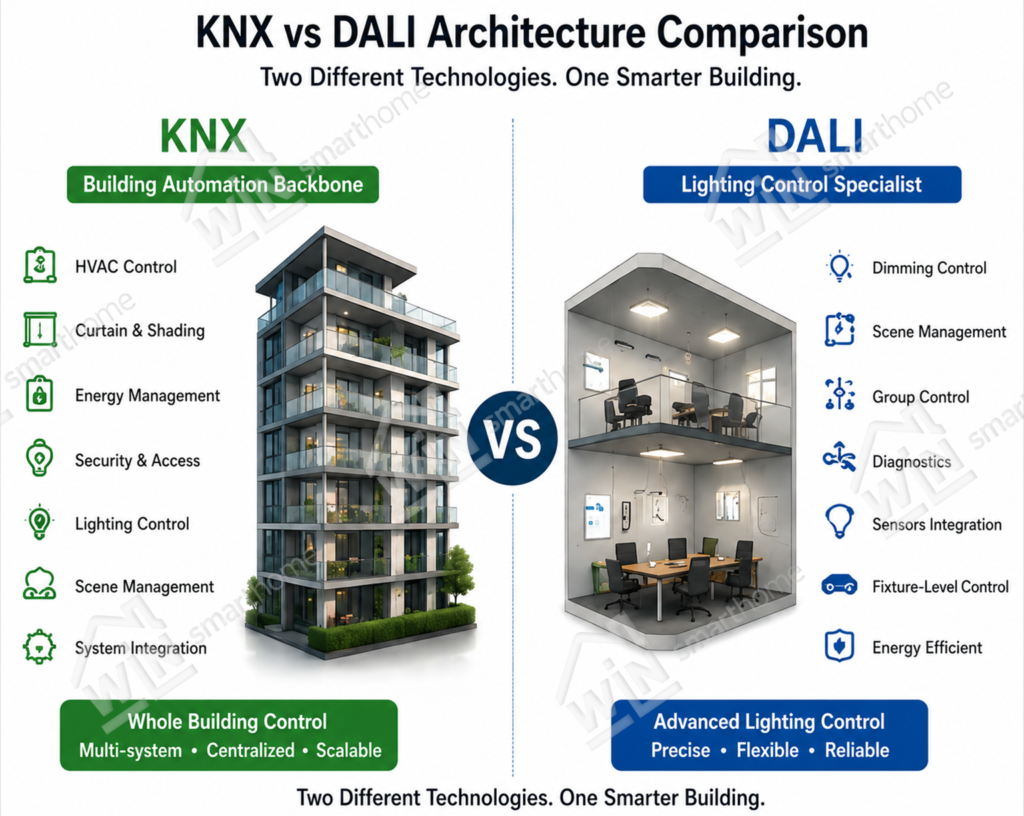
KNX is a complete building automation protocol capable of integrating lighting, HVAC, ventilation, heating, cooling, curtain control, shading systems, access control, and energy management into a single platform.
DALI (Digital Addressable Lighting Interface), on the other hand, was developed specifically for lighting control. Its primary focus is dimming, switching, scene management, diagnostics, and fixture-level control.
Because of these different design goals, KNX and DALI are often used together rather than against each other.
KNX vs DALI at a Glance
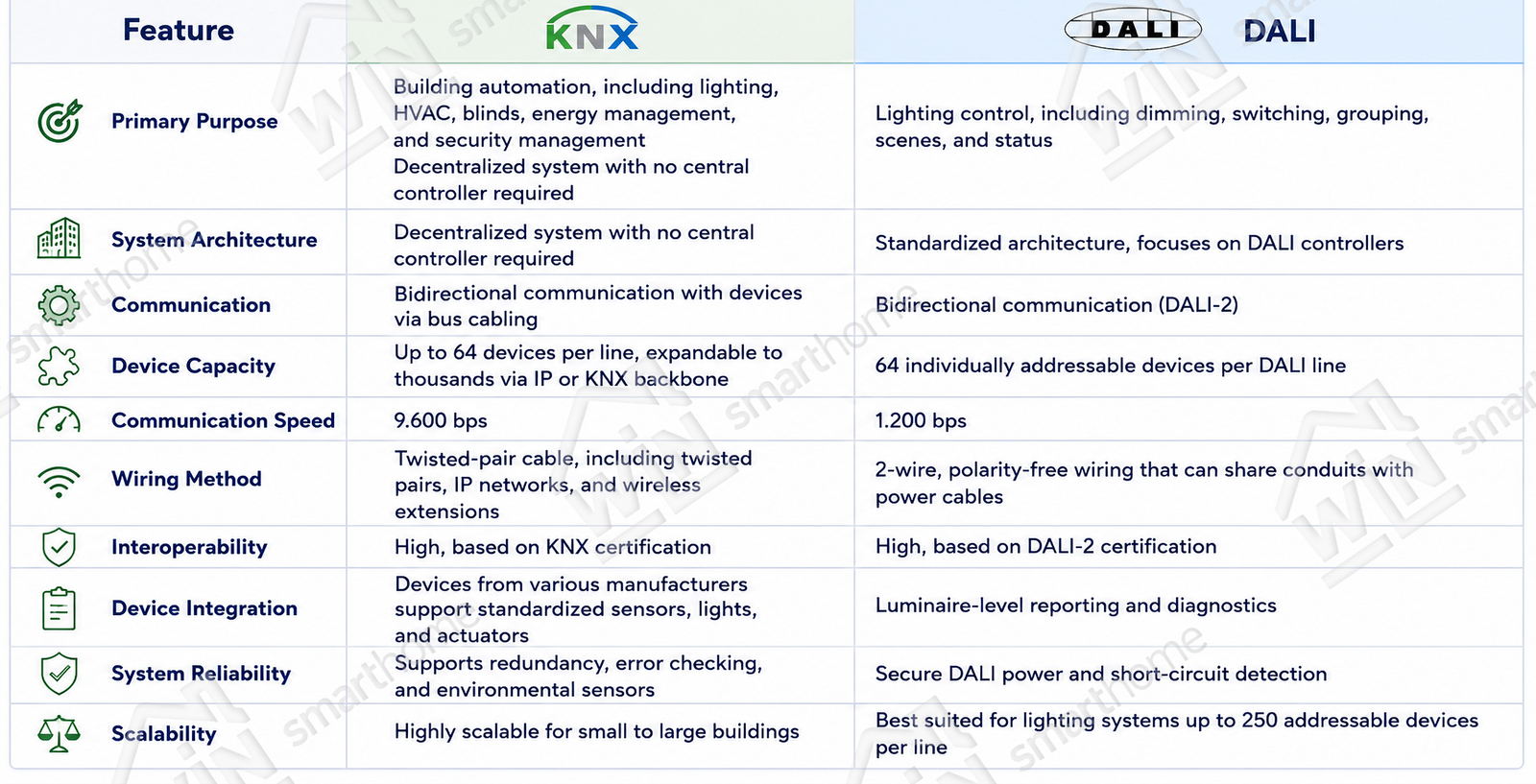
What This Comparison Really Means
Although KNX and DALI share some similarities, the table highlights an important fact: they were designed for different objectives.
KNX focuses on building-wide automation and system integration.
DALI focuses on lighting performance and control.
For this reason, the most successful smart building projects rarely choose KNX or DALI as an either-or decision. Instead, they use both technologies together, allowing each protocol to perform the role it was designed for.
KNX: The Building Automation Backbone
KNX is an international building automation standard recognized under ISO/IEC 14543 and supported by more than 400 manufacturers worldwide.
Unlike lighting-specific protocols, KNX was designed to connect multiple building systems through a single automation platform. Lighting is only one part of a typical KNX project. HVAC, curtains, ventilation, energy monitoring, access control, and many other systems can also be integrated into the same network.
A useful analogy is to think of KNX as a luxury SUV.
It is designed to provide a stable and reliable experience across an entire journey rather than excelling in just one area.
Technically, KNX supports line, tree, star, and mixed topologies, giving system integrators significant design flexibility. It uses a dedicated 29V DC bus, certified KNX cable, and CSMA/CA collision avoidance mechanisms to maintain reliable communication across large installations.
This makes KNX particularly suitable for villas, hotels, office buildings, hospitals, schools, and commercial projects where multiple systems must work together seamlessly.
DALI: The Digital Lighting Specialist
If KNX is a luxury SUV, DALI is a purpose-built off-road vehicle.
It may not control the entire building, but it performs exceptionally well in its specialized environment: lighting.
DALI is an international lighting standard defined under IEC 62386. In 2019, the protocol evolved into DALI-2, improving interoperability and introducing support for additional devices such as sensors and control interfaces through certification managed by the DiiA Alliance.
One of DALI‘s biggest advantages is fixture-level control. Every luminaire can have its own digital address, enabling functions such as:
- Individual fixture control
- Group control
- Scene management
- Occupancy-based lighting control
- Daylight harvesting
- Device diagnostics
- Fault reporting
DALI also supports smooth dimming from approximately 0.1% to 100%, making it ideal for applications where lighting quality, comfort, and energy efficiency are priorities.
As a result, DALI is widely used in offices, hotels, shopping malls, airports, hospitals, conference centers, and other projects that require advanced lighting management.
When Should You Use KNX, DALI, or Both?
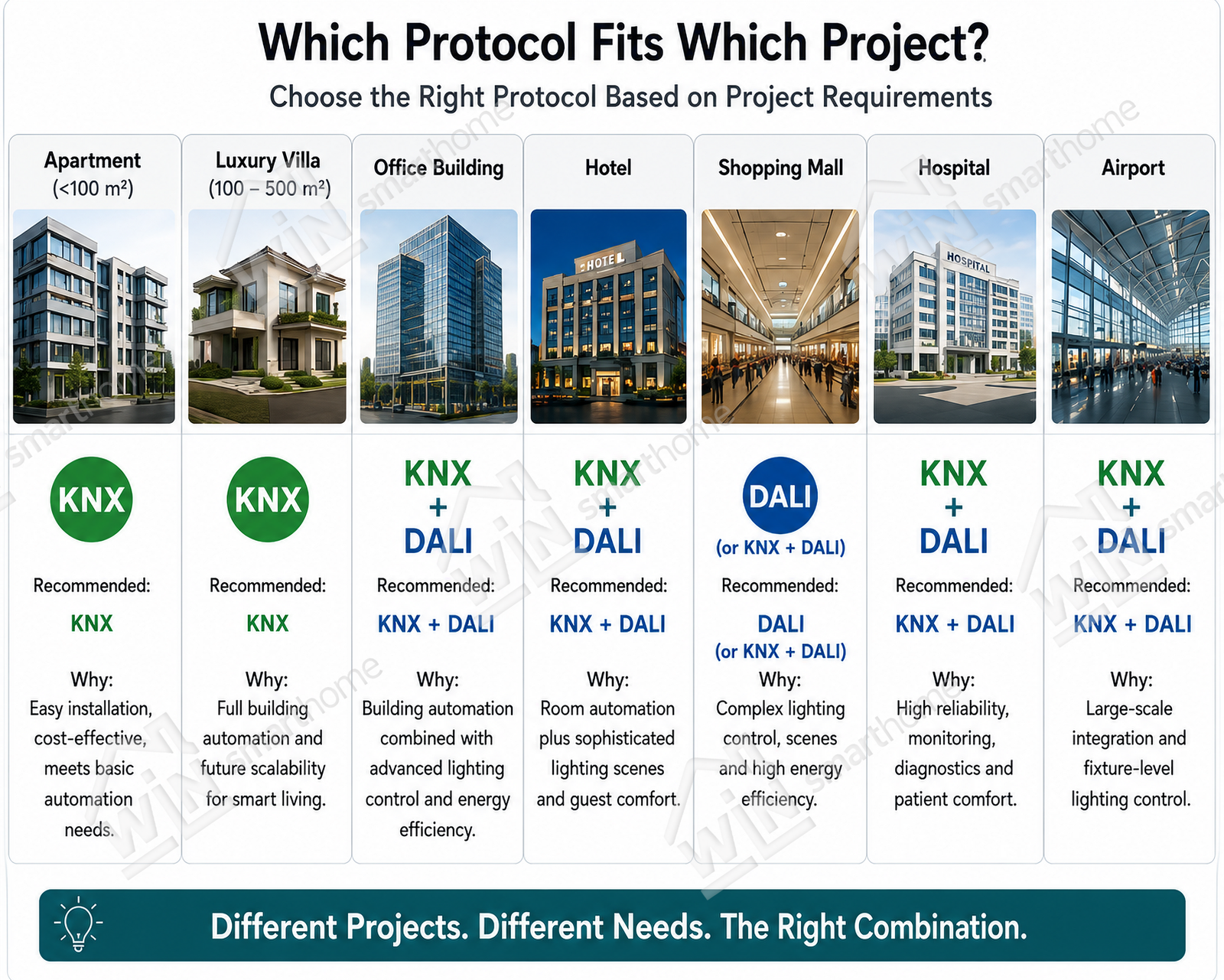
Understanding the technical differences between KNX and DALI is important, but for most building owners, consultants, and system integrators, the real question is much simpler:
Which protocol is the right choice for my project?
Start with the project brief, not the protocol name. For a villa, map lighting, HVAC and curtain functions first; add DALI if individual luminaires need addressing, scenes or diagnostics. For a hotel, define guest-room controls and lighting circuits separately, then check gateway mapping and scene requirements in a mock-up room. For an office, count addressable fixtures and occupancy/daylight zones, and determine whether lighting must coordinate with HVAC, shading or central building controls. Verify the selected devices and interfaces against the actual schedule before finalizing the BOM.
If the goal is building-wide automation, KNX is usually the better choice.
If the goal is advanced lighting control, DALI is often the preferred solution.
In many modern projects, however, the most effective approach is not choosing one over the other—it is combining both technologies.
Project-Based Selection Guide
| Project Type | Architecture to Evaluate | Primary Reason |
|---|---|---|
| Smart Home | KNX for multi-system control; evaluate DALI if addressable lighting is needed | Centralized control of lighting, HVAC, curtains, and energy management |
| Luxury Villa | KNX for multi-system control; add DALI if fixture-level lighting is required | Full building automation and future scalability |
| Office Building | DALI for addressable lighting; add KNX for building-wide integration | Building automation combined with advanced lighting control |
| Hotel | KNX for room systems; add DALI when the lighting scope requires it | Room automation plus sophisticated lighting scenes |
| Shopping Mall | DALI for lighting; add KNX where other building systems need integration | Complex lighting control and energy efficiency |
| Hospital | Assess lighting and building-system requirements; integrate where needed | High reliability, monitoring, and lighting diagnostics |
| Airport | Assess lighting scale and building controls; integrate where needed | Large-scale automation and fixture-level lighting management |
| Industrial Facility | Assess the controlled functions and selected device requirements | Integration of HVAC, ventilation, monitoring, and building controls |
When KNX Is the Better Choice
KNX is the preferred solution when multiple building systems need to operate together under a single automation platform.
In a typical KNX project, lighting is only one part of the overall system. Building owners often want to control HVAC, ventilation, curtains, energy monitoring, access control, and security functions from the same infrastructure.
For example, in a luxury villa or smart office, occupancy detection may automatically trigger lighting, adjust air conditioning, lower blinds, and activate energy-saving functions simultaneously.
This type of cross-system automation is where KNX delivers the greatest value.
Because KNX supports more than 400 certified manufacturers and is recognized under ISO/IEC 14543, it is often selected as the automation backbone for projects that prioritize long-term flexibility and interoperability.
When DALI Is the Better Choice
DALI becomes the preferred solution when lighting performance is the primary requirement.
Unlike general building automation systems, DALI was specifically designed for lighting control and allows every luminaire to have its own digital address.
This enables advanced functions such as:
- Individual fixture control
- Group control
- Scene management
- Occupancy-based lighting control
- Daylight harvesting
- Device diagnostics
- Fault reporting
For example, in a modern office building, hundreds of luminaires may need to automatically adjust brightness throughout the day based on available natural light.
Because DALI supports smooth dimming from approximately 0.1% to 100%, it provides a level of lighting precision that is difficult to achieve with traditional switching systems.
This is why DALI is widely used in offices, shopping malls, airports, hospitals, conference centers, and other lighting-intensive environments.
When KNX and DALI Should Work Together
Many of the most successful smart building projects use both technologies.
In this architecture, KNX acts as the building automation backbone, while DALI manages the lighting network.
A KNX-DALI gateway allows the two systems to communicate seamlessly, enabling building-wide automation without sacrificing advanced lighting control.
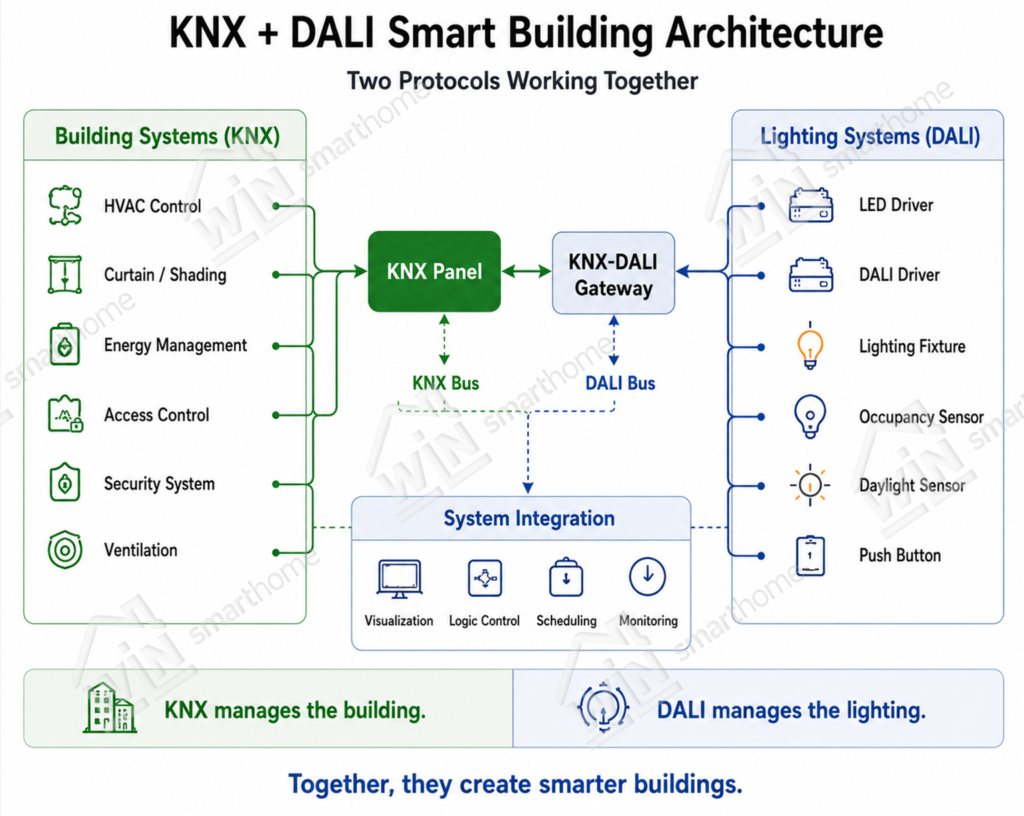
Typical Responsibilities in a KNX and DALI Integration Architecture
| Function | KNX | DALI |
|---|---|---|
| Lighting On/Off Logic | ✓ | ✓ |
| Precise Dimming | Limited | ✓ |
| Fixture-Level Addressing | Limited | ✓ |
| Scene Management | ✓ | ✓ |
| HVAC Control | ✓ | ✗ |
| Curtain & Blind Control | ✓ | ✗ |
| Energy Management | ✓ | ✗ |
| Occupancy Logic | ✓ | Limited |
| Building-Wide Automation | ✓ | ✗ |
| Lighting Diagnostics | Limited | ✓ |
| Fault Reporting | Limited | ✓ |
| Multi-System Integration | ✓ | ✗ |
These are typical roles, not a fixed capability checklist. Confirm the required functions, gateway mapping, device support and commissioning details for the selected products before choosing a KNX-only, DALI-only or combined architecture.
KNX manages occupancy logic, HVAC integration, curtain control, energy management, user interfaces, and overall building automation.
DALI manages fixture-level addressing, dimming, grouping, diagnostics, and lighting scenes.
A Typical Hotel Example
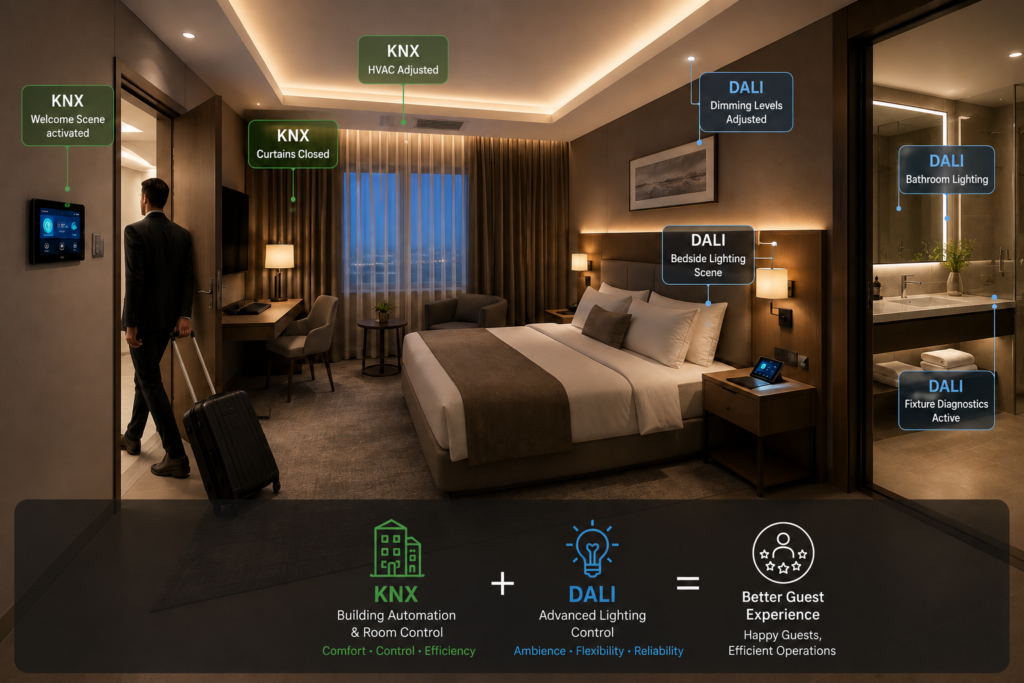
A smart hotel provides one of the best examples of KNX and DALI integration working together.
When a guest enters a room, KNX can activate a welcome scene, adjust HVAC settings, and control curtains or blinds.
At the same time, DALI can manage dimming levels, bedside lighting scenes, bathroom lighting, and fixture diagnostics.
The result is a seamless guest experience while maintaining centralized control and efficient facility management.
Which Approach Is Right for Your Project?
The decision is rarely KNX or DALI.
The better question is: What needs to be controlled?
If your project requires complete building automation, KNX should typically serve as the backbone.
If advanced lighting control is the primary objective, DALI may be sufficient.
If the project requires both building-wide automation and sophisticated lighting management—as is often the case in hotels, office buildings, hospitals, and commercial facilities—integrating KNX and DALI together will usually provide the most flexible and future-proof solution.
Final Thoughts
When comparing KNX and DALI, the question is not which protocol is better.
The real question is what problem you are trying to solve.
A useful analogy is to think of DALI as a large off-road vehicle. It may not be the fastest system, but it is highly tolerant of challenging environments. With its flexible 2-wire architecture, fixture-level addressing, and advanced dimming capabilities, DALI excels in complex lighting applications where precision and reliability are essential.
KNX, by comparison, is like a luxury SUV. It is designed to provide a smooth, stable, and reliable experience across an entire journey. Thanks to its dedicated bus cable, flexible topology support, and powerful automation capabilities, KNX can coordinate lighting, HVAC, curtains, energy management, security systems, and many other building functions from a single platform.
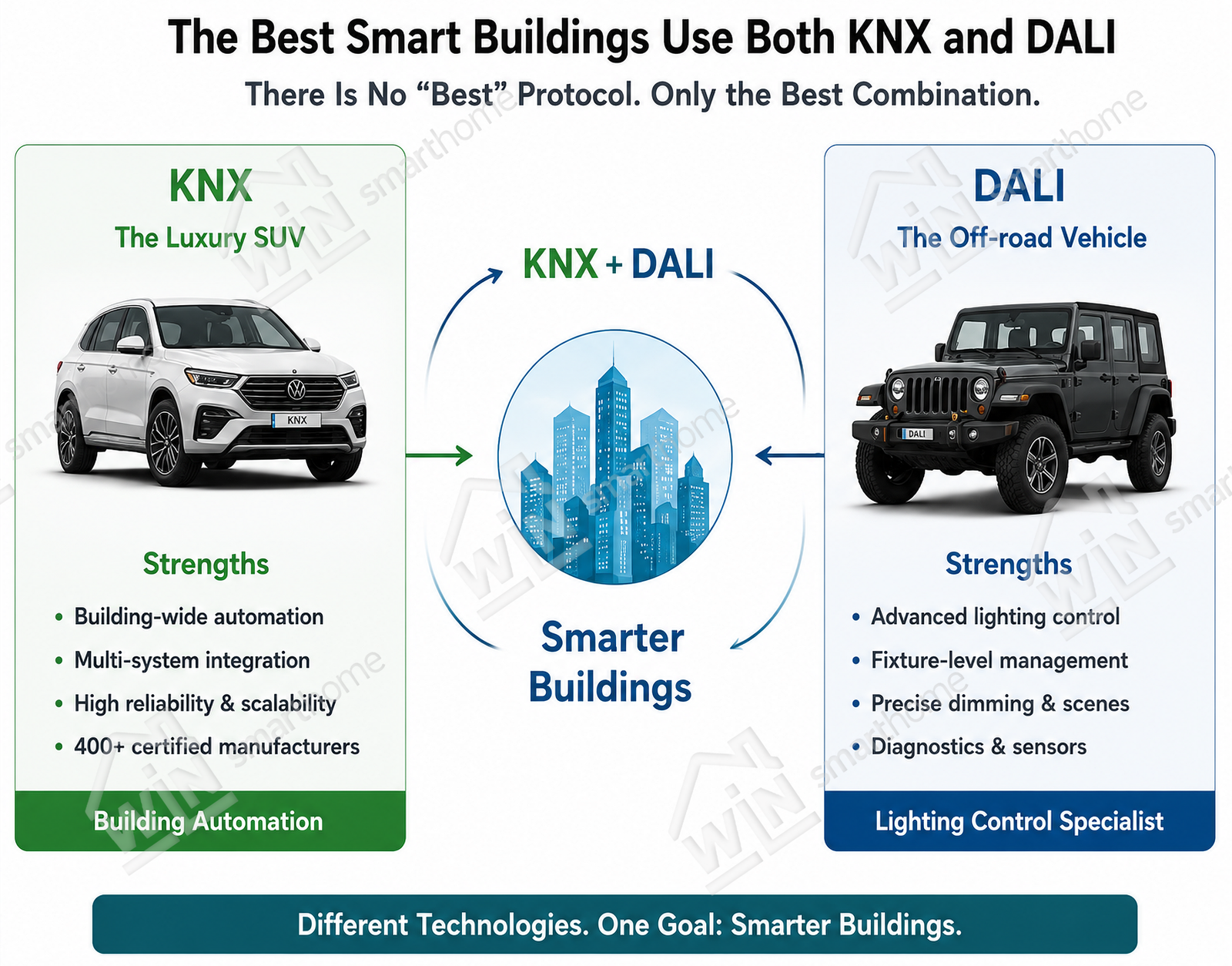
This is why KNX and DALI integration is not about competing technologies.
KNX manages the building.
DALI manages the lighting.
For many modern smart buildings, hotels, offices, hospitals, and commercial projects, the most effective solution is often combining both technologies—using KNX as the building automation backbone and DALI as the lighting control specialist.
Understanding the strengths of each protocol allows system integrators, consultants, and building owners to design smarter, more scalable, and more future-proof projects.
Frequently Asked Questions
1. Is DALI better than KNX?
Not necessarily. DALI and KNX were designed for different purposes. DALI specializes in lighting control, while KNX is designed for whole-building automation. The better choice depends on the requirements of the project.
2. Can KNX control DALI lighting?
Yes. A KNX-DALI gateway allows KNX systems to control DALI lighting networks, including switching, dimming, scene management, and status monitoring.
3. Do I need DALI if I already have KNX?
Not always. For simple lighting applications, KNX alone may be sufficient. However, if a project requires advanced dimming, fixture-level addressing, diagnostics, or large-scale lighting management, DALI can provide significant advantages.
4. Which protocol is better for hotels?
Most modern hotels benefit from using both. KNX is commonly used for room automation, HVAC, curtain control, and energy management, while DALI provides advanced lighting control and scene management.
5. Can DALI and KNX work together in the same project?
Absolutely. In fact, this is one of the most common architectures in commercial buildings. KNX handles building-wide automation, while DALI manages lighting devices and dimming functions, allowing each protocol to perform the role it was designed for.
Planning a Smart Hotel, Villa, or Smart Building Project?
WinSmartHome supports developers, distributors, hotel automation companies, and system integrators with:
- KNX smart home product sourcing
- Matter-compatible smart home products
- Smart hotel and villa automation planning
- HVAC control and thermostat selection
- Lighting control and dimming solutions
- Multi-protocol system integration
- OEM / ODM smart home product support