
KNX vs Matter: evaluate KNX when the project needs a professionally commissioned control infrastructure across lighting, HVAC and shading. Evaluate Matter when interoperable devices and connection to smart-home platforms are priorities. Existing wiring, required functions, network design, budget and maintenance ownership matter more than floor area. A suitable KNX Matter gateway can connect selected functions when both approaches are needed.
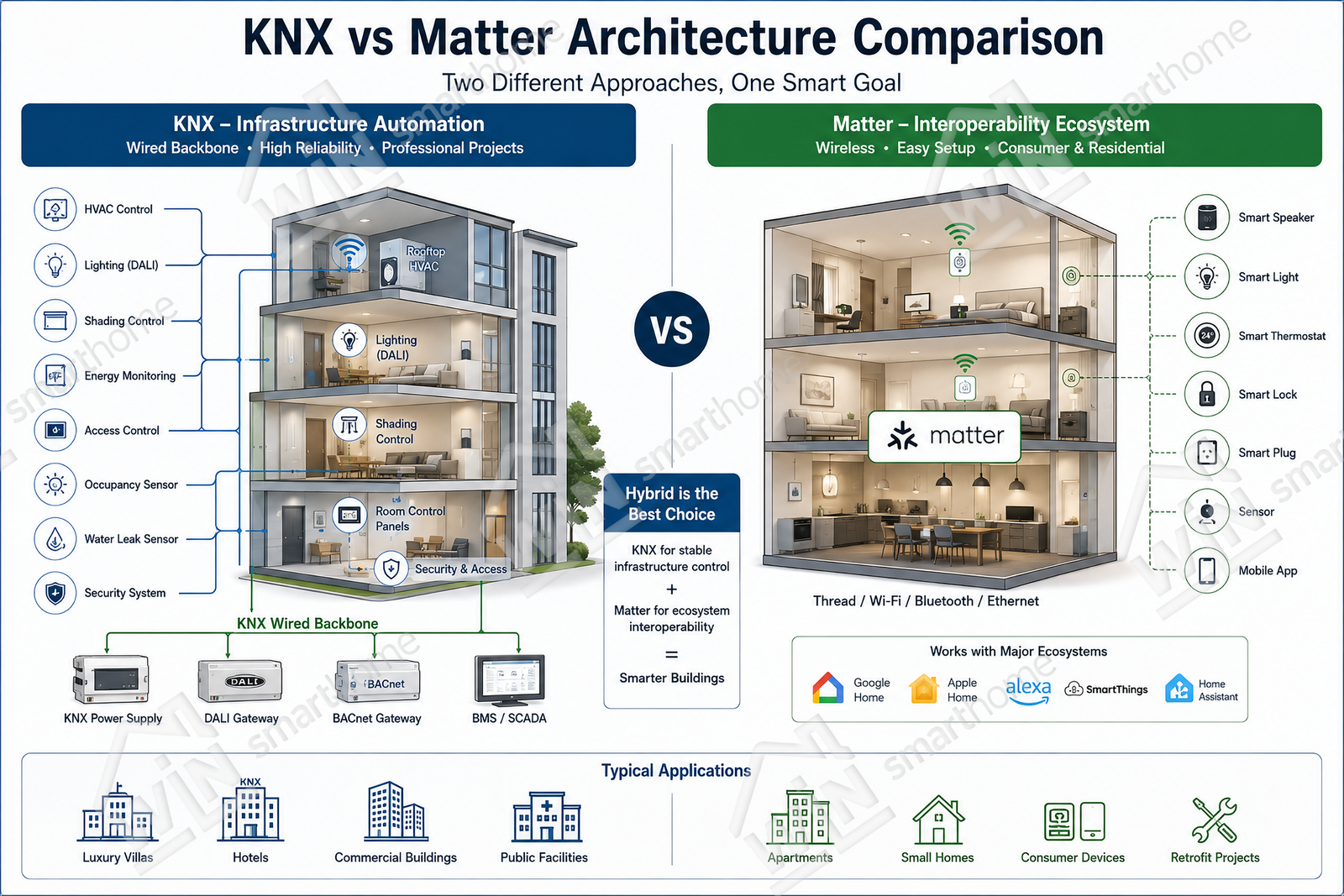
When Matter became one of the most discussed standards in the smart home industry, many developers, distributors, and system integrators started asking the same question:
Will Matter replace KNX?
At first glance, this question sounds reasonable. Matter promises easier device onboarding, cross-brand interoperability, and smoother connection between Apple Home, Google Home, Amazon Alexa, and other ecosystems.
But in real professional projects, the answer is more complicated.
Matter smart home products are excellent for residential interoperability and wireless-first deployment. However, KNX smart home products are still widely used in villas, hotels, commercial buildings, and professional automation projects because KNX solves a different problem.
Matter solves device interoperability. KNX solves building infrastructure control.
That difference is the key to choosing the right protocol.
TL;DR
- Matter: Evaluate supported device functions, intended ecosystems and IP-network requirements.
- KNX: Evaluate coordinated building controls, installation work and professional commissioning.
- Retrofit: Check existing wiring, available installation space, power and network coverage before choosing.
- Hybrid: Add a gateway only where the required function mapping justifies integration and maintenance work.
The Biggest Misunderstanding About KNX vs Matter
Many online comparisons treat KNX and Matter as direct competitors.
In reality, they are designed for different layers of smart home and building automation.
Matter focuses on making smart devices from different brands work together more easily. It is especially useful when users want to connect lights, sensors, locks, plugs, and appliances across different consumer ecosystems.
KNX, on the other hand, is closer to infrastructure. It is designed for professional automation systems where lighting, HVAC, curtains, sensors, access control, and energy management need to operate reliably over many years.
This is why a small apartment and a 150-room hotel should not use the same protocol logic.
| Question | Matter | KNX |
|---|---|---|
| What problem does it solve? | Consumer device interoperability | Professional building automation |
| Selection priority | Supported device functions and ecosystem access with appropriate network/controller design | Coordinated controls with appropriate installation and professional commissioning |
| Design opportunity | Common device functions across supported platforms | Distributed control and coordinated engineering across supported equipment |
| Planning requirement | Verify device types, controller support, network capacity and ownership | Plan installation, bus power, configuration, documentation and support |
Why Matter Became Popular So Quickly
Matter became popular because it addresses a very real pain point: smart home fragmentation.
Before Matter, many users had to deal with different apps, different gateways, different pairing processes, and inconsistent compatibility between brands. For homeowners, distributors, and developers selling residential smart home packages, this was a major problem.
With Matter, devices can work more smoothly across major ecosystems. For apartment projects or retrofit residential upgrades, this is a strong advantage.
For example, if a developer wants to upgrade an existing apartment building without opening walls or rewiring, Matter-compatible devices can reduce installation complexity. A wireless-first system is faster to deploy, easier to explain to homeowners, and more flexible for future device replacement.
This is why Matter certified products are becoming more attractive for distributors and OEM buyers who serve residential smart home markets.
Why KNX Still Makes Sense for Professional Projects
Professional automation projects have different priorities.
A hotel operator is not only asking whether a device can connect to a mobile app. A villa developer is not only thinking about voice control. A commercial building contractor is not only evaluating how fast a device can be paired.
They care about:
- long-term stability
- room-by-room maintenance
- centralized control
- HVAC coordination
- lighting scene reliability
- future expansion
- integration with building management systems
This is where KNX remains strong.
KNX Is Closer to Infrastructure Than Consumer Electronics
KNX should not be understood as a consumer smart home gadget ecosystem.
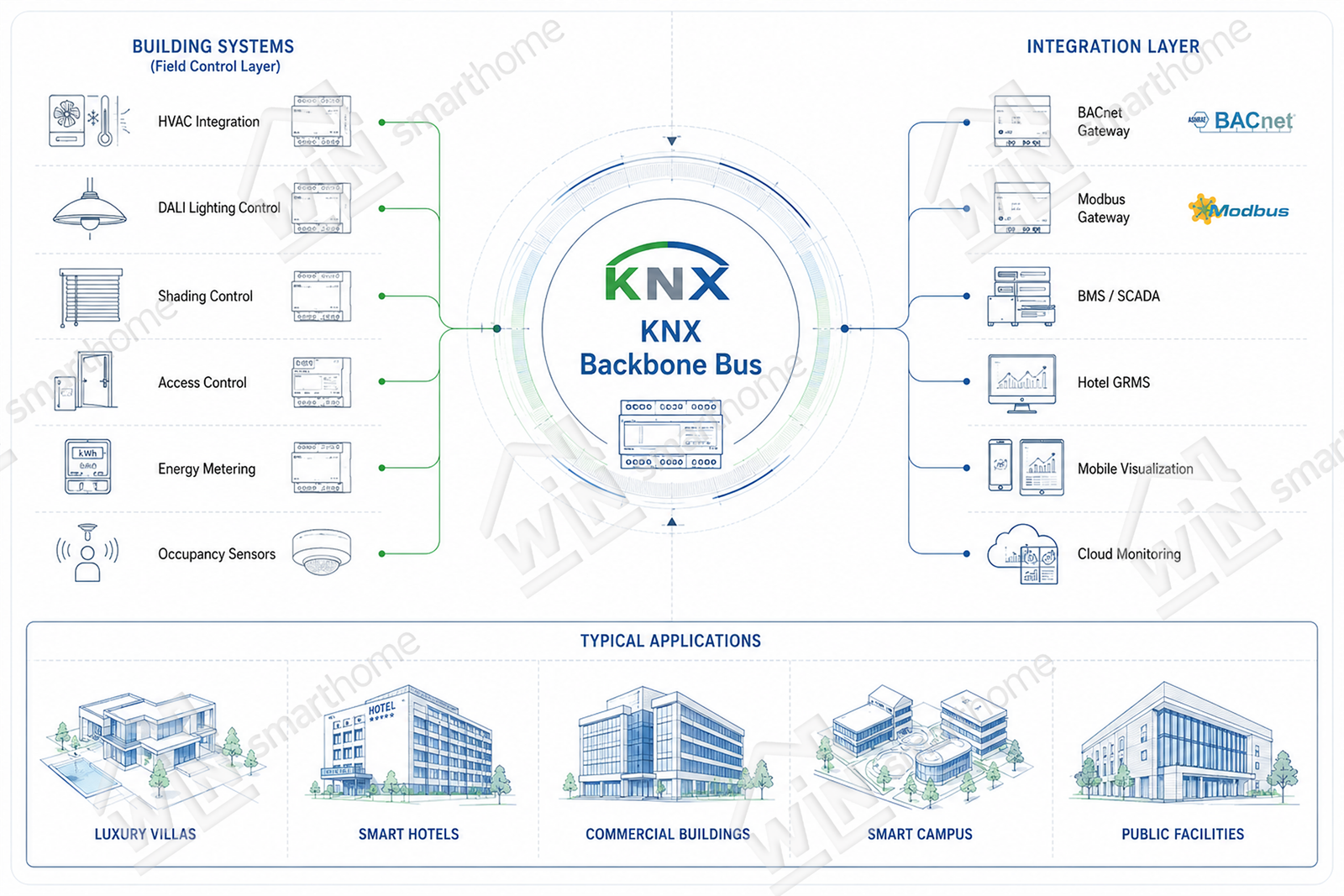
Its real value lies in professional infrastructure control. In high-end residential projects, smart hotels, commercial buildings, and public facilities, KNX is often used as the stable control layer behind lighting, HVAC, shading, access control, sensors, and energy management.
Assess the installed cost of devices, wiring, configuration and ongoing support against the actual control requirements. Price segment alone does not determine the appropriate architecture.
Instead, KNX is better positioned for projects where reliability, system expansion, long-term maintenance, and multi-system integration matter more than short-term device convenience.
In a large villa or hotel, lighting, curtains, HVAC, sensors, and access systems are not separate gadgets. They are part of one automation infrastructure. When the system is installed, the owner expects it to run reliably for years.
Many integrators describe a well-designed KNX system as:
“Install once, run for ten years.”
Treat this as an aspiration, not a service-life guarantee. Operation and maintainability depend on design, selected equipment, commissioning, documentation and support.
One Table to Understand Main Smart Home Protocols
These technologies are not all alternatives at the same layer: Matter defines an application layer over IP, while Thread, Wi-Fi and Ethernet provide network connectivity. KNX, Zigbee and DALI have different control and integration roles. A Matter-over-Thread device uses both Matter and Thread; adding more protocols is not automatically beneficial. See the CSA Matter FAQ and Thread Group explanation.
| Protocol | Main Advantage | Main Limitation | Best Use Case |
|---|---|---|---|
| Wi-Fi | Fast connection, no dedicated gateway for many devices | High power use, network congestion when device count grows | Cameras, speakers, TVs, high-bandwidth devices |
| Zigbee | Low power, mature mesh networking | Requires gateway, ecosystem compatibility varies | Sensors, switches, door contacts, low-power devices |
| Thread | IP-based low-power mesh, important for Matter ecosystems | Still developing in some markets | Future Matter-based smart home networks |
| KNX | Stable wired infrastructure, scalable control, professional integration | Requires planning, wiring, and professional commissioning | Luxury villas, hotels, smart buildings |
| DALI | Professional lighting dimming and addressable lighting control | Lighting-focused, usually needs integration with other systems | Hotel lighting, office lighting, villa lighting scenes |
| Matter | Cross-brand interoperability and easier device onboarding | Still less mature for large-scale building automation | Consumer smart homes, apartments, retrofit projects |
Which Protocol Fits Which Project?
The most practical way to choose a protocol is not by asking “Which one is best?”
The better question is:
What kind of project are we designing?
| Project conditions | Architecture to evaluate | Checks before selection |
|---|---|---|
| Existing home; limited rewiring | Matter-capable devices on the appropriate network; retain useful existing controls | Power, neutral wires, installation space, controller and network coverage. |
| New build or renovation with coordinated controls | KNX where its control scope and commissioning fit; Matter where ecosystem access is needed | Lighting/HVAC/shading interfaces, wiring, commissioning budget and maintenance ownership. |
| Villa with multiple zones | Compare KNX, Matter-based and hybrid designs against the function schedule | Required zone logic, device count, local operation and recovery. Floor area is not a protocol threshold. |
| Hotel | Assess room-control and central-management requirements; integrate only required systems | Guest operation, HVAC interfaces, room reset, staff permissions and maintenance procedures. |
| Commercial building | Assess control, BMS and lighting requirements separately | Required interfaces, reporting, security, support responsibilities and lifecycle cost. |
Real Scenario: Why Large Villas and Hotels Often Choose KNX
Required response, fallback and maintenance procedures should be specified for any project, including apartments. A hotel example highlights coordination needs; it does not establish that every hotel requires the same protocol.
For a villa or hotel with coordinated room controls, evaluate the complete sequence and the consequences of a failed device or connection.
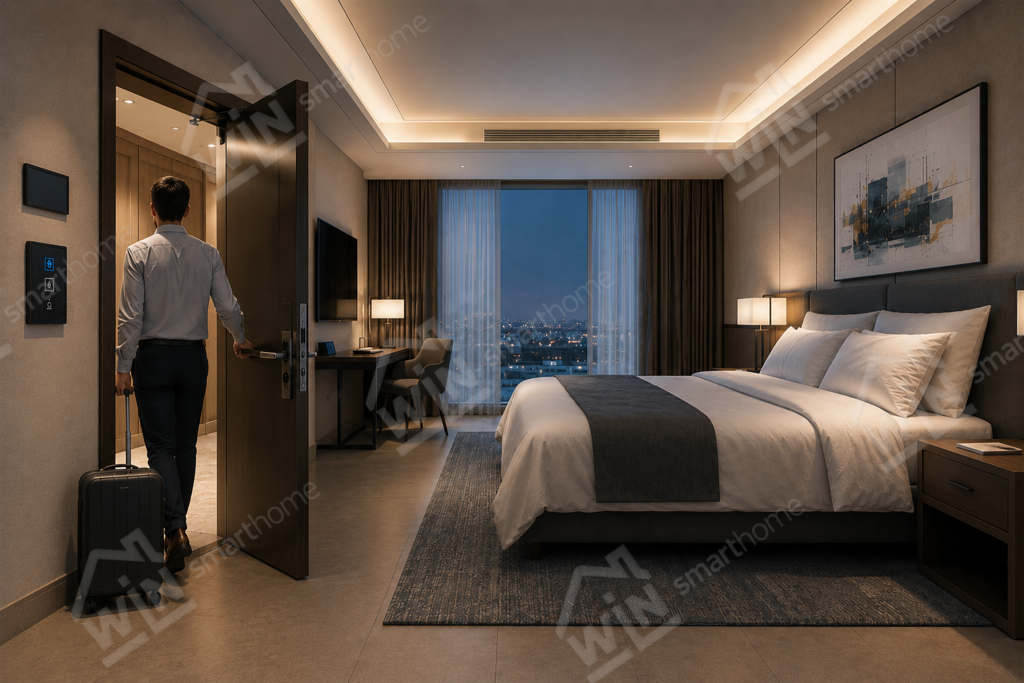
Imagine a hotel room where the guest opens the door. The system needs to trigger:
- entrance lighting
- curtain scene
- air-conditioning mode
- occupancy logic
- energy-saving control
- central room status update
If the system response is unstable, the issue is no longer just a smart home inconvenience. It becomes a hotel operation problem.
This is why hotels often use KNX as the control backbone. KNX can work with KNX smart thermostats, sensors, actuators, gateways, and lighting systems to create predictable room automation.
For lighting, KNX is often combined with DALI or dimming systems. For example, a hotel may use KNX for scene logic while using LED dimming drivers or DALI-compatible lighting infrastructure for smoother brightness control.
This is also where KNX gateway servers become important. A gateway helps connect KNX systems with remote control, app control, cloud platforms, or broader building automation systems.
KNX vs Matter: Engineering Comparison
| Engineering factor | KNX design checks | Matter design checks |
|---|---|---|
| Network and installation | Selected KNX medium, bus/IP topology, power and installation capacity. | Selected Thread, Wi-Fi or Ethernet connection, controller and any border-router requirements. |
| HVAC and lighting | Actual actuator/thermostat interfaces and supported gateway functions; DALI only if required. | Actual device functions and ecosystem support; gateways where a different system must be connected. |
| Commissioning | ETS/application versions, group addresses, parameters and handover documentation. | Onboarding, controller ownership, network reachability, reset and replacement procedures. |
| Reliability and recovery | Test local controls, bus/power failures, device recovery and any server dependencies. | Test local controls, network/controller/power failures, recovery and any cloud dependencies. |
| Maintenance | Keep project files, configuration backups, replacement plans and supplier support terms. | Keep device/firmware records, account handover, replacement plans and supplier support terms. |
The Future Is Hybrid, Not Single-Protocol
In real projects, pure single-protocol systems are becoming less common.
A practical smart building may use:
- Wi-Fi for cameras, speakers, and bandwidth-heavy devices
- Zigbee or Thread for low-power sensors
- Matter for consumer ecosystem interoperability
- KNX for stable infrastructure automation
- DALI for professional lighting control
- BACnet for building management system integration
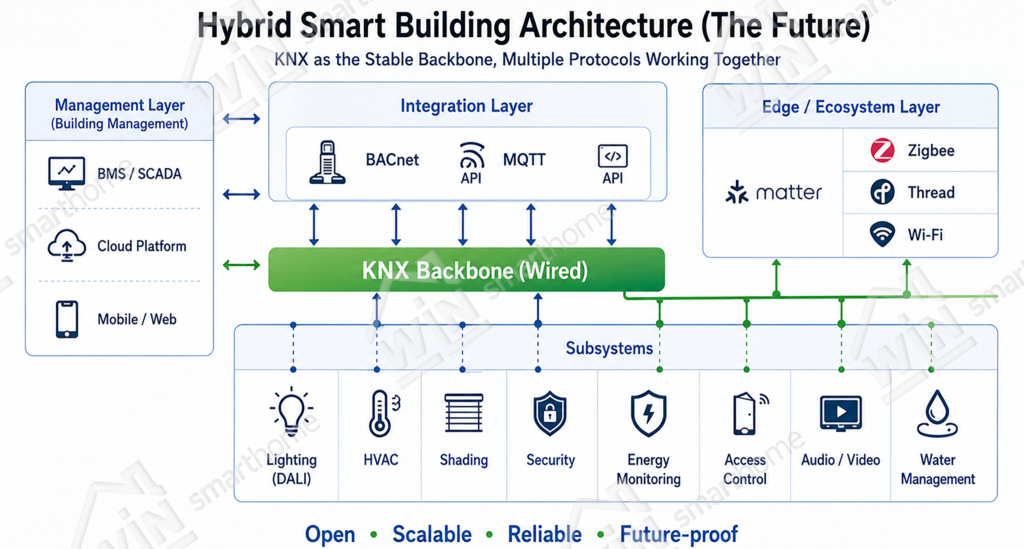
How KNX and Matter Can Connect
A Matter controller sends a command to a supported function exposed by the KNX Matter gateway. The gateway maps that function to the configured KNX communication objects or group addresses, and the relevant KNX device performs the action. Where supported and configured, KNX state feedback is mapped back to the Matter side.
A network connection alone does not expose every KNX function. Confirm device types, data-point mappings, direction of control, feedback, scene ownership and failure behaviour for the selected gateway and firmware. Retain and test required KNX local controls independently of the integration. This is a general workflow, not a specification for every gateway.
For product enquiries, review the KNX Matter Gateway on our Matter products page. Ask for the model-specific manual and mapping scope before approval. A public KNX Association bridge example illustrates the concept but does not establish WinSmartHome model capabilities.
The goal is not to force every device onto one protocol.
The goal is to design a system where each protocol does what it is best at.
This is exactly why professional smart home integration services matter. The more protocols a project uses, the more important system architecture becomes.
Without proper planning, hybrid systems can create new problems:
- gateway conflicts
- unstable device communication
- difficult commissioning
- unclear troubleshooting responsibility
- higher long-term maintenance cost
So the real question is not whether KNX or Matter is better.
The real question is whether the project has the right system architecture.
Why Maintenance Matters More Than Installation Speed
Many smart home discussions focus on installation speed.
That makes sense for small residential projects. A wireless system that can be installed quickly has obvious value.
But professional developers and hotel operators think differently. They are not only buying devices. They are buying a system that must continue working for years.
A wireless system may be easier to install at the beginning. But in large buildings, long-term issues may appear:
- signal blind spots
- mesh instability
- firmware fragmentation
- network congestion
- device replacement inconsistency
For a hotel or commercial building, these problems can increase operational cost.
Apply the same maintenance review to both designs. KNX also needs correct bus/power design, accessible equipment, current project files and replacement support. For either system, agree ownership, documentation, updates, failure testing and recovery procedures; the protocol name alone does not guarantee reliability.
Procurement Considerations for Developers, Integrators, and Distributors
If you are choosing between KNX, Matter, or a hybrid system, the decision should not be based only on protocol popularity.
For B2B projects, the procurement team should evaluate:
| Decision Factor | Why It Matters | Recommended Action |
|---|---|---|
| Control scope and scale | Device counts, zones and dependencies determine planning work | Compare topology and commissioning against the function schedule, not floor area alone |
| HVAC requirements | Exact equipment interfaces and control logic affect comfort and energy use | Check compatible thermostats/interfaces, supported commands and feedback in the proposed design |
| Lighting control | Actual loads, dimming, scenes and addressing determine equipment needs | Use suitable actuators/drivers; evaluate DALI only when the lighting scope justifies it |
| Retrofit limitations | Rewiring may be expensive or impossible | Use Matter, Zigbee, Thread, or Wi-Fi where wiring is limited |
| Long-term maintenance | Operational cost continues after installation | Prioritize stable architecture and reliable supplier support |
For buyers comparing product options, WinSmartHome also provides KNX product catalogues and technical documents for project evaluation.
So, Is KNX Better Than Matter?
Matter is a candidate where supported smart-home functions and ecosystem access match the requirements.
For retrofit apartments, Matter can reduce wiring cost and simplify deployment.
For consumer smart home packages, Matter improves compatibility and makes the user experience easier.
KNX is a candidate where coordinated control infrastructure and professional commissioning fit the project, including suitable villa, hotel and commercial applications.
In these environments, the key requirement is not only device compatibility.
The key requirement is stable infrastructure control.
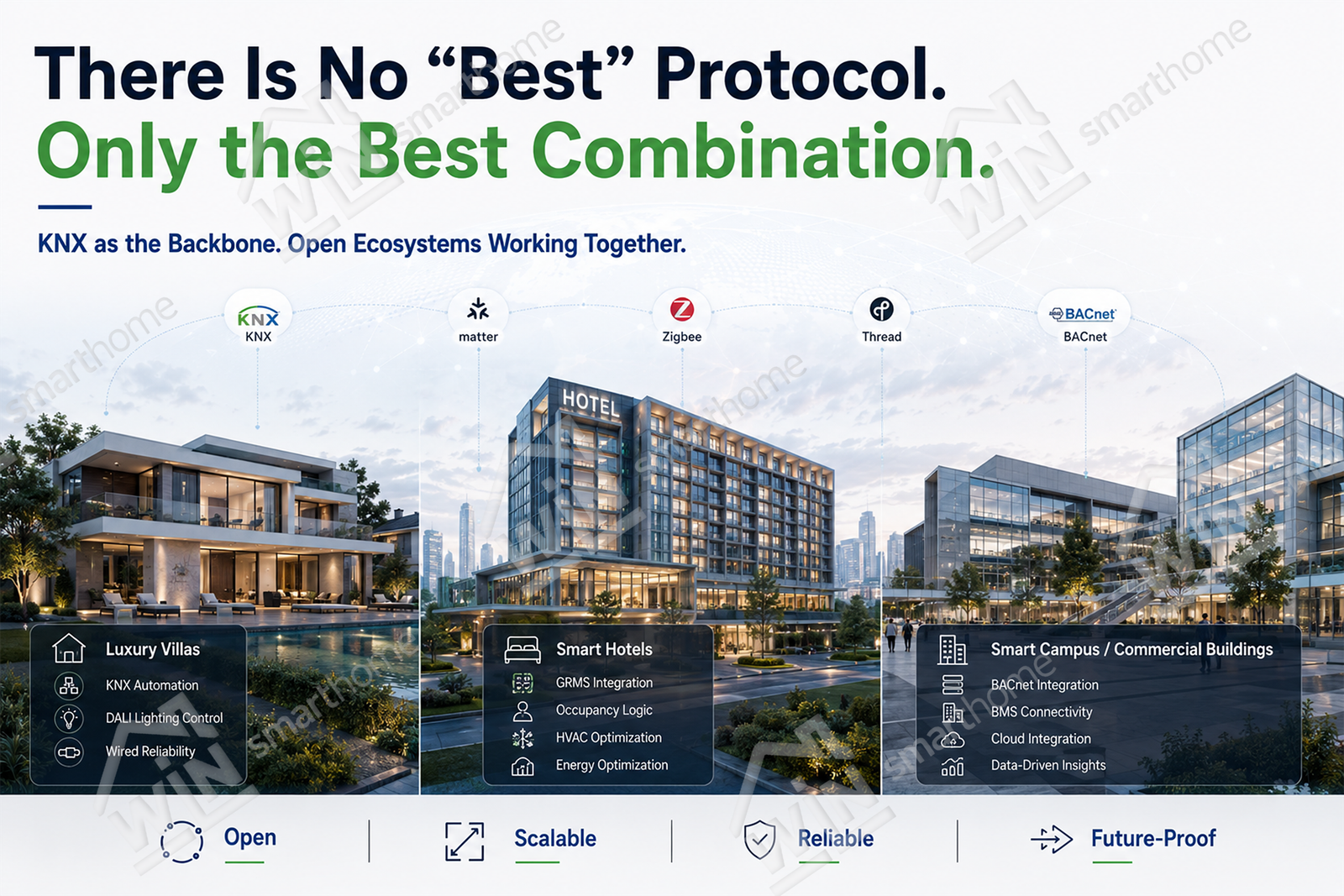
Final Conclusion: There Is No Best Protocol, Only the Best Combination
The best smart home protocol is not always KNX.
It is not always Matter either.
The best solution depends on the project.
For small apartments, wireless systems are practical.
For medium-sized homes, Zigbee, Thread, Wi-Fi, and Matter can work well together.
For coordinated multi-system controls, evaluate a properly engineered KNX backbone alongside the other viable designs.
For lighting, DALI or dimming systems may be needed.
For BMS integration, BACnet may be required.
For consumer interoperability, Matter can add value.
There is no best protocol. There is only the most suitable combination for your project.
FAQ
Is KNX better than Matter for smart hotels?
KNX is worth evaluating where room controls need coordinated HVAC, shading, lighting and central-management interfaces. Compare the actual function schedule, installation, recovery and staff-maintenance needs with a Matter-based or hybrid design rather than deciding by building type alone.
Can KNX and Matter work together?
Yes, through a suitable gateway with configured function mappings. Check supported Matter device types, KNX data points, command and feedback paths, controller requirements and failure behaviour. Combining them is useful when the project needs both control infrastructure and Matter ecosystem access, not simply because the project is a villa or hotel.
Is Matter replacing KNX?
No. Matter and KNX solve different problems. Matter improves device interoperability in consumer smart homes. KNX provides professional automation infrastructure for larger projects such as villas, hotels, and commercial buildings.
Which protocol is better for large villas?
For large villas, compare required zones, lighting/HVAC/shading interfaces, wiring opportunities and maintenance ownership. KNX, Matter-based devices or a gateway-linked combination should be selected against those requirements, not an area threshold.
What is the best smart home protocol combination?
A common professional combination is KNX for core automation, Matter for interoperability, Zigbee or Thread for sensors, DALI for lighting control, and Wi-Fi for high-bandwidth devices. The right mix depends on project size, budget, and maintenance requirements.
Planning a Smart Hotel, Villa, or Smart Building Project?
WinSmartHome supports developers, distributors, hotel automation companies, and system integrators with:
- KNX smart home product sourcing
- Matter-compatible smart home products
- Smart hotel and villa automation planning
- HVAC control and thermostat selection
- Lighting control and dimming solutions
- Multi-protocol system integration
- OEM / ODM smart home product support
Request Technical Consultation
Products and Project Resources
- KNX products
- Matter products and KNX Matter Gateway
- KNX catalogues and technical documents
- KNX villa planning example
- Project selection consultation