
How to Choose an OEM Smart Home Manufacturer in China
TL;DR
- ✅ Modern smart home OEM manufacturing is no longer just hardware production. Integration capability now matters more.
- ✅ Matter, Zigbee, KNX, DALI, and BACnet increasingly work together in residential and commercial smart building projects.
- ✅ Reliable OEM partners should support certifications, firmware, cloud platforms, and long-term deployment stability.
- ✅ The future of smart home OEM is smart building system integration.
Introduction
The demand for OEM smart home manufacturer in China is growing rapidly alongside the continued upgrade of global consumer demand and smart living expectations. As China remains one of the world’s largest smart home manufacturing hubs, smart home brands, system integrators, real estate developers, electrical contractors, hotel automation companies, distributors, and even small business buyers are all facing the same challenge: how to choose a reliable OEM smart home manufacturer in China.
After 10 years of working closely with smart home OEM and ODM suppliers, one thing has become increasingly clear — selecting the right manufacturing partner is far more complicated than simply finding a factory that can produce smart switches or sensors.
The core purpose of smart home OEM manufacturing is to allow brands, distributors, and project companies to focus on front-end sales, project deployment, and customer service, while professional OEM and ODM manufacturers handle production, firmware development, protocol integration, certifications, and supply chain management behind the scenes.
The market demand itself is becoming increasingly complex. Some brands require small-batch customized smart home products. Some residential and commercial projects require Zigbee smart home OEM solutions with stable mesh networking. Others need Matter smart home manufacturers capable of cross-platform ecosystem integration. Large smart building projects may also require KNX, DALI, BACnet, or cloud platform compatibility.
For buyers evaluating modern automation ecosystems, understanding how different protocols work together is becoming increasingly important in residential and commercial projects. You can also read our related guide: KNX vs Matter for Villas, Hotels & Smart Buildings.
All of these requirements place significantly higher demands on the engineering capability, manufacturing consistency, and integration experience of OEM smart home manufacturers.
Many inexperienced buyers make the mistake of assuming that OEM sourcing simply means finding a factory that can manufacture products at a lower price. But in today’s highly competitive smart home industry, choosing the wrong OEM smart home manufacturer can create serious long-term problems.
Minor issues may result in delayed delivery schedules, unstable firmware, or failed certifications. More serious problems can damage customer reputation, increase after-sales complaints, delay property handovers, or even force entire smart building projects to be redesigned. In many cases, the hidden cost of choosing the wrong supplier becomes far higher than the original manufacturing cost itself.
For distributors, smart home brands, system integrators, and real estate developers, the real challenge is this:
Can the manufacturer support real-world smart building projects — not just manufacture devices?
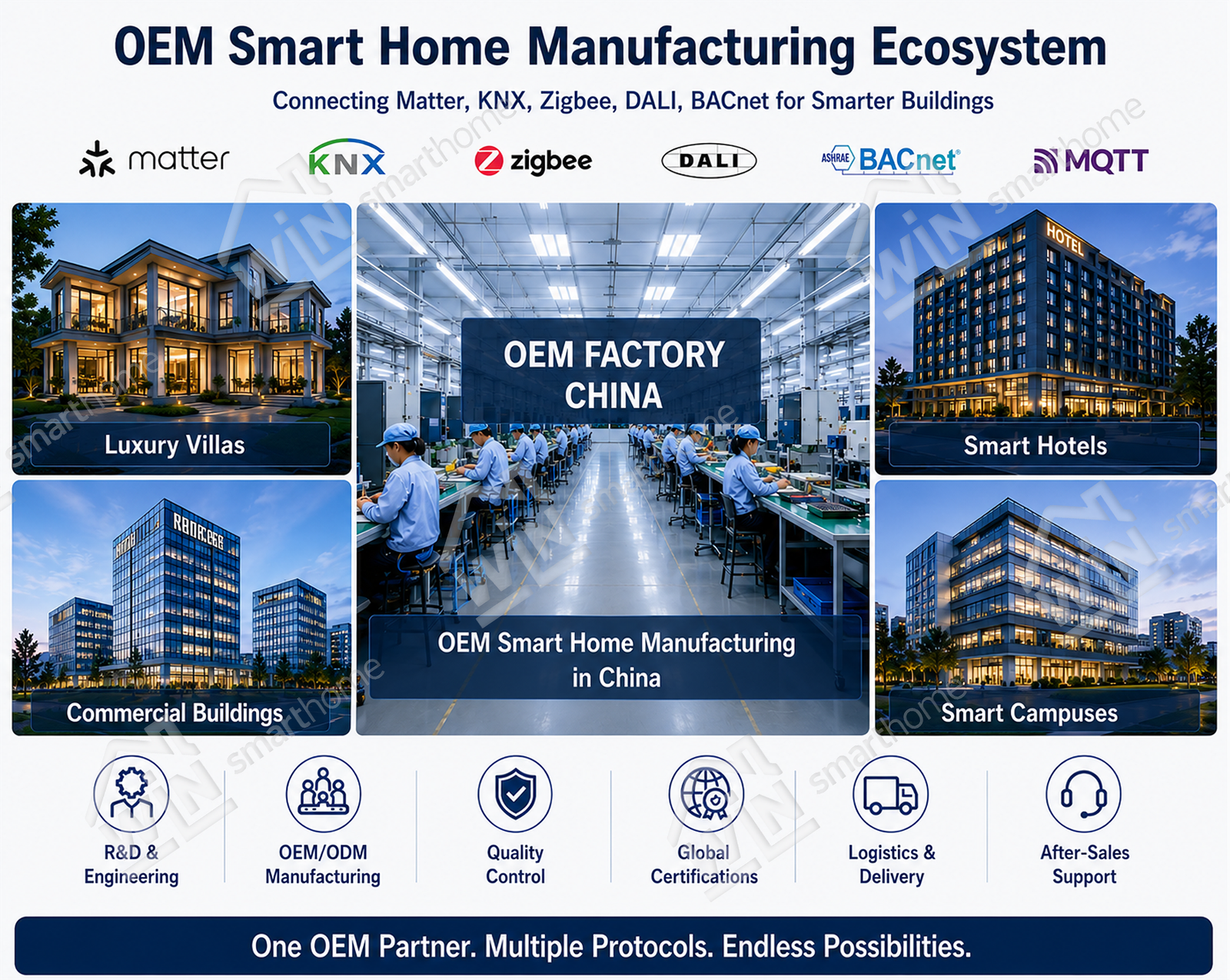
Case Study 1: Building a Complete Matter Product Portfolio for a European Smart Home Brand
A European smart home brand approached us looking to build a complete Matter-enabled product portfolio for the European market.
Like many buyers, the customer initially searched through Alibaba and found dozens of suppliers offering seemingly similar products at dramatically different prices. However, it was difficult to determine which companies were genuine manufacturers, which were trading companies, and which suppliers could actually support long-term ODM development, certifications, firmware customization, and Matter ecosystem integration.
The customer’s roadmap extended beyond a single product and included multiple categories:
| Product Category | Requirement |
|---|---|
| Smart Switches | Matter-enabled |
| Smart Sensors | Matter-compatible |
| Smart Thermostats | HVAC integration |
| Smart Locks | European market adaptation |
| Curtain Motors | Smart home ecosystem integration |
| Energy Metering Devices | Future energy management applications |
One challenge quickly became clear: no single factory was the strongest supplier across every product category.
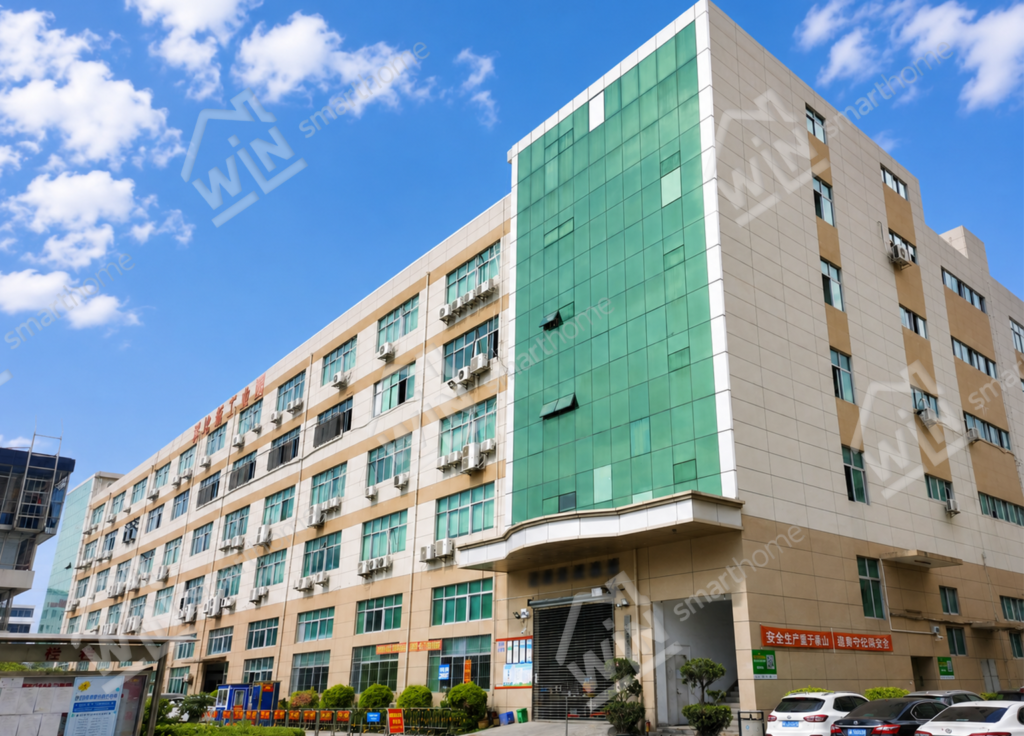
Because we have worked closely with specialized manufacturers for many years, we were able to evaluate suppliers based on factors beyond price, including protocol support, certification readiness, engineering capability, production stability, and long-term roadmap compatibility.
One of the suppliers we ultimately shortlisted stood out because it met several critical requirements. The company operates a 2,500–3,000㎡ manufacturing facility in Shenzhen, equipped with automated production lines and an ISO9001-certified quality management system. Its products have already obtained major international certifications including CE, RoHS, FCC, SAA, and UKCA, helping reduce compliance risks for overseas projects.
From a technical perspective, the supplier supports multiple communication technologies, including:
| Protocol | Typical Application |
|---|---|
| Matter | Cross-platform smart home ecosystems |
| Wi-Fi | Retrofit projects and DIY installations |
| Zigbee | Hotels, offices, and large-scale deployments |
| BLE | Local device communication |
| MQTT | Platform integration and custom automation |
The supplier also offers local deployment options and open-platform integration capabilities, making it suitable for smart homes, hospitality projects, commercial buildings, and other B2B environments that require greater control over data security and system scalability. Buyers looking for broader smart home integration services often prioritize this type of multi-protocol flexibility when planning long-term projects.
Case Study 2: Sourcing Certified KNX Stack Suppliers Beyond Public Marketplaces
While many smart home products can be sourced through Alibaba or other B2B platforms, some categories operate very differently.
One of our clients from Egypt approached us with a highly specialized requirement: sourcing a certified KNX Stack component for a new KNX product development project.
Unlike smart switches, sensors, or gateways, KNX Stack solutions belong to a much more niche segment of the building automation industry. Most suppliers in this field focus on technology licensing, protocol development, or OEM component support rather than selling finished products through public marketplaces.
| Category | Typical Sales Model |
|---|---|
| Smart Switches, Sensors, Gateways | Widely available on Alibaba and B2B marketplaces |
| KNX Stack Solutions | Technology licensing, engineering partnerships, OEM cooperation |
Initially, the customer considered purchasing from established European suppliers. While Europe remains the historical center of the KNX ecosystem, the customer faced two practical challenges.
- First, pricing was significantly higher than expected.
- Second, the customer’s long-term goal was not limited to a single KNX Stack component. They planned to gradually expand into a broader KNX product portfolio, including switches, actuators, sensors, gateways, and building automation solutions.
From a supply chain perspective, relying exclusively on European suppliers would limit future sourcing flexibility and increase development costs.
At the same time, the customer recognized that China had developed a much broader KNX manufacturing ecosystem over the past decade. Beyond finished products, China now hosts a growing network of KNX-certified component suppliers, engineering teams, and OEM manufacturers supporting global building automation projects.
The challenge was that many of these suppliers are not visible on Alibaba, Made-in-China or any other B2B platform.
Unlike consumer smart home products, KNX Stack suppliers often operate through industry relationships, technical partnerships, engineering networks, and long-term OEM cooperation. Some do not actively market themselves online because their primary business comes from existing customers and industry referrals.
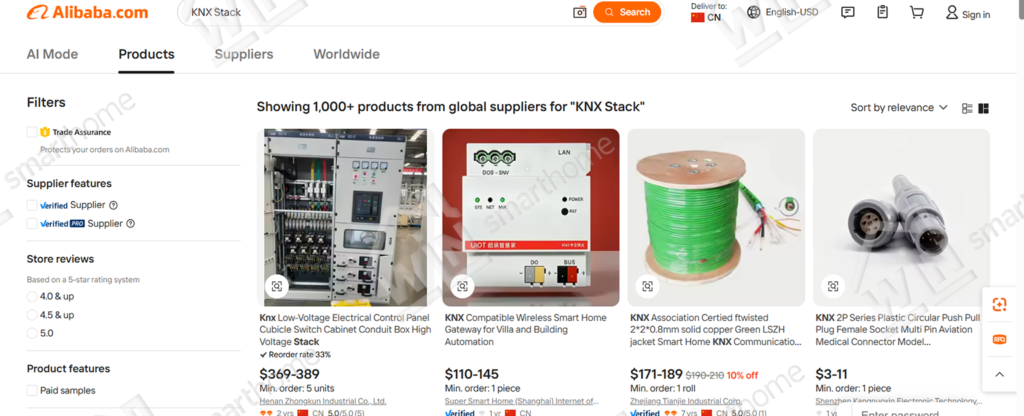
As a result, a standard supplier search would not have produced meaningful results.
Because we have spent years working within the smart home and building automation industry, we were able to leverage our network to identify potential suppliers that matched the customer’s technical requirements.
After evaluating multiple options, we introduced the customer to a specialized KNX technology supplier capable of providing the certified KNX Stack solution required for the project. The supplier met the customer’s requirements for technical compliance, development support, and future product expansion.
More importantly, the relationship opened access to a wider KNX ecosystem in China, creating opportunities for future sourcing of additional KNX switches, KNX actuator supplier China, and automation products as the project evolves.
| Customer Challenge | Solution Provided |
|---|---|
| High European supplier pricing | Identified qualified Chinese KNX ecosystem suppliers |
| Limited visibility of KNX Stack vendors online | Leveraged industry relationships and technical networks |
| Future product portfolio expansion requirements | Connected customer with broader KNX manufacturing ecosystem |
For the customer, the value was not simply finding a lower-cost supplier. The real value was gaining access to a supplier network that would have been difficult to discover through conventional sourcing channels.
This project highlights an important reality in the building automation industry: the best suppliers are not always the easiest to find. In highly specialized sectors such as KNX, long-term industry relationships and technical networks often play a more important role than public B2B marketplaces.
In the first case, the customer could easily find potential suppliers online, but struggled to determine which manufacturers had the technical capability, certification readiness, and long-term reliability required for a successful Matter project.
For a finished hotel-room controller rather than a KNX stack licensing project, see the OEM KNX room control unit series and its 420-room hotel mock-up application. These examples show how product selection and room-level validation fit into an OEM sourcing process.
How to Choose the Right OEM Smart Home Manufacturer in China
Although these two projects involved very different requirements, they revealed the same underlying challenge faced by many buyers sourcing smart home and building automation products from China.
- In the first case, the customer could easily find potential suppliers but struggled to determine which manufacturers had the technical capability and long-term reliability required for a successful Matter smart home products project.
- In the second case, the customer could not even identify the right suppliers because the required KNX Stack technology existed within a highly specialized ecosystem that was largely invisible through conventional sourcing channels.
Once suitable suppliers have been identified, the next question becomes even more important:
How do you evaluate whether an OEM manufacturer is truly capable of supporting your project?
For smart home brands, distributors, system integrators, and real estate developers, we typically evaluate OEM suppliers using six core criteria.
Six Criteria for Evaluating an OEM Smart Home Manufacturer
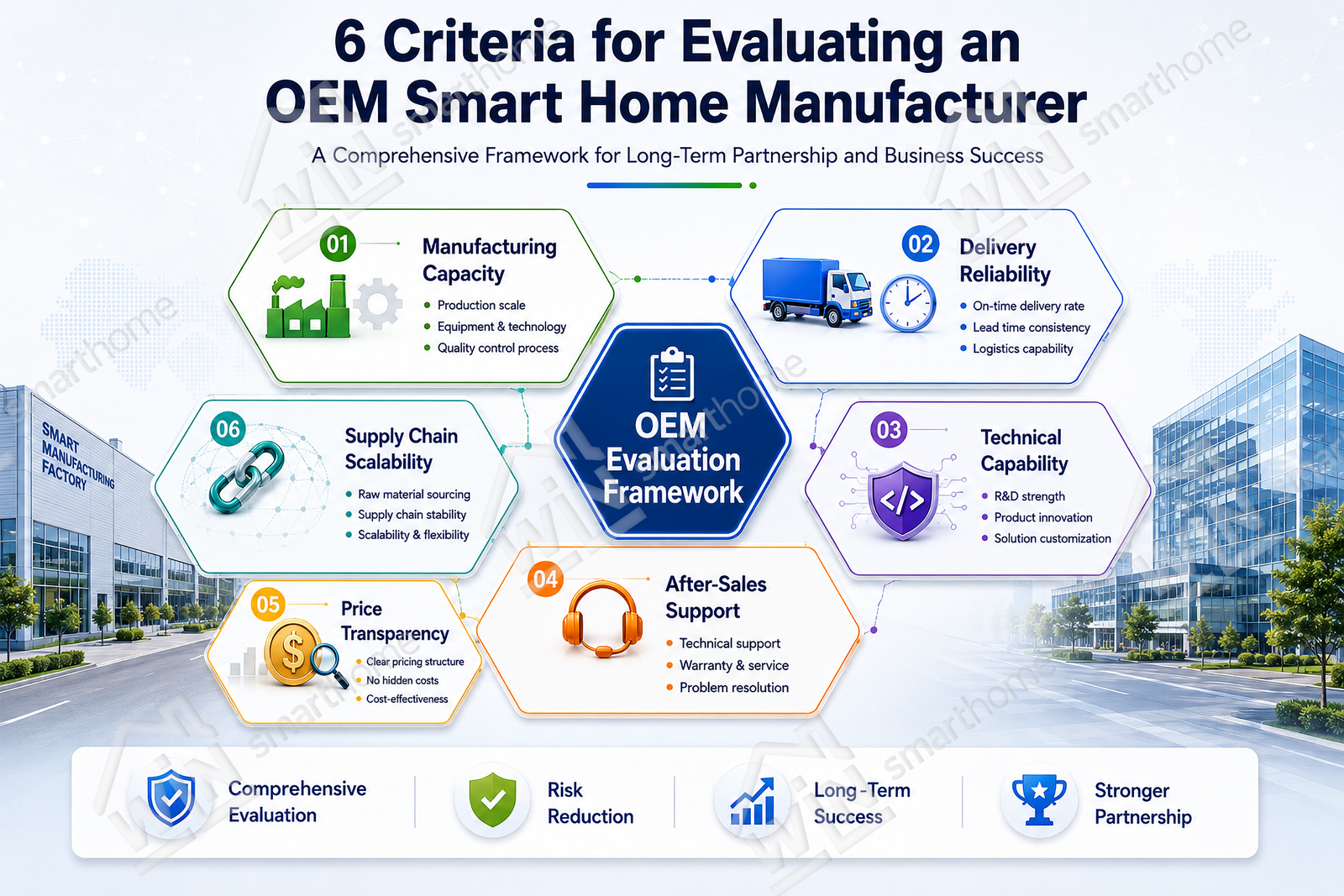
| Criteria | What to Evaluate | Why It Matters |
|---|---|---|
| Manufacturing Capacity | Monthly output, factory scale, automation level, and quality control systems. | Ensures the supplier can support customized projects and larger production volumes. |
| Delivery Reliability | Lead times, production workflow, and traceability systems. | Reduces project delays and improves delivery consistency. |
| Technical Capability | Experience with Matter, Zigbee, Wi-Fi, BLE, MQTT, KNX, and building automation protocols. | Determines whether the supplier can support complex smart home projects. |
| After-Sales Support | Technical response time, firmware support, warranty handling, and troubleshooting capability. | Protects customer satisfaction after deployment. |
| Price Transparency | Direct factory pricing, material quality, testing standards, and engineering support. | Helps buyers avoid hidden costs caused by low-quality products. |
| Supply Chain Scalability | Product ecosystem, certification support, engineering resources, and long-term development capability. | Supports future expansion across broader smart home systems. |
1. Manufacturing Capacity and Factory Scale
Production capability is the first qualification threshold.
As a practical benchmark, reliable OEM manufacturers should be capable of producing approximately 20,000–50,000 units per month, allowing them to support both customized projects and larger production volumes.
Factory infrastructure matters just as much. Leading manufacturers often operate 12 Industry 4.0 production lines, using automated assembly, intelligent scheduling, and digital quality control systems to improve production efficiency by more than 30%.
Factory size is another useful indicator. Facilities covering approximately 13,000㎡ generally provide sufficient space for production, warehousing, testing, and quality management, reducing operational risks as order volumes grow.
2. Delivery Reliability and Traceability
A competitive quotation becomes meaningless if products cannot be delivered on time.
For most smart home projects, manufacturers should be capable of supporting 7-day lead times for standard products and 30-day lead times for customized orders.
Equally important is production traceability. Advanced factories use QR-code tracking and digital workflow systems to monitor production status, reduce errors, and improve delivery consistency.
3. Technical Capability and Product Precision
Modern smart home products require more than manufacturing capacity.
Suppliers should demonstrate experience with technologies such as Matter, Zigbee, WiFi smart device OEM, BLE, MQTT, KNX smart home, and other building automation protocols.
Production precision is also critical. Factories equipped with advanced automation systems are often capable of maintaining tolerances within 1mm accuracy, helping ensure product consistency and reducing installation issues in large-scale deployments.
4. After-Sales Support
Many buyers focus on specifications and pricing but underestimate the importance of technical support.
Reliable OEM manufacturers should provide dedicated support teams capable of responding within 24 hours for firmware issues, deployment questions, warranty claims, and technical troubleshooting.
For distributors and system integrators, rapid support often has a direct impact on customer satisfaction and project success.
5. Price Transparency vs. Lowest Price
One of the biggest sourcing mistakes is assuming that the cheapest quotation represents the best value.
The real question is whether the supplier is a genuine manufacturer offering direct factory pricing or simply reducing costs through lower-quality materials, limited testing, or insufficient engineering support.
We often explain this using a simple calculation.
A distributor once compared 2 suppliers. One offered a price approximately $25 lower than a qualified OEM manufacturer. Initially, the cheaper option appeared attractive.
However, product failures later required replacements, additional labor, technical support, and customer compensation. The total remediation cost exceeded $100, while the customer relationship suffered significant damage.
The lesson is simple: a small saving during procurement can quickly become a much larger cost after deployment.
Successful smart home brands evaluate total lifecycle cost rather than purchase price alone.
6. Long-Term Supply Chain Scalability
Many projects begin with a single product category but eventually expand into broader ecosystems that include:
- Smart switches
- Sensors
- Thermostats
- Gateways
- Curtain motors
- Energy management devices
- Building automation solutions
The strongest OEM partners provide more than manufacturing services. They offer engineering resources, certification guidance, supply chain access, and long-term product development support that enable customers to scale efficiently.
A Practical OEM Supplier Validation Process
Before committing to mass production, B2B buyers should convert supplier promises into a documented validation process. This is especially important when the project combines several product categories, protocols or manufacturers.
- Supplier qualification: review legal identity, manufacturing scope, engineering resources, relevant certifications, export experience and quality-management procedures.
- Sample and compatibility validation: test the required functions, firmware behavior, protocol compatibility, installation conditions and target ecosystems before approving a model.
- Golden sample and BOM control: retain an approved reference sample and confirm the bill of materials, key components, firmware version, appearance and packaging specifications.
- Pilot production: begin with a controlled small batch so assembly consistency, packaging, documentation and after-sales procedures can be verified before scaling.
- Change management: require written approval for component, firmware, tooling or packaging changes that may affect certification, compatibility or product quality.
WinSmartHome works independently with selected manufacturers rather than limiting buyers to a single catalog. We help match products to the target market, coordinate samples and testing in China, and support OEM/ODM, private label, packaging, certification and long-term supply-chain communication. Buyers can combine KNX project solutions, Matter smart home products and other suitable categories into one commercially workable portfolio.
OEM KNX Sourcing: From Product Shortlist to a Project Quote
Choosing an OEM smart home manufacturer is easier when the product scope and validation plan are clear. For a hotel or building project, first compare the OEM KNX room control unit series and KNX smart switches against your room functions, wiring, ETS configuration and target market. Confirm the exact model and technical documents before selecting samples.
- Customisation: Share requirements for logo, packaging, enclosure, firmware, ETS parameters and interface configuration. Availability and engineering scope must be confirmed for the selected model and order.
- Samples and quality: Ask which samples are available, what they cost, and how you will test installation, protocol compatibility and the approved golden sample before a pilot order. Request model-specific technical and compliance documents for your destination market.
- MOQ, price and delivery: Provide the expected first-order quantity, annual forecast, market and timeline. MOQ, sample terms, quotation and lead time are confirmed case by case after product and customisation review; they are not fixed across the portfolio.
For long-term distribution or private-label cooperation, apply to become a KNX distributor or OEM partner. For a specific building project, request a product shortlist and quote with the required models, quantities, integrations and delivery market.
Final Thoughts
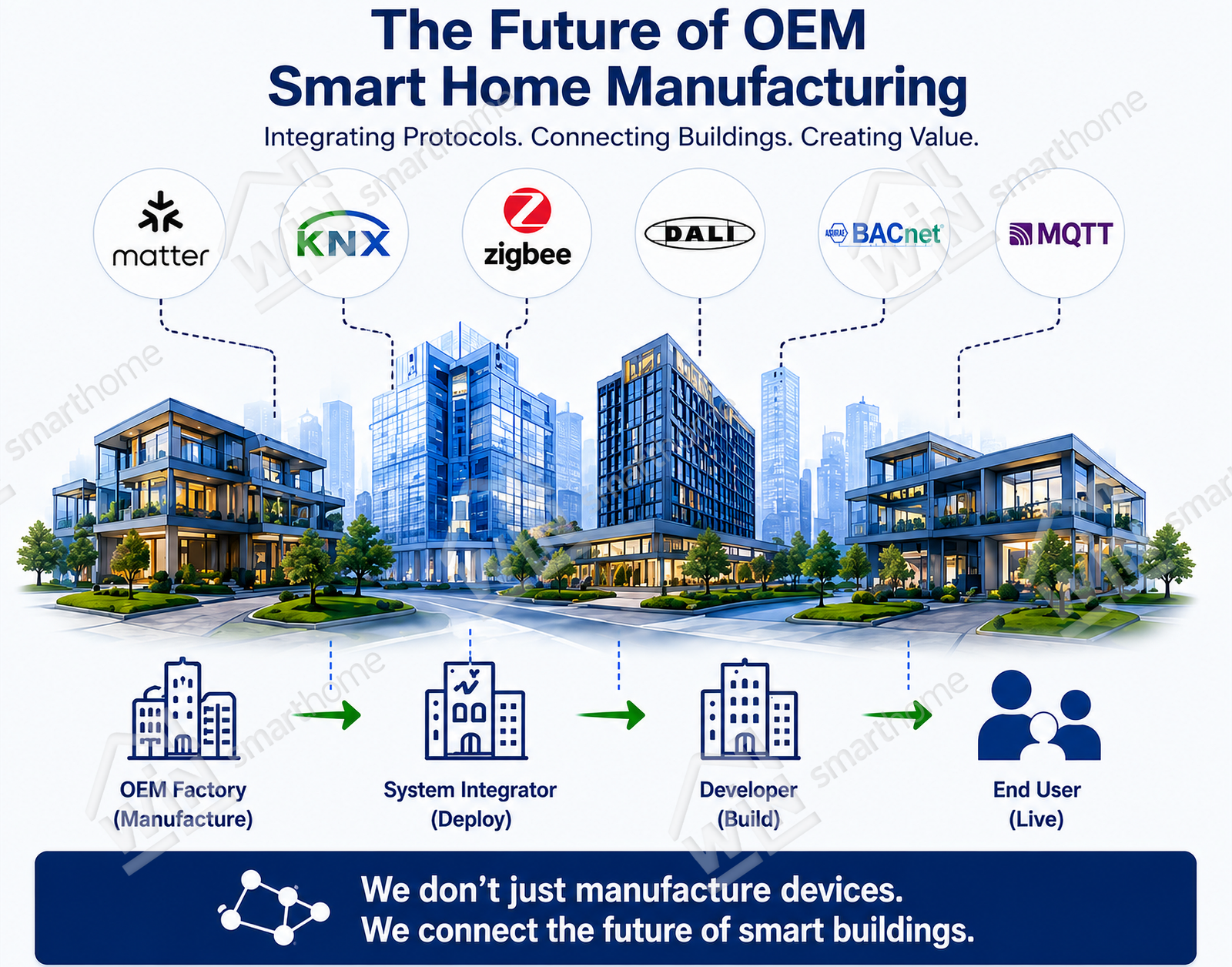
Ultimately, the best OEM smart home manufacturer in China is not necessarily the factory with the largest facility or the lowest quotation.
It is the partner that can consistently deliver reliable products, support future growth, and provide the technical expertise required for long-term success.
Frequently Asked Questions
1. How do I know whether a supplier is a real manufacturer or a trading company?
The most reliable approach is to evaluate factory ownership, production facilities, certifications, engineering capabilities, and quality management systems. A genuine manufacturer should be able to demonstrate production capacity, technical expertise, and long-term product development support rather than simply offering products at competitive prices.
2. Is the lowest quotation always the best option?
Not necessarily. Many sourcing problems occur when buyers focus only on unit price while overlooking quality control, certification readiness, delivery reliability, and after-sales support. A slightly higher-priced supplier may deliver a significantly lower total cost of ownership over the lifecycle of a project.
3. What production capacity should an OEM smart home manufacturer have?
There is no universal requirement, but for most international projects, manufacturers capable of producing 20,000–50,000 units per month are generally better positioned to support both small-batch customization and larger-scale production requirements.
4. Why is technical capability important for OEM projects?
Modern smart home products often require support for Matter, Zigbee, Wi-Fi, BLE, MQTT, KNX, and other protocols. Engineering expertise affects product stability, ecosystem compatibility, firmware customization, certification compliance, and future product expansion.
5. What should I evaluate beyond manufacturing capability?
Buyers should also assess delivery performance, certification support, after-sales responsiveness, and supply chain scalability. The strongest OEM partners provide not only manufacturing services but also technical guidance, engineering resources, and long-term support for future product development.
Planning a Smart Hotel, Villa, or Smart Building Project?
WinSmartHome supports developers, distributors, hotel automation companies, and system integrators with:
- KNX smart home product sourcing
- Matter-compatible smart home products
- Smart hotel and villa automation planning
- HVAC control and thermostat selection
- Lighting control and dimming solutions
- Multi-protocol system integration
- OEM / ODM smart home product support