
Matter vs Tuya: Understanding the Real Difference Beyond Technology
TL;DR
- Matter vs Tuya: Matter is an interoperability standard; Tuya is an IoT platform. They can work together rather than replace one another.
- Is Tuya Matter compatible? Some models support Matter directly; supported non-Matter devices may connect through a compatible Matter bridge. A Tuya or Smart Life label alone is not proof of Matter support.
- Check the exact configuration: confirm model, firmware, target ecosystem and supported functions. Matter over Thread also requires a compatible Thread Border Router; controller requirements depend on the ecosystem.
- Before a bulk order: test pairing, control, offline operation, bridging and updates with the intended devices and platform.
Use our Matter Product Sampling and Compatibility Checklist to prepare a pilot test. Then review our Matter product range and send your target market, product categories, ecosystem and required functions for a tailored product and sample plan.
Choosing Matter, Tuya or a Hybrid Product Portfolio?
We compare suppliers, compatibility, product positioning and OEM feasibility for your target market—not only the protocol. Send us your required categories for a tailored product and sample plan.
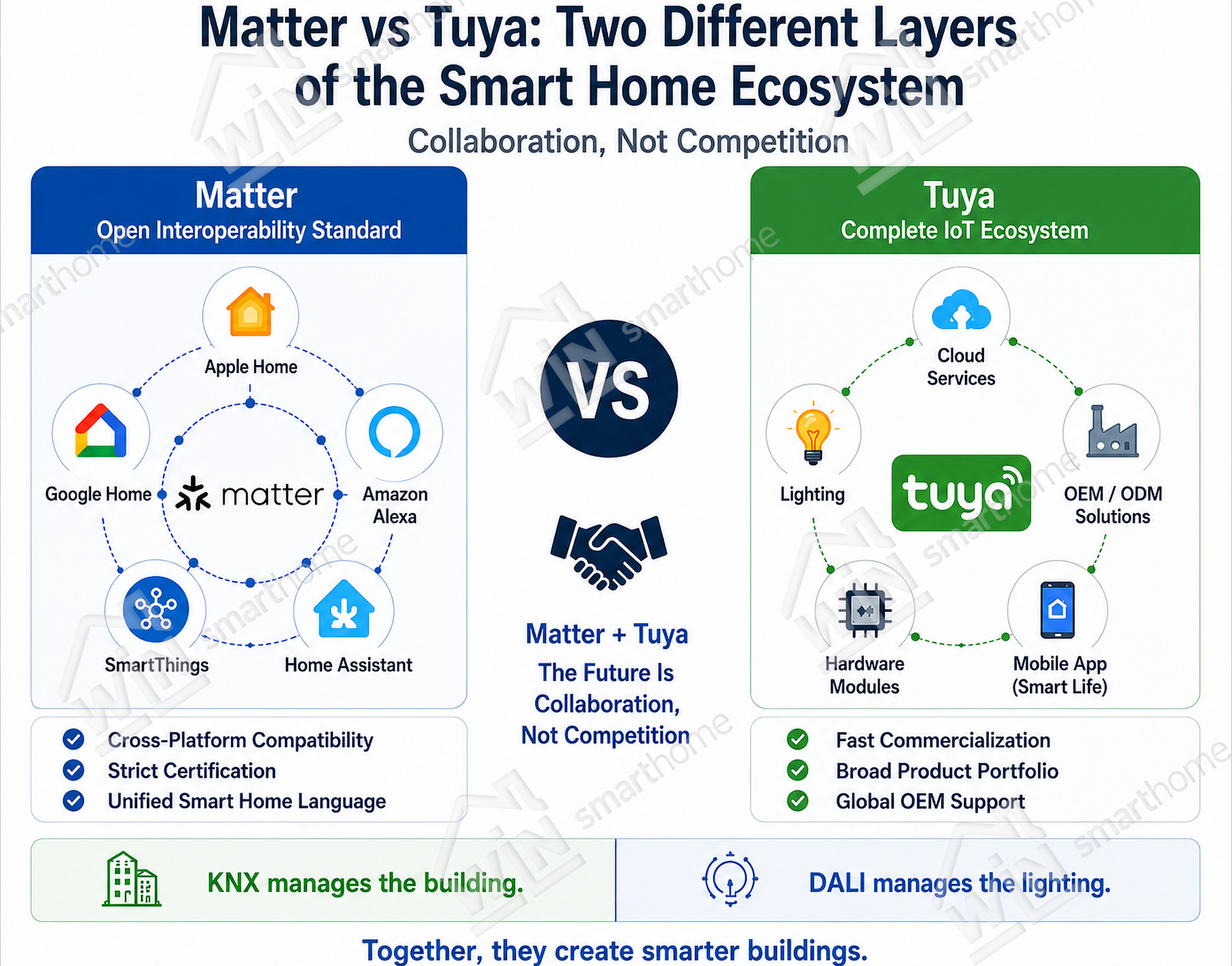
Many discussions about Matter vs Tuya start with the wrong assumption: that they are competing technologies and that one will eventually replace the other.
In reality, they operate at completely different layers of the smart home ecosystem. Matter is an open interoperability standard designed to help devices from different brands work together, while Tuya is a complete IoT platform that provides hardware modules, cloud services, mobile apps, OEM solutions, and global supply chain resources.
More importantly, Tuya is not an outsider to the Matter ecosystem. Tuya is a member of the Connectivity Standards Alliance (CSA) and has invested heavily in Matter development. Today, hundreds of Tuya-powered products already support Matter, allowing users to connect Tuya devices to Apple Home, Google Home, Amazon Alexa, and Samsung SmartThings through standardized interfaces.
This is why the question should not be: Matter or Tuya?
A better question is:
How can Matter and Tuya work together to create better products and more reliable smart home experiences?
What Is Matter?
Matter is an open smart home standard developed by the Connectivity Standards Alliance (CSA), with support from major technology companies including Apple, Google, Amazon, Samsung, and many other industry leaders.
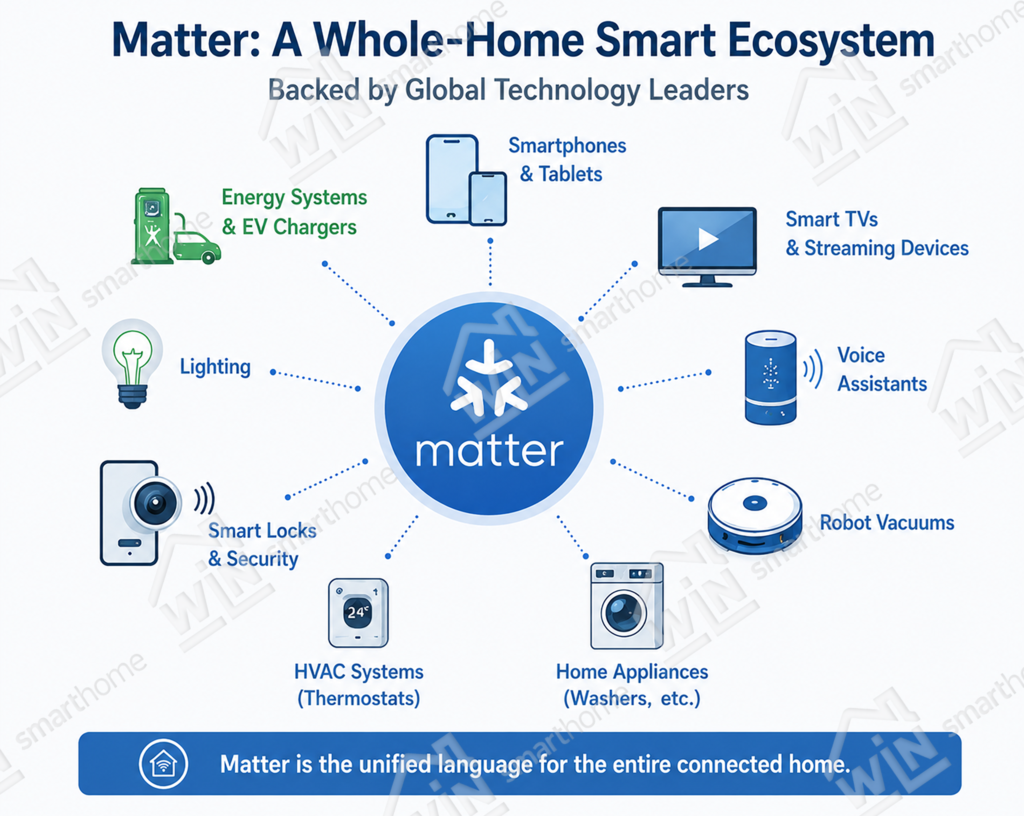
The primary goal of Matter is straightforward: eliminate compatibility problems between smart home brands.
In the past, consumers often had to choose an ecosystem first and then purchase products that worked within that ecosystem. A device designed for Apple HomeKit might not work with Google Home, while an Alexa-compatible product could require completely different integrations. Matter aims to solve this problem by creating a unified communication standard.
Matter itself is not a cloud platform, a mobile app, or a product ecosystem. Instead, it acts as a common language that allows certified devices to communicate across multiple platforms.
The introduction of Matter has also raised the industry’s quality expectations. Certification requires interoperability testing, security validation, and compliance with standardized user experiences. These additional requirements increase development costs, but they also help reduce compatibility issues for end users.
What Is Tuya?
Tuya represents a completely different approach.
Rather than focusing on interoperability standards, Tuya provides a full-stack IoT ecosystem that includes:
- Hardware modules
- Cloud infrastructure
- Mobile applications
- Voice assistant integrations
- OEM and ODM solutions
- Global supply chain resources
For manufacturers, this dramatically lowers the barriers to entering the smart home market. Instead of developing communication protocols, cloud services, and mobile applications from scratch, brands can leverage Tuya’s existing ecosystem to launch products much faster.
This advantage has made Tuya one of the world’s largest smart home platforms, supporting products across more than 10 major categories, including lighting, electrical devices, security systems, sensors, curtains, HVAC, appliances, health products, and energy management solutions.
At the same time, Tuya has actively embraced Matter rather than competing against it. The company has invested heavily in Matter compatible Tuya devices, cloud platforms, and certification programs, enabling OEM manufacturers to build products that support both ecosystems simultaneously.
In many real-world projects, the choice is no longer Matter versus Tuya. Instead, manufacturers increasingly adopt a hybrid approach:
- Tuya provides the cloud platform, OEM resources, and product ecosystem.
- Matter provides interoperability with Apple, Google, Amazon, and other major smart home platforms.
This combination allows brands to benefit from Tuya’s mature supply chain while also meeting the growing demand for Matter compatibility.
Matter vs Tuya at a Glance
| Feature | Matter | Tuya |
|---|---|---|
| Category | Open interoperability standard | Complete IoT platform |
| Developed By | Connectivity Standards Alliance (CSA) | Tuya Smart |
| Primary Goal | Cross-brand compatibility | End-to-end smart home ecosystem |
| Cloud Dependency | Optional | Native cloud services |
| Mobile App | Apple Home, Google Home, Amazon Alexa, Samsung SmartThings, Home Assistant, Homey… | Smart Life and Tuya apps |
| OEM Support | Growing rapidly | Extremely mature |
| Product Variety | Expanding but still limited | One of the industry’s broadest portfolios |
| Certification Requirements | Strict Matter certification | Flexible, depending on product category |
| Best For | Open ecosystems and interoperability | Fast commercialization and OEM development |
Ultimately, Matter and Tuya should not be viewed as direct competitors.
Matter is the industry’s new open standard, backed by the world’s largest technology companies. Tuya, meanwhile, is an experienced ecosystem player with years of market validation, extensive product categories, and highly developed OEM capabilities.
The smart home industry does not need to abandon established platforms simply because new technologies emerge. The most successful brands are increasingly combining both approaches: leveraging Tuya’s mature supply chain and broad product selection while embracing Matter’s interoperability and future-proof ecosystem.
The Real Challenge with Tuya: Choosing the Right Supplier
One of Tuya’s greatest strengths is also one of its biggest challenges.
The Tuya ecosystem is incredibly mature, offering products across lighting, security, sensors, curtains, HVAC, appliances, and energy management. For system integrators and property developers, this means it is possible to build an entire smart home solution within a single ecosystem.
However, finding the right supplier is often much more difficult than choosing the right technology.
At first glance, many Tuya products look almost identical. They may use the same Smart Life app, similar industrial designs, and even the same Tuya modules. Yet the price differences can be enormous, and more importantly, the quality of technical support and after-sales service can vary dramatically.
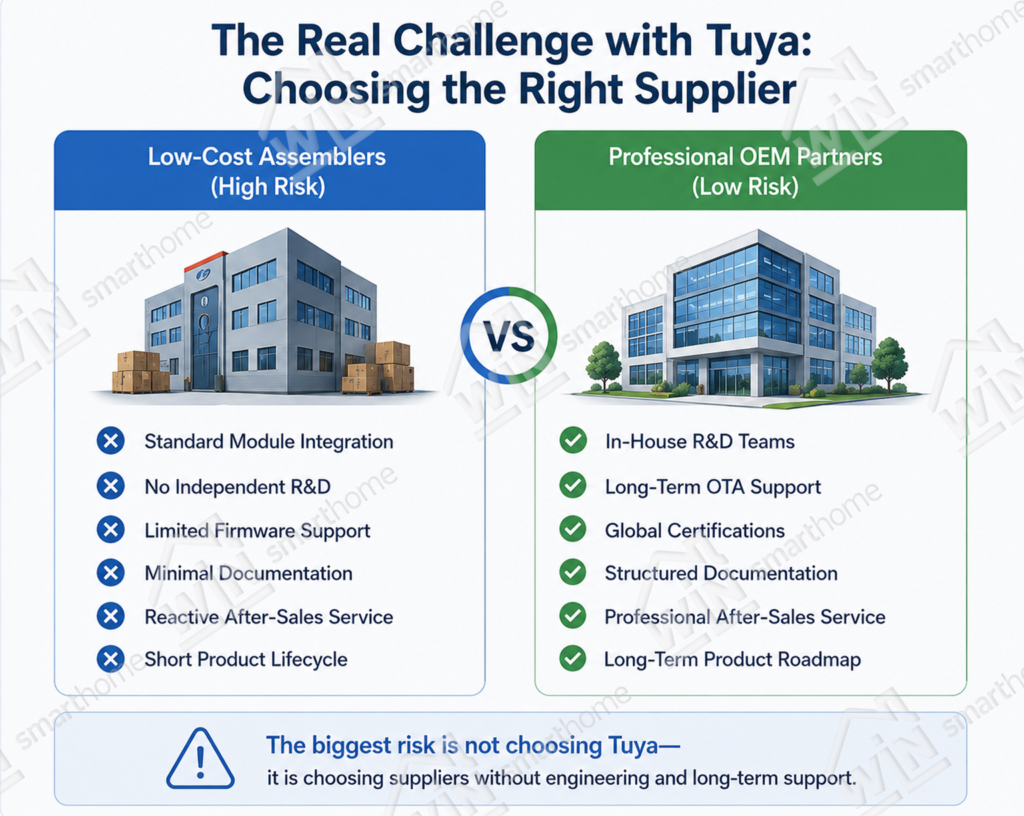
We have seen projects where customers selected low-cost Tuya products that worked well initially but later encountered firmware or hardware issues. The original supplier was still operating, but they simply could not solve the problem because they had no independent R&D capabilities. In many cases, their business model was based on sourcing standard Tuya modules and assembling products rather than developing and maintaining their own technologies.
This is not necessarily a weakness of Tuya itself. In fact, Tuya’s open ecosystem and low barriers to entry are exactly what allow thousands of manufacturers to bring affordable smart products to market. Tuya’s primary business is selling IoT modules and enabling rapid commercialization, so its product certification requirements are naturally more flexible than those of Matter.
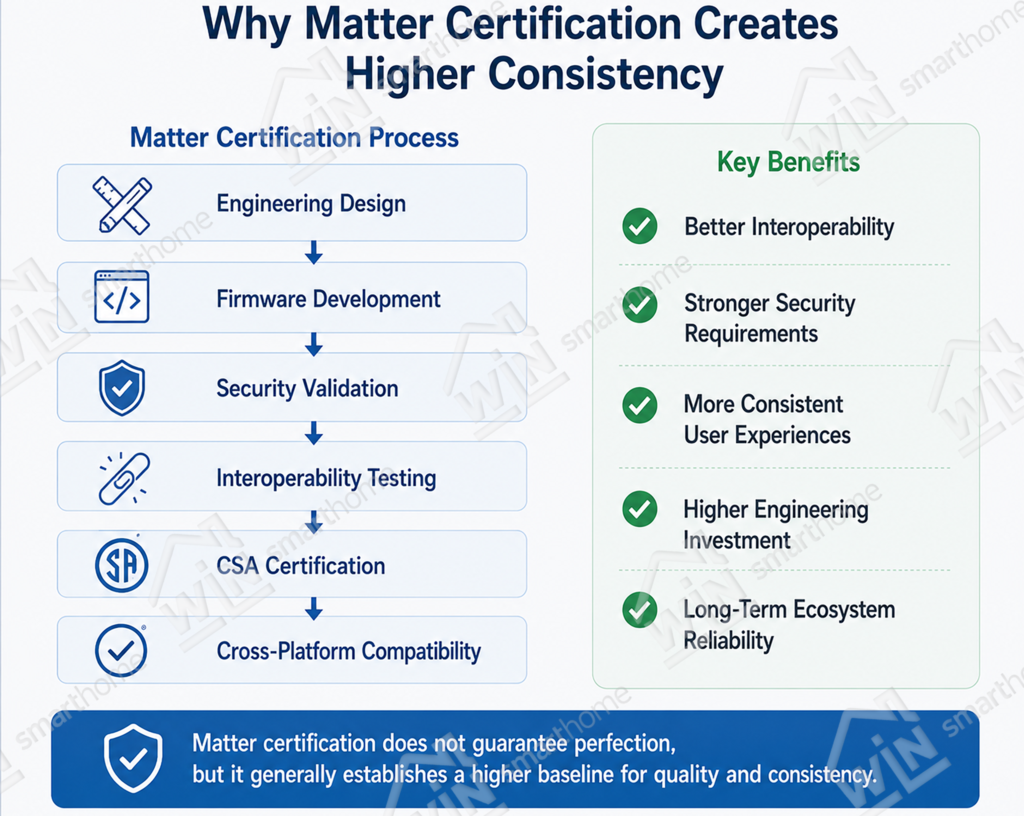
Matter takes a different approach.
Because Matter certification involves stricter interoperability testing, security validation, and ecosystem compliance, manufacturers generally need stronger engineering capabilities and a greater commitment to long-term product support. While certification does not guarantee that every Matter product is perfect, it does create a higher baseline for consistency and quality.
For distributors, system integrators, and real estate developers, the real question is not whether to choose Matter or Tuya.
The real question is whether the supplier behind the product can still support your projects five years from now.
Which Smart Home Strategy Fits Your Project?
After comparing Matter and Tuya from both technology and supply chain perspectives, the next question becomes much more practical:
Which solution actually fits your home, budget, and long-term expectations?
In reality, there is no single “best” approach. Different projects require different levels of automation, flexibility, and investment. Based on our experience, most smart home deployments can generally be divided into three categories: pure Matter solutions, Matter with bridges and mixed protocols, and advanced Home Assistant hybrid systems.
Three Typical Smart Home Approaches
| Comparison | Matter Direct | Matter + Bridge | Home Assistant Hybrid |
|---|---|---|---|
| Typical Home Size | Small apartments | Family homes | Villas and large houses |
| Number of Devices | 20–30 | 50–80 | 100+ |
| Budget Range* | US$500–700 | US$2,600–3,400 | US$6,000+ |
| Installation Difficulty | Very Low | Moderate | High |
| Setup Time | Same day | Several days | 1–2 weeks |
| Local Control | Local Matter functions; controller-dependent | Depends on bridge and device support | Depends on selected integrations |
| Offline Operation | Verify required functions offline | Verify bridge and automations offline | Local integrations only; test offline |
| Apple Home Experience | ★★★★★ | ★★★★☆ | ★★★★☆ |
| Expansion Flexibility | ★★☆☆☆ | ★★★☆☆ | ★★★★★ |
| Best For | Renters and small homes | New home renovations | Advanced users and large projects |
These scenarios, device counts, budgets, setup times and ratings are illustrative—not system limits, tested benchmarks or quotations. Actual costs, capacity, compatibility and offline functions depend on the selected products, controller, bridge, integrations and site requirements. Validate a sample configuration before a bulk order.
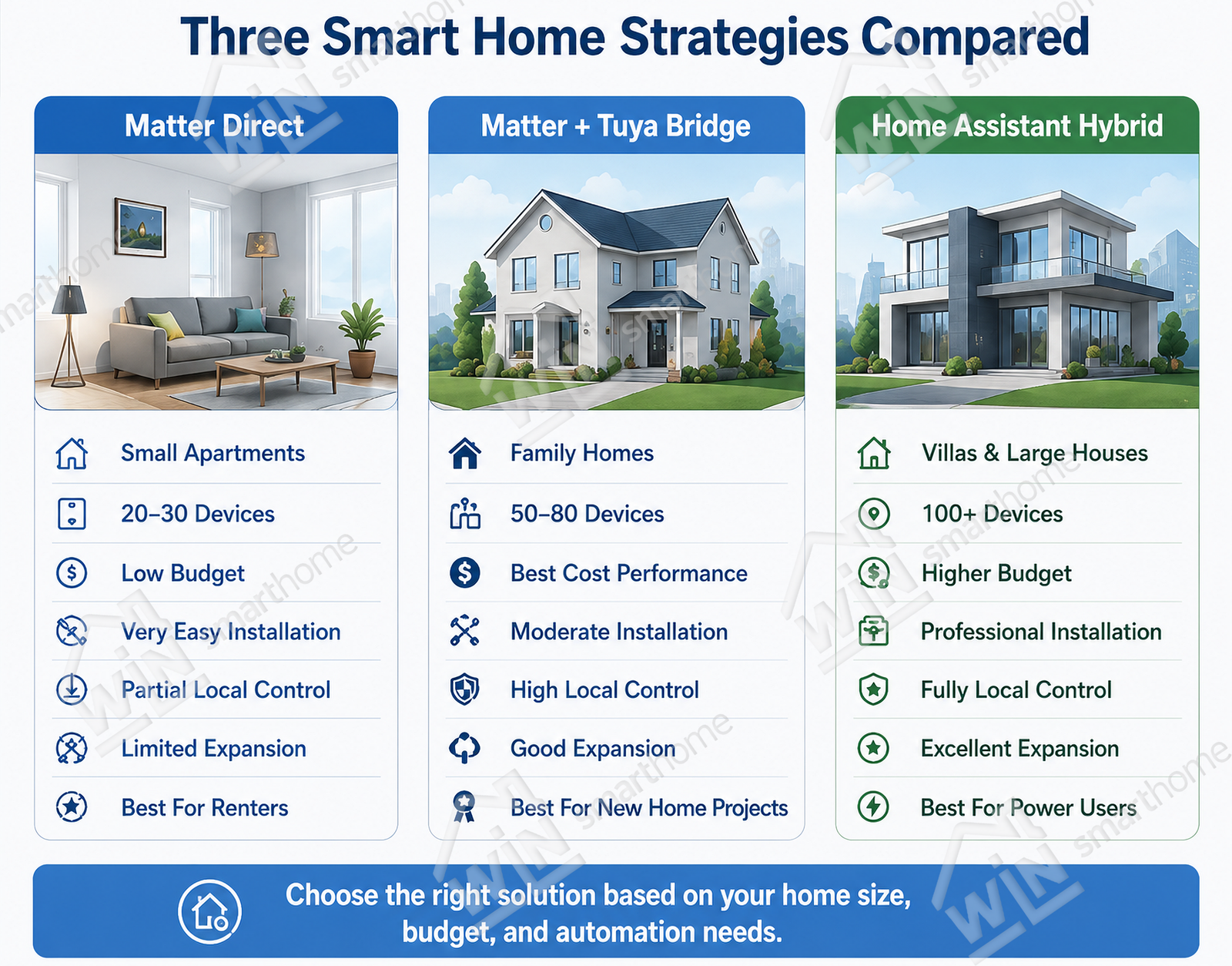
Scenario 1: Matter Direct
A pure Matter setup is often the simplest and most affordable option.
It works particularly well for:
- Existing homes where rewiring is not practical
- Apartments and smaller living spaces
- Users who prefer plug-and-play solutions
- Families with limited budgets
- Apple Home, Google Home, or Alexa users seeking native compatibility
Matter devices can simplify installation, but the required infrastructure depends on the model and target ecosystem. Confirm the Matter controller requirements; Matter over Thread devices also need a compatible Thread Border Router. These roles may be combined in one hub.
The downside is that expansion possibilities remain relatively limited compared with more advanced systems, especially for large properties with dozens of devices.
Scenario 2: Matter + Tuya Bridge Solutions
For many homeowners, this is currently the most practical balance between cost, flexibility, and functionality.
Instead of relying exclusively on native Matter devices, users combine Matter with mature ecosystems such as Tuya Zigbee products, local gateways, and integrated automations.
This approach offers several advantages:
- Broader product selection
- Lower overall project costs
- Better coverage across lighting, curtains, HVAC, sensors, and security
- Access to supported functions in Apple Home, Google Home and Alexa through a compatible Matter bridge; device and platform support must be verified.
For new home projects, this hybrid model often provides the best value because it combines Matter’s openness with Tuya’s extensive ecosystem and mature supply chain.
Scenario 3: Home Assistant Hybrid Systems
For large homes, villas, and advanced users, Home Assistant remains one of the most powerful smart home platforms available.
A Home Assistant hybrid system typically combines:
- Matter devices
- Tuya products
- Zigbee networks
- Local Tuya integrations
- Energy management systems
- Security and surveillance devices
- Custom automations and AI-based scenarios
Home Assistant can run local automations when the selected devices and integrations support local operation. Cloud-dependent integrations, remote access and some voice services may stop during an internet or cloud outage. Test the required functions offline before deployment.
However, this flexibility comes with higher complexity. System maintenance, troubleshooting, and future upgrades generally require technical knowledge or professional integration support.
A Simple Decision Framework
The following questions can help narrow down the most suitable approach:
Are you renovating or building a new home?
- No → Matter Direct is usually the simplest option.
- Yes → Continue to the next question.
Do you want advanced automation and local control?
- No → Matter + Tuya Bridge solutions often provide the best balance between cost and functionality.
- Yes → Consider a Home Assistant hybrid system.
Is your home larger than 150 square meters or does it include specialized spaces such as home theaters, energy management systems, or advanced security requirements?
- No → Matter + Tuya Bridge solutions are typically sufficient.
- Yes → Home Assistant offers greater flexibility and scalability.
The Unique Value of Tuya + Matter
One reason why many manufacturers and homeowners continue to adopt Tuya is that the ecosystem complements Matter rather than competing against it.
Some of Tuya’s biggest advantages include:
- Extensive product categories covering lighting, security, sensors, curtains, HVAC, appliances, health devices, and energy management systems
- Competitive pricing enabled by mature OEM and supply chain resources
- Native Matter support across an increasing number of products and modules
- Flexible integrations with Apple Home, Google Home, Amazon Alexa, Home Assistant, and other ecosystems
- Global deployment experience across international markets
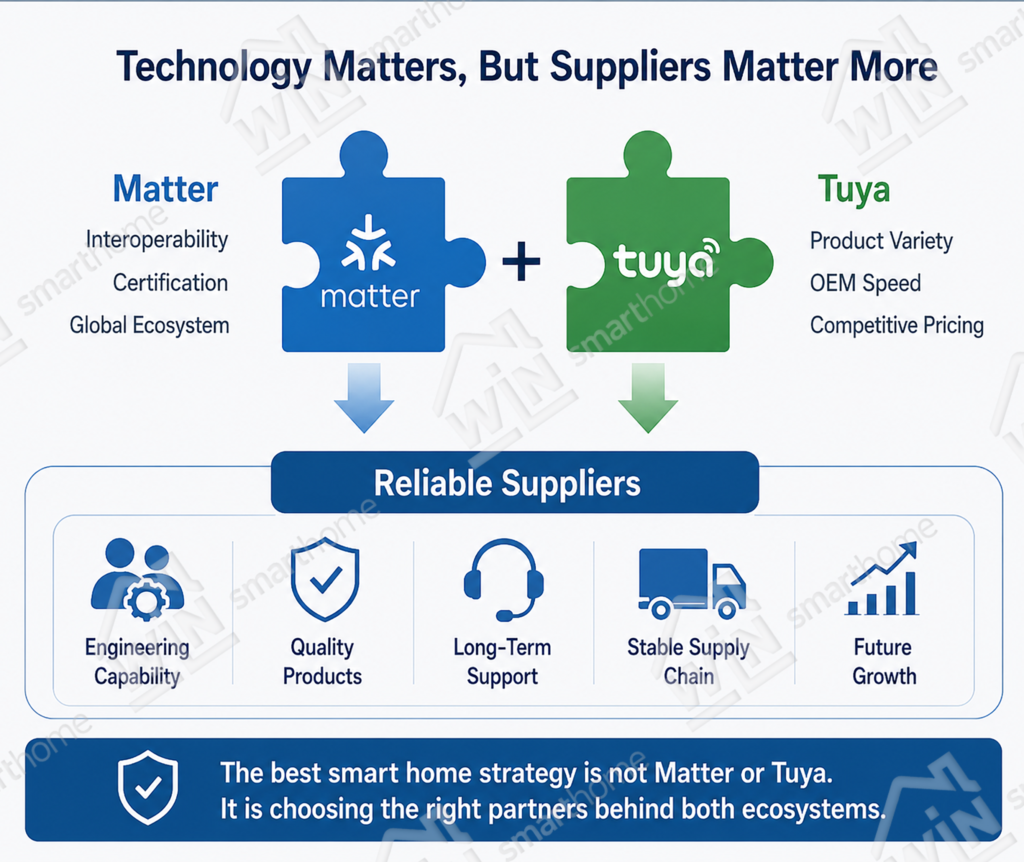
This combination gives users far greater freedom than being locked into a single platform or brand.
Ultimately, the best smart home strategy is rarely about choosing Matter or Tuya alone.
It is about combining the strengths of both ecosystems while selecting suppliers that can provide reliable products, long-term support, and sustainable growth for future projects.
FAQ
1. Is Matter replacing Tuya?
No. Matter is not replacing Tuya, and Tuya is actively supporting Matter development.
Matter is an interoperability standard, while Tuya is a complete IoT ecosystem that includes hardware modules, cloud services, mobile apps, and OEM resources. In fact, many Tuya products already support Matter, allowing users to integrate them with Apple Home, Google Home, Amazon Alexa, and other platforms.
The future is more likely to be Matter and Tuya working together rather than one replacing the other.
2. Why are Matter products usually more expensive than Tuya products?
Matter products generally involve higher certification and development costs. Manufacturers must invest in interoperability testing, security requirements, and ecosystem validation to ensure devices work consistently across multiple platforms.
Tuya, on the other hand, benefits from a highly mature OEM ecosystem and lower barriers to entry, which often leads to lower product costs and broader product availability.
However, price should not be the only consideration. Long-term technical support and supplier capabilities are equally important.
3. Are cheap Tuya products reliable?
They can be, but reliability depends heavily on the manufacturer behind the product.
The Tuya ecosystem includes both highly professional OEM partners and low-cost suppliers with limited engineering resources. Buyers should evaluate factors such as firmware support, certifications, after-sales service, and long-term product roadmaps rather than focusing only on price.
Choosing the right supplier is often more important than choosing the protocol itself.
4. Can Tuya devices work with Apple Home and Google Home?
Some Tuya-enabled devices support Matter directly, while supported non-Matter devices may connect through a compatible Matter bridge. A Smart Life or Tuya label alone does not establish Matter compatibility. Check the exact model, firmware, bridge support, target platform and exposed functions before ordering.
In addition, Tuya’s Smart Life ecosystem provides its own cloud platform and mobile applications, giving users multiple options for managing their smart homes.
This flexibility is one of the reasons why Tuya remains popular despite the rapid growth of Matter smart home.
5. Should I choose Matter, Tuya, or both?
The answer depends on your project requirements.
If cross-brand interoperability and future ecosystem compatibility are your priorities, Matter is an excellent choice.
If you need a wider product selection, faster deployment, and cost-effective OEM solutions, Tuya offers significant advantages.
For many homeowners and smart home brands, the most practical approach is to combine both ecosystems—using Tuya’s mature product portfolio while leveraging Matter’s compatibility with major global platforms.
In most cases, the best strategy is not Matter or Tuya, but Matter and Tuya.
6. What should I look for when selecting a smart home supplier?
Beyond product specifications, buyers should evaluate:
- In-house engineering capabilities
- Firmware and OTA support
- International certifications
- After-sales service processes
- Long-term product roadmaps
- OEM and customization capabilities
Smart home systems are long-term investments. Choosing a reliable supplier with strong technical support is often far more important than selecting the latest technology or the lowest price.
Planning a Smart Hotel, Villa, or Smart Building Project?
WinSmartHome supports developers, distributors, hotel automation companies, and system integrators with:
- KNX smart home product sourcing
- Matter-compatible smart home products
- Smart hotel and villa automation planning
- HVAC control and thermostat selection
- Lighting control and dimming solutions
- Multi-protocol system integration
- OEM / ODM smart home product support
Request Technical Consultation
Choosing Matter, Tuya or a Hybrid Product Portfolio?
We compare suppliers, compatibility, product positioning and OEM feasibility for your target market—not only the protocol. Send us your required categories for a tailored product and sample plan.