
TL;DR
- ✅ Start with the room, user, load types and installation conditions—not the appearance of the panel.
- ✅ Push buttons are efficient for frequent actions; touch screens suit multi-function control; thermostats and voice panels solve more specialized needs.
- ✅ European and Chinese KNX panels are not simply “premium versus budget.” They differ in design language, customization, lead time, ecosystem depth and commercial flexibility.
- ✅ Verify KNX certification, ETS database quality, mounting compatibility, sample performance and technical support before approving a product.
- ✅ For distributors and project buyers, a multi-manufacturer sourcing partner can reduce selection risk and build a more competitive portfolio.
Introduction
A wall panel may be one of the smallest components in a building automation project, but it is the part users touch every day. The wrong choice can create confusing room control, mismatched finishes, difficult installation and costly replacement work. The right KNX smart switch combines intuitive operation, reliable bus communication and a design that fits both the interior and the project’s commercial position.
This guide explains how to choose a KNX smart switch for villas, hotels, apartments and commercial buildings. It also provides a practical Chinese vs European KNX switches comparison—an area often reduced to price, even though project support, customization and supply-chain flexibility can matter just as much.
1. Define the Project Before Choosing the Panel
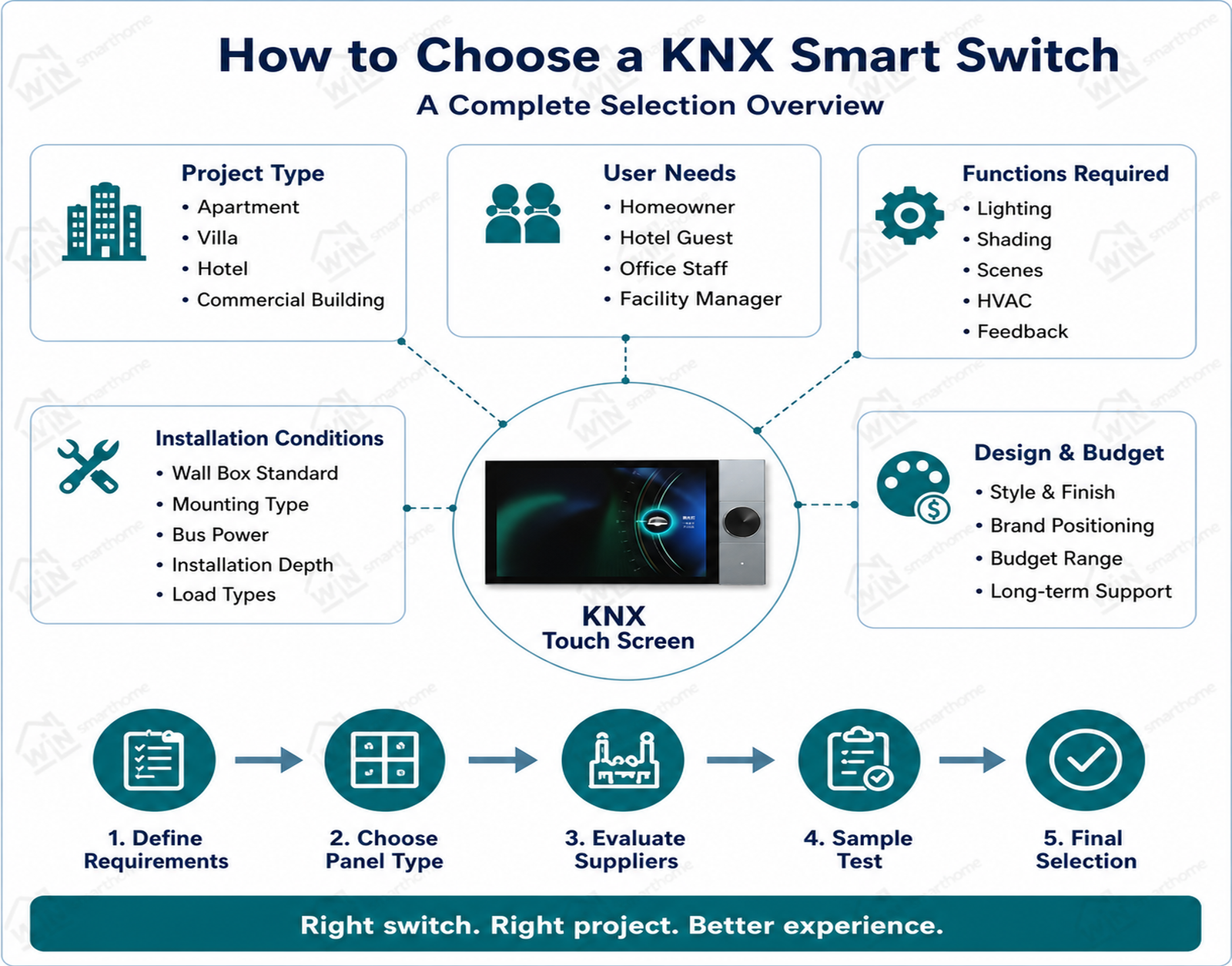
Do not begin by comparing catalog photos. A professional selection starts with a room-by-room control schedule. Identify who will use the panel, which functions are used frequently and what should remain inside the app, touch screen or building management system.
Confirm the building and user profile
A luxury villa owner may value a refined metal finish, personalized scenes and control of lighting, curtains, HVAC and music. A hotel guest needs a panel that can be understood in seconds. An office requires consistent labeling, clear status feedback and durable operation. Public buildings may prioritize robustness and standardized maintenance over decorative variety.
List the required functions
- Lighting: on/off switching, dimming, color temperature or RGB control.
- Shading: open, close, stop, position control and long-press adjustment.
- Scenes: welcome, away, meeting, movie, sleep or all-off commands.
- HVAC: temperature, operating mode, fan speed, floor heating and fresh air.
- Feedback: LED status, values, alarms, room conditions or equipment state.
Check the engineering conditions
Confirm the wall box standard, panel dimensions, auxiliary power, bus current and installation depth. Decide whether loads are controlled by separate KNX actuators or whether a built-in relay is useful. For large projects, verify the ETS product database, communication objects, parameter logic, scene capacity and integration with the rest of the KNX smart home product portfolio.
A beautiful panel is not automatically a suitable panel. The best selection is the one that users understand and integrators can commission, replace and support consistently.
2. Compare the Main KNX Panel Types
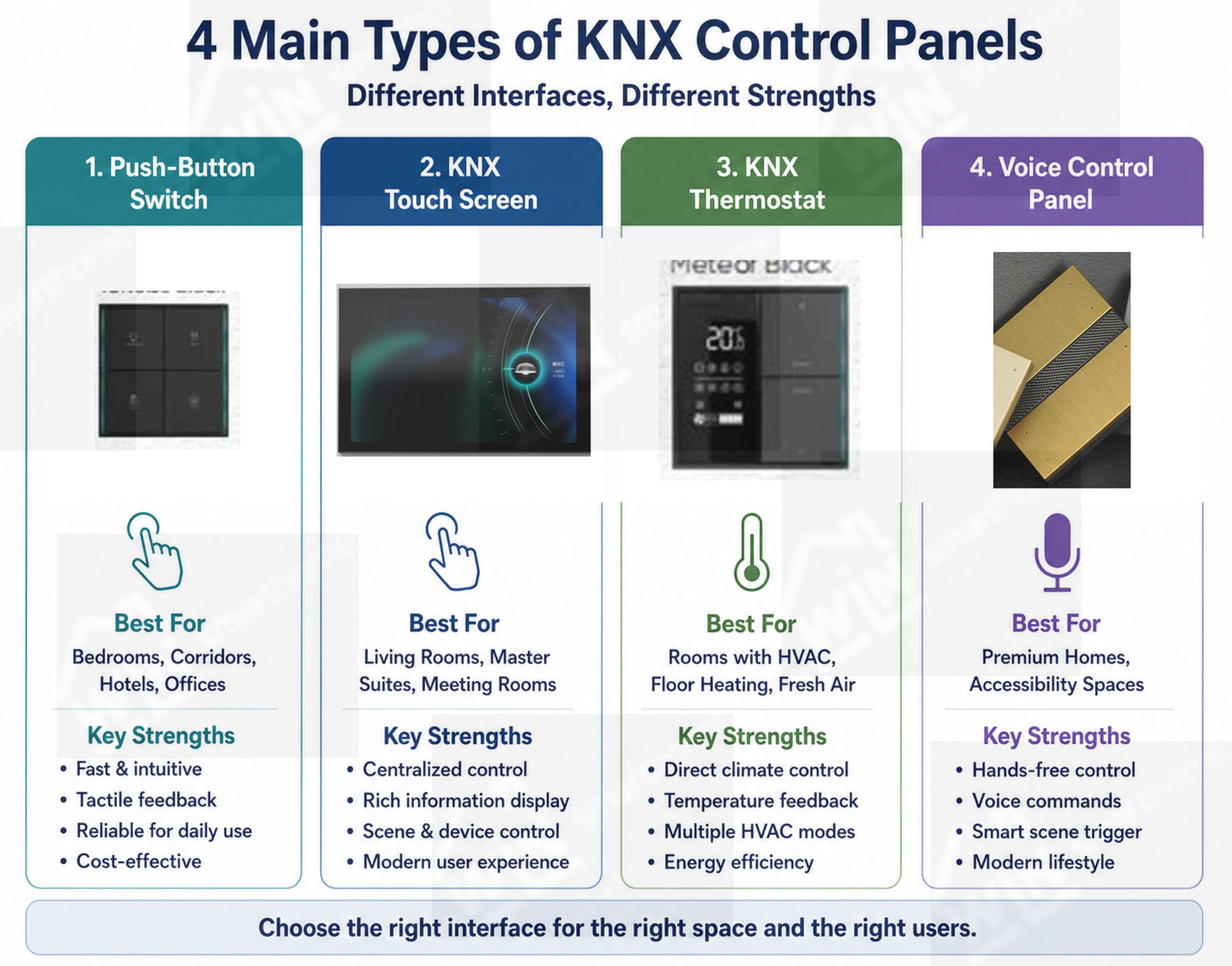
There is no universal panel for every room. A useful KNX push button panel comparison should include mechanical operation, touch interfaces, climate control and voice-assisted control.
| Panel type | Best use | Main strengths | Points to check |
|---|---|---|---|
| Push-button switch | Bedrooms, corridors, hotel rooms, offices | Fast, tactile and easy for frequent actions | Button logic, labeling, LED feedback and number of functions |
| KNX touch screen | Living rooms, master suites, meeting rooms | Centralizes multiple subsystems and displays status | UI clarity, screen size, response speed and auxiliary power |
| KNX thermostat | Rooms with HVAC, fresh air or floor heating | Direct environmental control and feedback | HVAC type, fan-coil logic, sensors and setpoint limits |
| Voice control panel | Premium homes and accessibility-focused spaces | Hands-free scenes and device commands | Language, privacy, network dependence and fallback controls |
KNX push-button switches
Push buttons remain the most efficient interface for actions performed many times a day. Users can operate them without navigating a menu, and long press, short press or divided-button logic can multiply the available functions. WinSmartHome’s KNX smart switch range includes multi-gang options, LED status indication, proximity sensing, replaceable icons and text, and coordinated switch, socket and thermostat combinations. Certain configurations also support a built-in relay, which can simplify selected retrofit or room-control applications.
KNX touch screens
A touch screen makes sense when one location must control lighting, curtains, scenes, dimming, HVAC, fresh air, floor heating, background music or intercom functions. A 4-inch screen can provide compact room control, while a 10-inch panel is more suitable as a central interface. Review the KNX touch screen options by function and UI—not screen size alone. Frequently used commands should remain accessible in one or two touches.
KNX thermostats and multifunction controls
A dedicated KNX smart thermostat is often more intuitive than placing all climate functions on a general-purpose screen. Available formats include full-color knob controls, monochrome thermostats and touch-screen models. For hotels and villas, check whether one device can coordinate air conditioning, fresh air and floor heating while showing temperature, humidity or air-quality information.
Voice panels as a complementary interface
A KNX voice control panel can improve convenience, but it should complement physical controls rather than replace them. Always retain a clear manual path for essential lighting, shading and climate functions.
3. Chinese vs European KNX Switches: A Project-Based Comparison
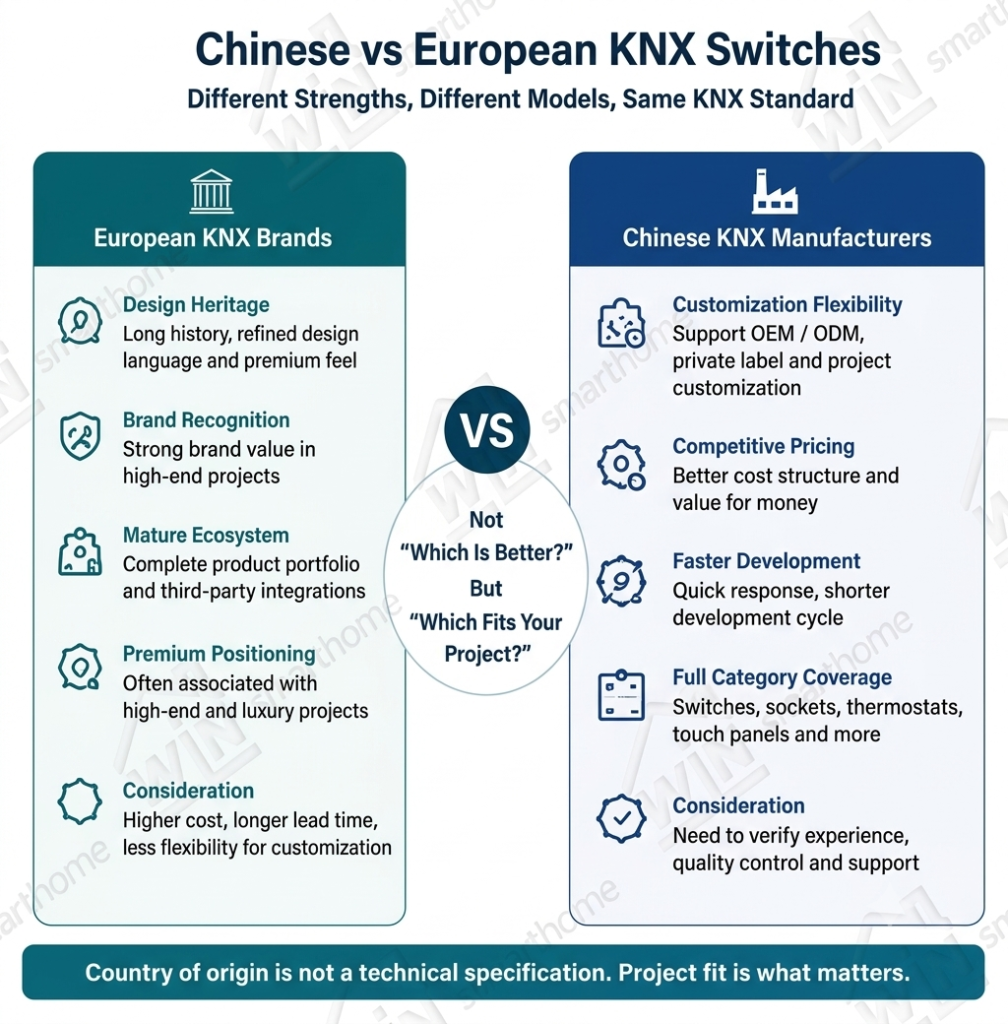
The most useful comparison is not “which country makes the better switch?” It is “which supplier model fits this project?” Established European brands and capable Chinese manufacturers can both deliver reliable KNX panels, but their strengths are often different.
What established European brands typically offer
Brands such as ABB, Schneider Electric, Legrand, Siemens, Hager, Gira, Vimar, Jung, Ekinex and Basalte have developed recognizable design systems and mature channel networks. Their panels are frequently specified for landmark projects where brand familiarity, architect approval and continuity with a complete wiring-accessory range are important.
- Design heritage: distinctive collections, refined materials and coordinated sockets, frames and controls.
- Specification confidence: established documentation, distributor networks and long market references.
- Ecosystem consistency: easier alignment with the brand’s actuators, room controls and accessories.
- Trade-off: higher acquisition cost, less flexibility for private labeling and potentially longer or channel-dependent lead times.
The product approach also varies by brand. ABB’s Peonia series combines room functions and scene control in a restrained format. Schneider Electric ranges such as Unica, D-Life and SpaceLogic emphasize coordinated design and intuitive operation. Legrand Living Now uses a modular language across controls, thermostats and sockets. Siemens Delta is often engineering-oriented, while Gira, Jung, Vimar, Ekinex and Basalte provide different balances of material, tactile feel and architectural expression.
What Chinese KNX manufacturers typically offer
Chinese brands and OEM manufacturers—including HDL, GVS, INSPrid, TTG, KANONBUS, EASEMORE, DeepSmart, Moorgen and others—have expanded from basic keypads into touch panels, thermostats, sensors, voice interfaces and coordinated room-control families. Their strongest commercial advantages are frequently flexibility and speed.
- Broader price coverage: portfolios can serve value-oriented apartments as well as premium villas and hotels.
- Customization: colors, icons, text, button quantities, UI, packaging and branding can often be adapted.
- Fast product iteration: touch displays, proximity sensing and multifunction combinations can reach the market quickly.
- Portfolio flexibility: buyers can combine specialized manufacturers instead of accepting one brand’s limitations.
- Trade-off: capability varies substantially, so certification, ETS quality, component consistency and support must be verified supplier by supplier.
| Decision factor | Established European brands | Qualified Chinese suppliers |
|---|---|---|
| Brand recognition | Usually stronger with architects and consultants | Growing, but often requires buyer education |
| Design approach | Mature signature collections and materials | Wide choice, rapid development and adaptable styling |
| Customization | Normally limited to standard catalog structures | OEM/ODM, icons, colors, functions and packaging often available |
| Price positioning | Premium to high premium | Value, mid-range and premium options |
| Lead time and MOQ | Influenced by regional stock and distributor channels | Often more negotiable, but must be confirmed per model |
| Technical consistency | Generally mature documentation and long references | Ranges from excellent to weak; prequalification is essential |
| Best fit | Brand-specified or architect-led premium projects | Customized portfolios, private labels and cost-performance projects |
How to decide by project type
For a landmark residence where the architect specifies a particular collection, an established European brand may protect the design intent. For a hotel chain requiring custom icons, room-specific functions and coordinated pricing across hundreds of rooms, a qualified Chinese supplier may provide better commercial control. Distributors developing a private-label range also benefit from OEM flexibility and access to several panel categories.
For a KNX switch for hotel and villa projects, build a weighted scorecard instead of deciding from unit price. Score appearance, tactile feel, functions, ETS usability, certification, lead time, replacement continuity and technical support. A higher-priced device may reduce commissioning time; a lower-cost panel may create more margin only if quality and support remain consistent.
Compare total project cost, not only panel price
The purchase price is only one line in the project budget. A panel that requires additional gateways, auxiliary power supplies, special back boxes or more commissioning time can become more expensive after installation. The same is true when an unfamiliar interface creates repeated training or service calls. Ask suppliers to quote a complete room configuration and list every required accessory. Then compare engineering hours, installation labor, spare stock and warranty logistics alongside the device price.
For hotel projects, calculate the cost per typical room and per public-area room, because their control requirements differ. For villas, compare the cost of each room type and the effect of premium finishes or larger screens. For distributors, include demonstration samples, packaging, certification documents, local stock and future replacement stock. This total-cost method often changes the shortlist.
Match design freedom to commercial positioning
A private-label range does not need the same specification at every price point. Entry and mid-market projects may prioritize dependable push-button control and coordinated wiring accessories. Premium projects may justify metal finishes, engraved icons, proximity lighting and multifunction touch screens. Chinese manufacturers can be particularly useful when a buyer wants several tiers under one market strategy, but visual consistency must be actively managed. Confirm whether switches, sockets, thermostats and touch panels share the same dimensions, colors, surface treatment and mounting logic.
European collections can simplify this design coordination when the complete family is already specified. However, mixing a premium European panel in flagship spaces with qualified Chinese devices in repetitive rooms can also be commercially sensible—provided the consultant accepts the design and the integrator validates system behavior. The goal is not to defend one origin. It is to place the right product where its strengths create value.
Country of origin is not a technical specification. Compare the product, manufacturer and support model against the same documented project requirements.
4. Evaluate the Supplier—and the Support Behind the Product
Once the panel type is clear, the supplier becomes the next risk point. Buyers searching for a reliable KNX switch supplier in China should request evidence, not general promises.
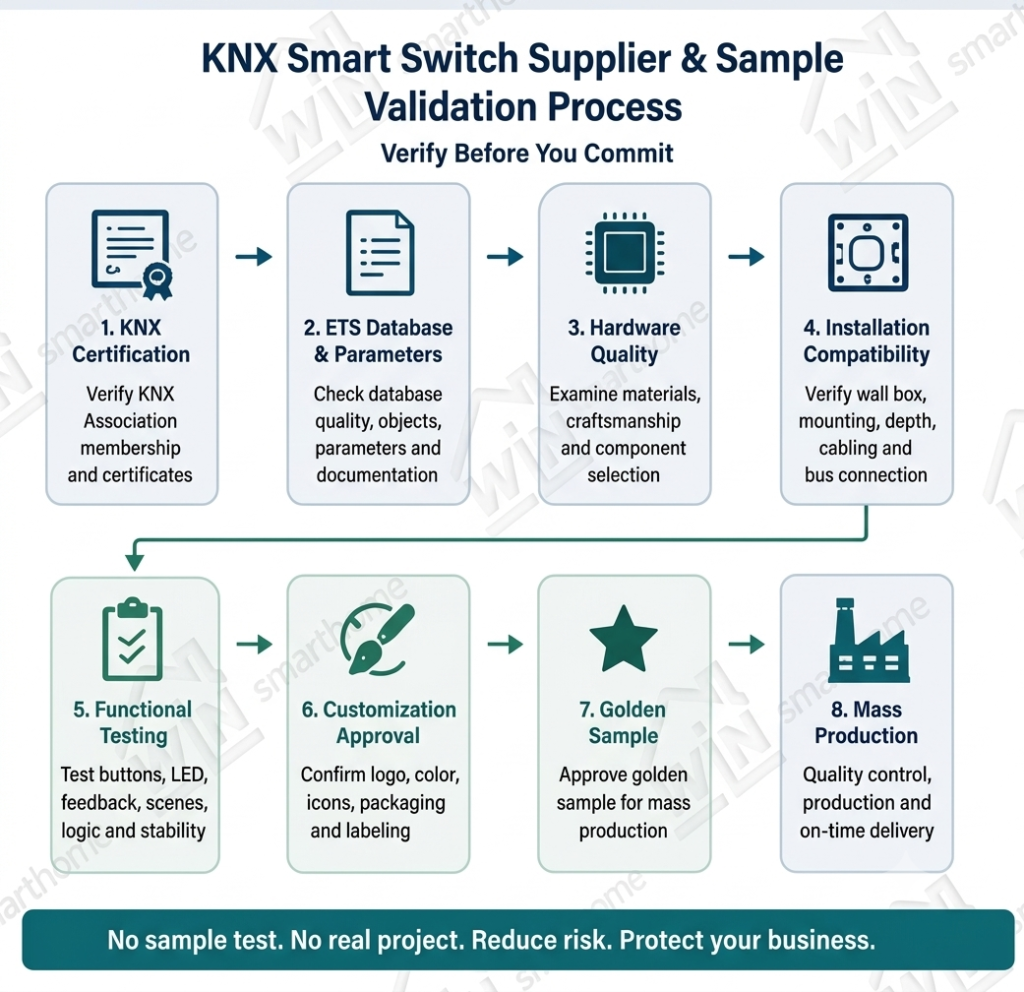
Use a structured supplier review
- Certification: confirm the KNX-certified product entry, CE documentation and market-specific compliance.
- ETS resources: review application files, parameters, communication objects and documentation before ordering.
- Hardware quality: evaluate button feel, gaps, surface finish, LED consistency, screen response and terminals.
- Compatibility: test installation boxes, frames, actuators, HVAC logic and the intended KNX topology.
- Lifecycle: ask about component changes, firmware policy, replacement availability and warranty handling.
- Customization control: approve drawings, icon files, color samples, UI details and golden samples in writing.
Why sample validation matters
A catalog cannot reveal tactile quality, UI delays or installation problems. Test samples using a realistic room sequence: short press, long press, dimming, curtain movement, scene recall, status feedback, restart behavior and bus recovery. For thermostats, simulate heating, cooling, fan speeds and sensor offsets. Record every issue and freeze the approved configuration before mass production.
| Sample test | Acceptance question | Evidence to retain |
|---|---|---|
| Mechanical and finish | Are gaps, button force, color and surface consistent? | Photos, color sample and signed golden sample |
| KNX functions | Do all short/long press, value, scene and feedback objects work? | ETS project file and test record |
| Installation | Does the device fit the specified box and frame without rework? | Dimension drawing and installation photos |
| Reliability | Does it recover correctly after power and bus interruptions? | Restart and endurance test results |
| Customization | Do icons, labels, UI, logo and packaging match approval files? | Artwork revision and approval sheet |
How WinSmartHome supports project buyers
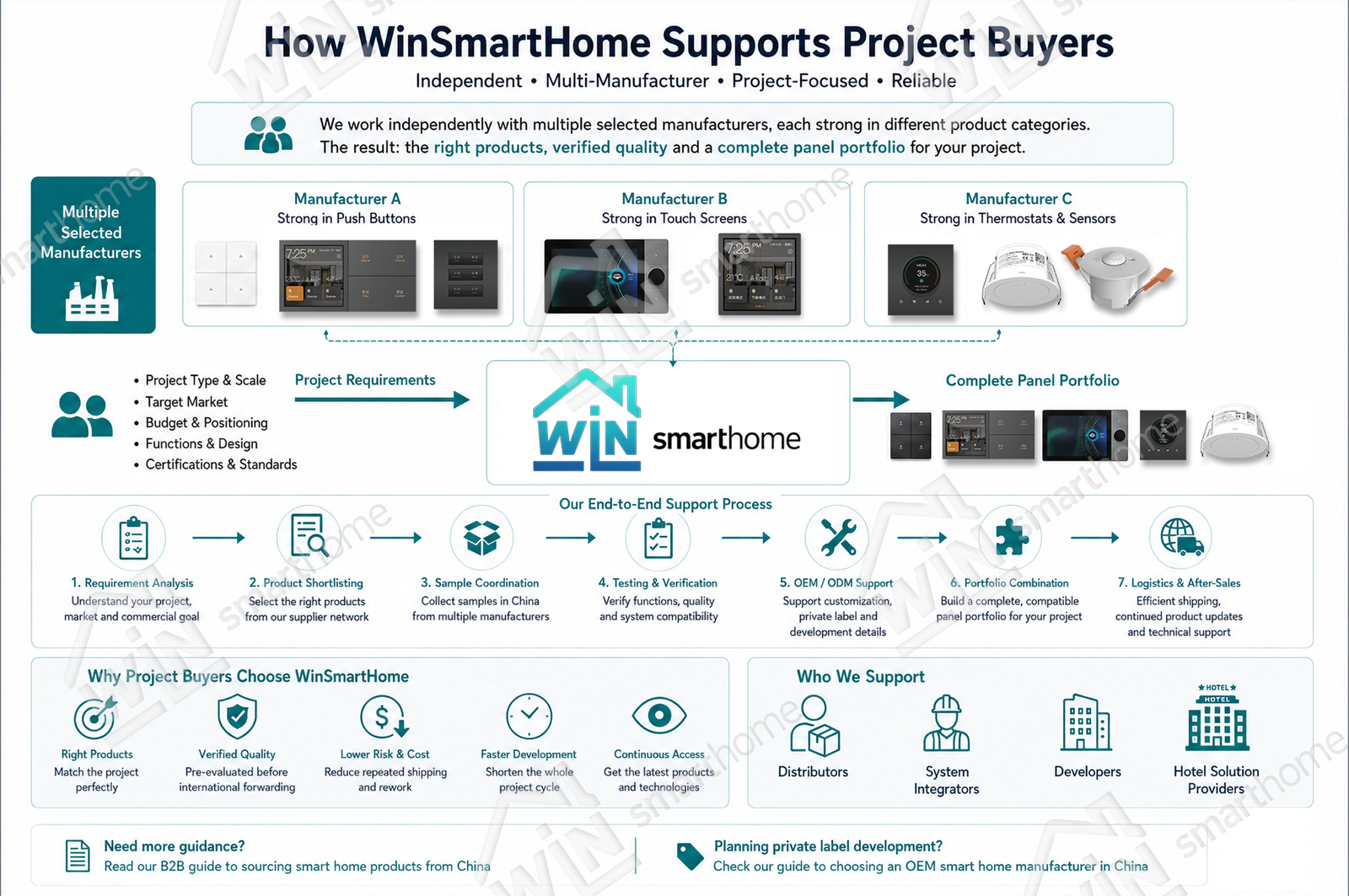
WinSmartHome works independently with multiple selected manufacturers rather than forcing every requirement into one factory’s catalog. This matters because one manufacturer may be strongest in push buttons, another in touch screens and another in thermostats or sensors.
Based on the project, market and commercial goal, we can shortlist the right products, coordinate samples in China, verify functions and compatibility, support OEM/ODM details and combine a complete panel portfolio. Pre-evaluating samples before international forwarding can identify problems earlier, reduce repeated shipping and shorten the development cycle. Buyers also gain continued access to new products and technology through our supplier network and industry experience.
This approach is useful for distributors, system integrators, developers and hotel solution providers that need more than a quotation. If you are still building your supplier strategy, read our B2B guide to sourcing smart home products from China. For private-label development, our guide to choosing an OEM smart home manufacturer in China provides a broader evaluation framework.
5. Final Checklist and FAQs
KNX smart switch selection checklist
- □ Project type, users and room functions are documented.
- □ Button, touch, thermostat or voice interface is justified by use frequency.
- □ Wall box, dimensions, bus current and auxiliary power are confirmed.
- □ KNX certification and ETS database have been verified.
- □ Finish, labels, LEDs, UI and customization are approved by sample.
- □ Warranty, lead time and replacement policy are documented.
Is a touch screen always better than a KNX push button?
No. Touch screens are valuable for many functions and status views, while push buttons are faster for frequent actions. Many successful projects use both.
Are Chinese KNX switches compatible with European KNX devices?
A KNX-certified device is designed for interoperability, but its specific functions, ETS application and power requirements still need to be checked. Always test the planned combination.
What should buyers test first?
Start with tactile quality, response speed, LED feedback, ETS parameterization, load-control sequences, restart behavior and physical installation. For custom models, approve a golden sample.
Can one supplier provide every panel category?
Some can, but breadth does not guarantee best-in-category performance. A multi-manufacturer strategy can create a stronger portfolio when design, functions and price positioning differ by market segment.
Choose the Right KNX Panel for Your Market
The best panel is not defined by the lowest price or the most features. It is the product that fits the user, installation, interior, project budget and long-term support plan. WinSmartHome can help you compare qualified products, evaluate samples and build a coordinated KNX panel portfolio from China. Learn more about WinSmartHome or contact us to discuss your project requirements.