TL;DR
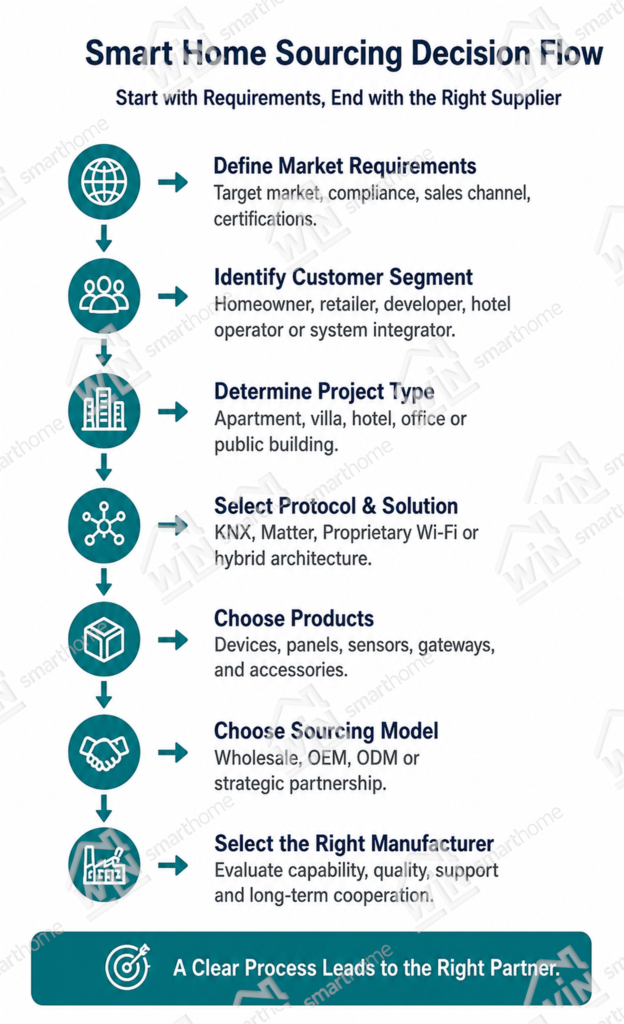
- ✅ Define the market, customer segment, product positioning, protocol and compliance requirements before contacting factories.
- ✅ Choose KNX for complex professional projects, Matter for accessible residential solutions, and proprietary Wi-Fi when ecosystem control and customization are priorities.
- ✅ Direct sourcing, a sourcing agency and a strategic partnership solve different problems. The right model depends on whether you need one product or a long-term portfolio.
- ✅ No single manufacturer is best at every smart home product category. A multi-manufacturer strategy can produce a stronger solution.
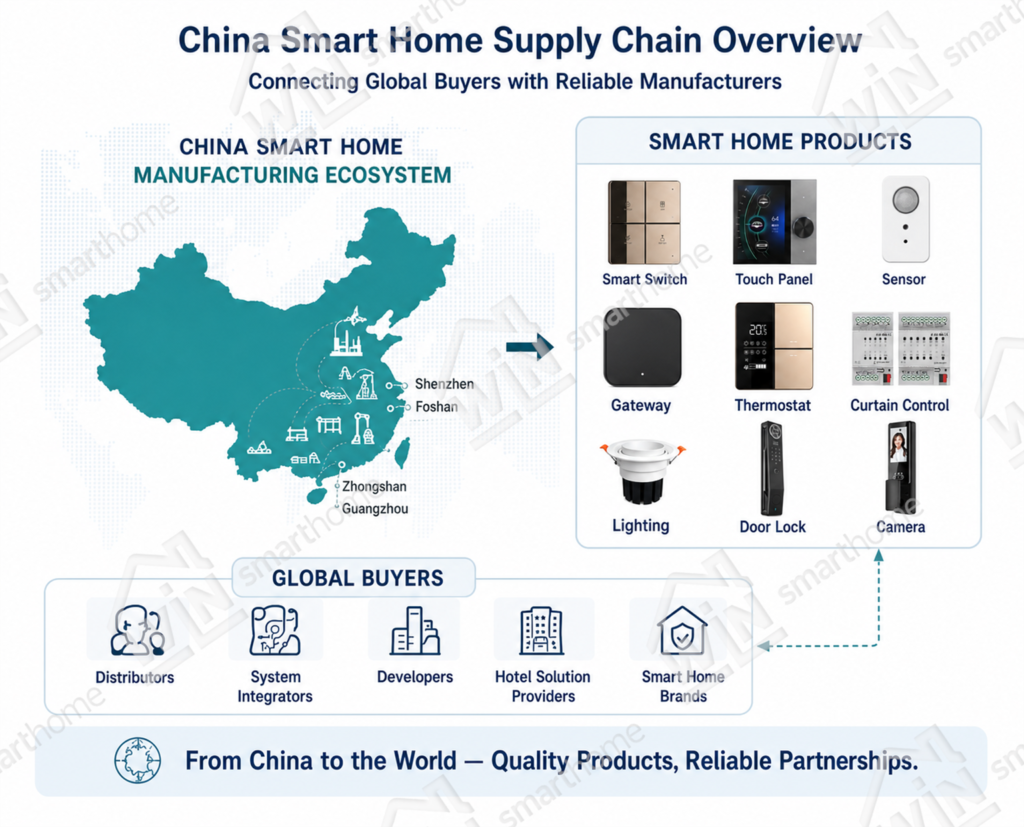
China has one of the world’s broadest smart home manufacturing ecosystems. Buyers can find smart switches, touch panels, sensors, gateways, thermostats, curtain controls and complete building automation solutions across many price levels. Yet the number of available factories is precisely what makes smart home product sourcing China more difficult than it first appears.
The challenge is not simply how to import smart home products from China. It is deciding which products fit your market, which manufacturers are genuinely strong in each category, and which sourcing model can support your business after the first order. This B2B guide explains how distributors, system integrators, real estate developers, hotel solution providers and smart home brands can source smart home products from China with a clearer commercial strategy.
1. Define Your Smart Home Sourcing Requirements
Before asking a China smart home products supplier for a quotation, define what success looks like in your market. A product that performs well in a luxury villa may be too expensive for an apartment package. A device designed for retail installation may not provide the engineering depth required by a commercial building.
Start with the business case, not the product catalogue. A useful sourcing brief should answer the following questions:
- Where will the products be sold and which certifications apply?
- Who is the customer: homeowner, retailer, developer, hotel operator or system integrator?
- Is the project an apartment, villa, hotel, office or large public building?
- Do you need individual devices or a complete interoperable solution?
- Is the desired positioning entry-level, mid-range or premium?
- Do you need standard products, private-label branding or full ODM development?
- What are the target price, expected volume and launch schedule?
| Requirement | Decision to Make |
|---|---|
| Target market | Country, sales channel and local compliance |
| Customer segment | Retail, project, hospitality or professional integration |
| Product positioning | Value, balanced or premium portfolio |
| Product scope | Single device, product family or complete solution |
| Commercial model | Wholesale, OEM, ODM or strategic partnership |
A precise brief also prevents a common mistake in smart home sourcing for distributors: comparing quotations from suppliers that are not offering equivalent products. Differences in materials, firmware, certification, cloud services, warranty and technical support can make two visually similar devices commercially very different.
If your roadmap includes custom hardware, firmware or branding, our related guide explains how to evaluate an OEM smart home manufacturer in China.
2. Choose the Right Products and Protocol
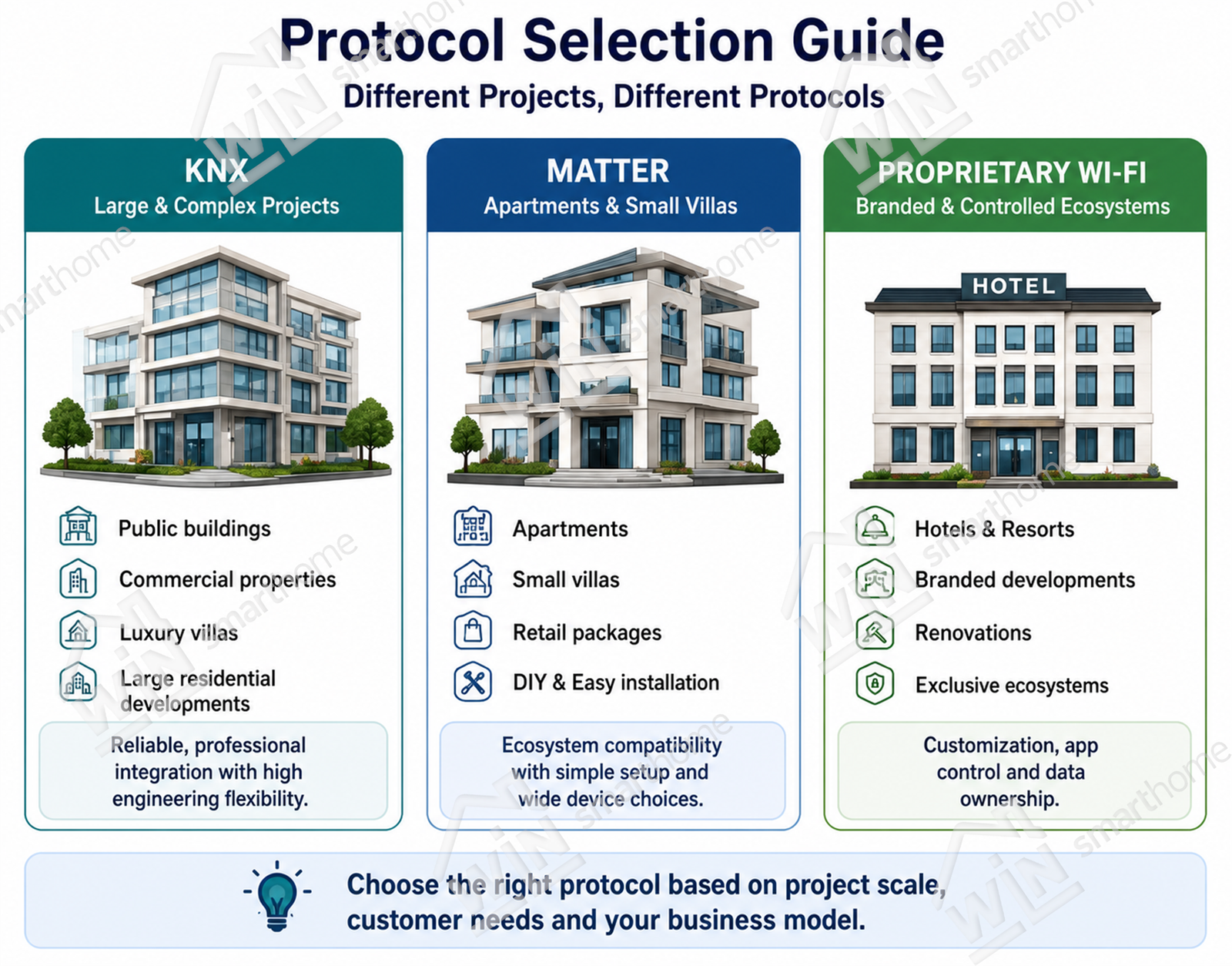
Protocol selection should follow the project and commercial model. It should not be based only on which technology currently receives the most publicity. Installation capability, project scale, end-user expectations, system lifespan and ecosystem ownership all matter.
KNX for Large and Complex Projects
KNX smart home products from China are best suited to public spaces, commercial properties, luxury villas and large residential developments. KNX gives property developers and professional system integrators reliable control across lighting, HVAC, curtains, sensors and other building systems.
It is the strongest option when project longevity, engineering flexibility and professional integration matter more than plug-and-play installation. Buyers should confirm KNX certification, ETS resources, technical documentation and the supplier’s ability to support a complete device portfolio.
Matter for Apartments and Small Villas
Matter smart home products China are more accessible for middle-class families, apartments, small villas and retail packages. Matter can also help traditional lighting companies, audio companies and electrical retailers offer user-friendly smart home installation without building a large specialist integration team.
However, the Matter logo alone does not guarantee a complete solution. Buyers still need to verify device certification, ecosystem compatibility, commissioning, Thread or Wi-Fi infrastructure, OTA updates and the real installation workflow.
Proprietary Wi-Fi for a Controlled Brand Ecosystem
WiFi smart home OEM solutions are useful for real estate developers, furnishing brands, hotel groups and renovation companies that want exclusive devices, custom automation and a differentiated installation experience.
This model can protect the customer relationship and create a controlled product ecosystem. Before committing, clarify who owns the app, firmware, cloud platform, API access and customer data, as well as what happens if the original technology provider changes.
The right smart home architecture depends on the project scale, target customer and business model.
| Solution | Best Fit | Main Advantage |
|---|---|---|
| KNX | Large buildings, luxury villas and complex projects | Reliable professional integration |
| Matter | Apartments, small villas and retail packages | Accessible installation and ecosystem compatibility |
| Proprietary Wi-Fi | Hotels, branded developments and renovations | Customization and ecosystem control |
For a deeper technical comparison, read KNX vs Matter for villas, hotels and smart buildings. Some projects will also benefit from a hybrid architecture rather than a single protocol.
3. Choose the Right Smart Home Sourcing Model
Once the requirements and solution architecture are clear, choose how you will manage suppliers. There are three practical models: sourcing directly, hiring a sourcing agency, or building a strategic partnership. Each has a legitimate role.
Model 1: Find and Manage Suppliers Directly
Buyers can search through Google, B2B platforms, exhibitions, referrals and factory visits. Direct sourcing gives your team direct communication and control, and it avoids a separate sourcing service fee.
- Best for: experienced buyers purchasing a clearly specified, standardized product.
- Advantages: direct factory communication, independent negotiation and close control.
- Limitations: high research workload, difficult supplier verification and significant coordination when several factories are involved.
This model becomes less efficient when smart home devices wholesale China sourcing expands from one SKU to several categories, protocols and price tiers.
Model 2: Use a Traditional Sourcing Agency
A sourcing agency normally searches for factories, collects quotations, coordinates samples, follows orders, arranges inspections and supports shipping. This is useful when the buyer already knows exactly what to purchase but needs execution support in China.
- Best for: clearly defined products, mixed orders and buyers needing local procurement support.
- Advantages: convenience, local communication, order follow-up and logistics coordination.
- Limitations: the relationship may focus on completing transactions rather than validating the product portfolio or developing the local market.
A general sourcing agency may also lack the technical depth to evaluate protocols, interoperability, app ownership, cloud architecture and long-term product roadmaps.
Model 3: Build a Strategic Partnership
Unlike a single-brand manufacturer, Win Smart Home works independently with multiple carefully selected manufacturers across smart home and building automation. The reason is simple: no single manufacturer can provide the strongest complete solution for every project and every product category.
The strategic partner’s role is to match the right products with the right manufacturers based on the business goal and project requirements—not limit the buyer to one factory’s catalogue.
This long-term model is especially relevant for complete KNX, Matter, Tuya, lighting and multi-protocol portfolios. It adds four capabilities beyond basic procurement.
1. Faster Supplier Selection
Experience with hundreds of major and niche suppliers makes it possible to create a relevant shortlist faster. The value is not the number of contacts; it is knowing which manufacturer is strong in each product category, technical architecture, design level and price segment.
2. Product and Market Validation
Product validation is more than testing whether a device works. It asks whether the product is right for the target customer. A premium smart panel may deliver richer functions and a better interface, while a simpler panel may create stronger value in price-sensitive projects. Neither is universally better.
Hotels illustrate the difference clearly. A 3-star project may prioritize reliable functions and competitive pricing; a 4-star project may need balanced design and features; a 5-star project may require premium materials, advanced scenes and customization. The same principle applies when building a Matter portfolio for markets such as the UAE.
Samples can first be evaluated in China against the project requirements before they are forwarded internationally. This can identify compatibility problems early, reduce repeated shipping, shorten development cycles and confirm that the final portfolio matches the local market strategy.
3. Continuous Access to New Products and Technologies
Regular attendance at the Guangzhou International Lighting Exhibition, Shanghai lighting events and other industry exhibitions helps partners track new products, manufacturers and technical trends without travelling to China for every sourcing cycle.
4. A Local Growth Partner Strategy
The relationship continues after product selection. Once the right portfolio is established, both sides can use customer feedback to refine positioning, introduce relevant new products and develop the local market together. For selected markets and qualified companies, Win Smart Home may work with one strategic partner in a country or defined market segment.
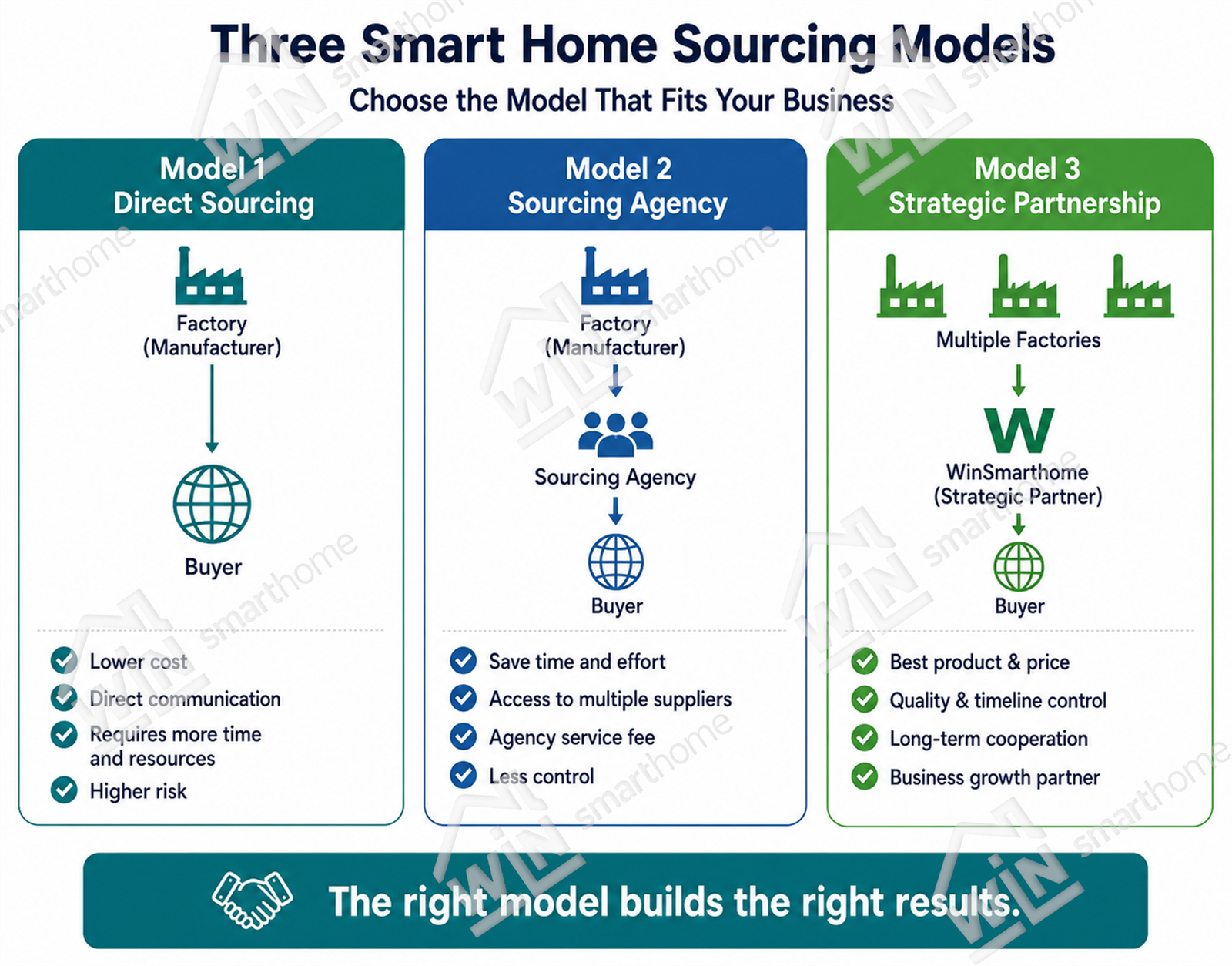
| Model | Best For | Main Trade-off |
|---|---|---|
| Direct sourcing | Experienced teams buying standard products | Maximum control, highest internal workload |
| Sourcing agency | Buyers needing local purchasing execution | Efficient transactions, limited market strategy |
| Strategic partnership | Companies building complete solutions and long-term markets | Greater strategic value, requires deeper cooperation |
If you need one standardized product, direct sourcing or a traditional agency may be sufficient. If your goal is a complete product portfolio, differentiated local positioning and continuous access to several specialist manufacturers, an independent smart home sourcing partner can provide a more suitable structure. Win Smart Home also provides broader smart home integration services for multi-protocol project planning.
4. Frequently Asked Questions
Is it better to source directly from a Chinese manufacturer?
Direct sourcing is effective when you have a precise specification, a mature procurement team and one standard product category. It becomes harder when several factories, protocols and product tiers must work together.
What is the difference between a sourcing agency and a strategic partner?
A sourcing agency mainly executes supplier search, quotations, orders and logistics. A strategic partner also helps shape the portfolio, validate products for the target market and support long-term market development.
Why might a complete smart home solution require multiple manufacturers?
Factories have different strengths. One may excel at touch panels, another at sensors, and another at gateways, firmware or lighting control. Selecting specialists by category can create a stronger overall solution than relying on one catalogue.
Which sourcing model is most suitable for Matter solutions?
A single-device Matter purchase can be handled directly. A complete Matter portfolio usually benefits from strategic coordination because certification, ecosystem compatibility, gateways, product categories and market positioning may involve several manufacturers.
Can samples be evaluated in China before international shipping?
Yes. Preliminary evaluation in China can verify functions, compatibility, installation, App experience and product positioning before samples are forwarded overseas, reducing avoidable logistics and testing cycles.
Build the Right Portfolio, Not Just a Supplier List
To source smart home products from China successfully, first define your market and customer, then select the right solution architecture and finally choose a sourcing model that matches the complexity of your business. The lowest quotation is rarely the complete answer.
If you are building a KNX, Matter or proprietary smart home portfolio, share your target country, customer segment, project type, preferred protocol, product categories and expected positioning. Contact Win Smart Home for a sourcing consultation, and we will help you evaluate whether direct sourcing, agency support or a strategic partnership is the right next step.