
TL;DR
- ✅ Matter vs Zigbee compares interoperability with reliable low-power mesh networking.
- ✅ Matter enables cross-brand control across major smart home ecosystems.
- ✅ Zigbee remains proven for sensors, lighting, switches, and battery-powered devices.
- ✅ Matter Bridges integrate existing Zigbee devices without replacing installed hardware.
- ✅ Hybrid architectures often deliver the best compatibility, reliability, and upgrade path.
Part 1: Why Are People Comparing Matter and Zigbee?
If you’ve been researching smart home technology recently, you’ve probably noticed one comparison appearing almost everywhere:
Matter vs Zigbee
At first glance, the question seems straightforward:
Which protocol is better for a smart home?
However, this question is actually based on a common misconception. Matter and Zigbee are frequently mentioned together, but they were never designed to solve the same problem.
For more than a decade, Zigbee has been one of the most widely deployed wireless technologies in smart homes, connecting millions of sensors, switches, lights, thermostats, and other IoT devices through reliable low-power mesh networking.
Meanwhile, Matter is a much newer standard developed by the Connectivity Standards Alliance (CSA). Instead of introducing another wireless protocol, Matter focuses on solving one of the industry’s biggest challenges: interoperability. Its goal is to allow devices from different manufacturers and ecosystems to communicate using a common application layer, making smart home systems easier to deploy and manage.
As Matter adoption accelerates, many homeowners, system integrators, manufacturers, and distributors naturally begin asking the same question:
Will Matter replace Zigbee?
The answer is more nuanced than a simple yes or no.
Why Do Matter and Zigbee Seem to Compete?
One reason for the confusion is that consumers often see both technologies listed on the same product packaging or discussed in the same buying guides. In reality, they play very different roles within a smart home architecture.
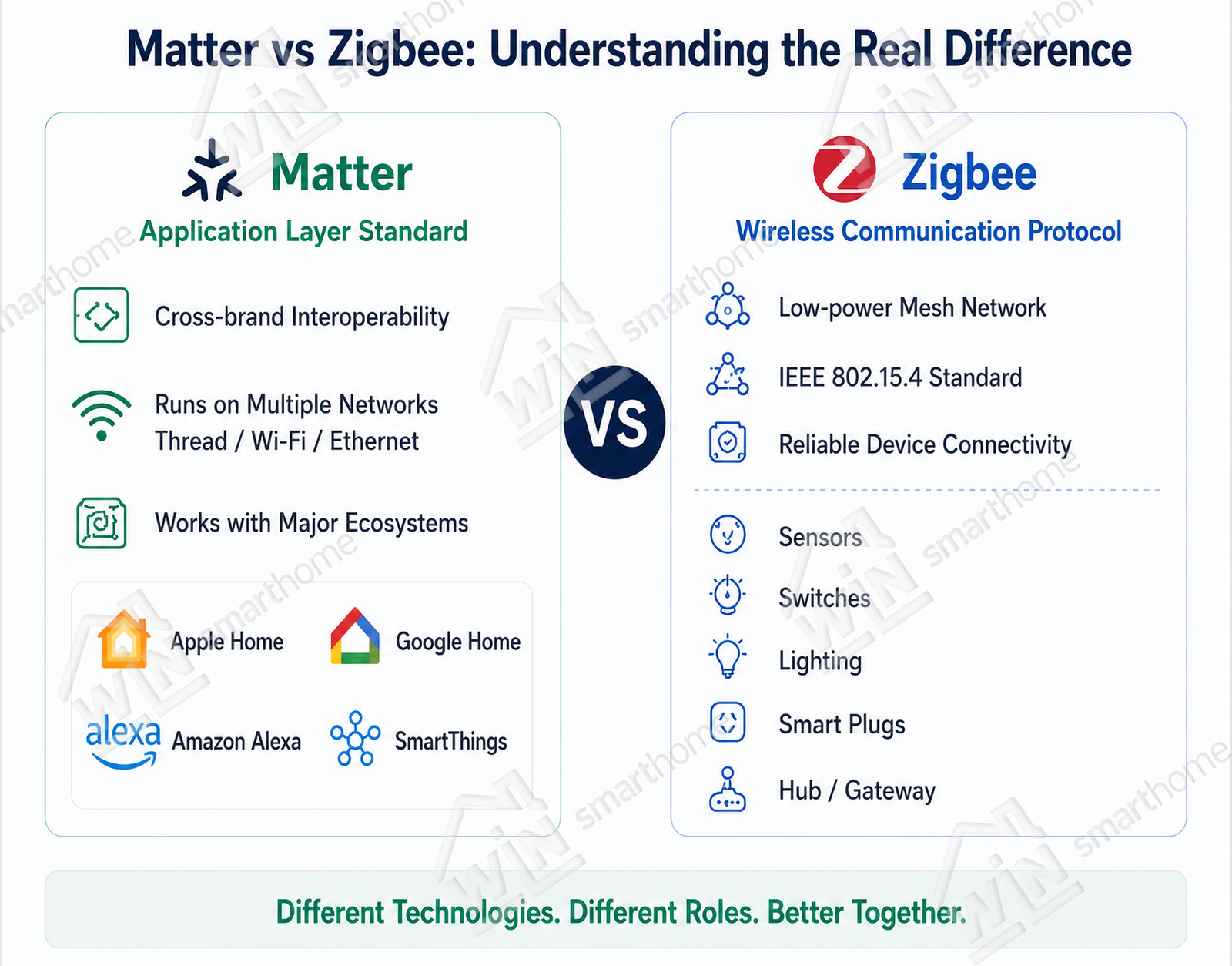
| Matter | Zigbee |
|---|---|
| An interoperability standard | A wireless communication protocol |
| Defines how devices understand each other | Defines how devices exchange data |
| Works across multiple ecosystems | Builds a low-power mesh network |
| Focuses on cross-brand compatibility | Focuses on reliable device connectivity |
Rather than competing, they often work together in the same deployment.
For example, a smart home may use:
- Zigbee sensors for reliable, low-power communication
- Thread-enabled door locks for secure mesh networking
- Wi-Fi cameras for high-bandwidth video streaming
- Matter to allow all of these devices to be controlled from Apple Home, Google Home, Amazon Alexa, or Samsung SmartThings
In this scenario, Matter does not replace Zigbee. Instead, it improves how devices from different ecosystems interact with one another.
The growing discussion around Matter vs Zigbee is therefore not really about choosing one technology over another. It reflects a broader shift in the smart home industry—from isolated brand ecosystems toward more open, interoperable systems.
Understanding this shift starts with answering a more fundamental question:
What exactly are Matter and Zigbee, and why were they designed for different purposes?
Part 2 – What Exactly Are Matter and Zigbee?
Before comparing Matter and Zigbee, it’s important to understand one key fact:
Matter and Zigbee are not the same type of technology.
Although they are often mentioned together, they were designed to solve different problems and operate at different layers of a smart home system.
Understanding this distinction makes the rest of the comparison much easier.
Matter: A Common Language for Smart Home Devices
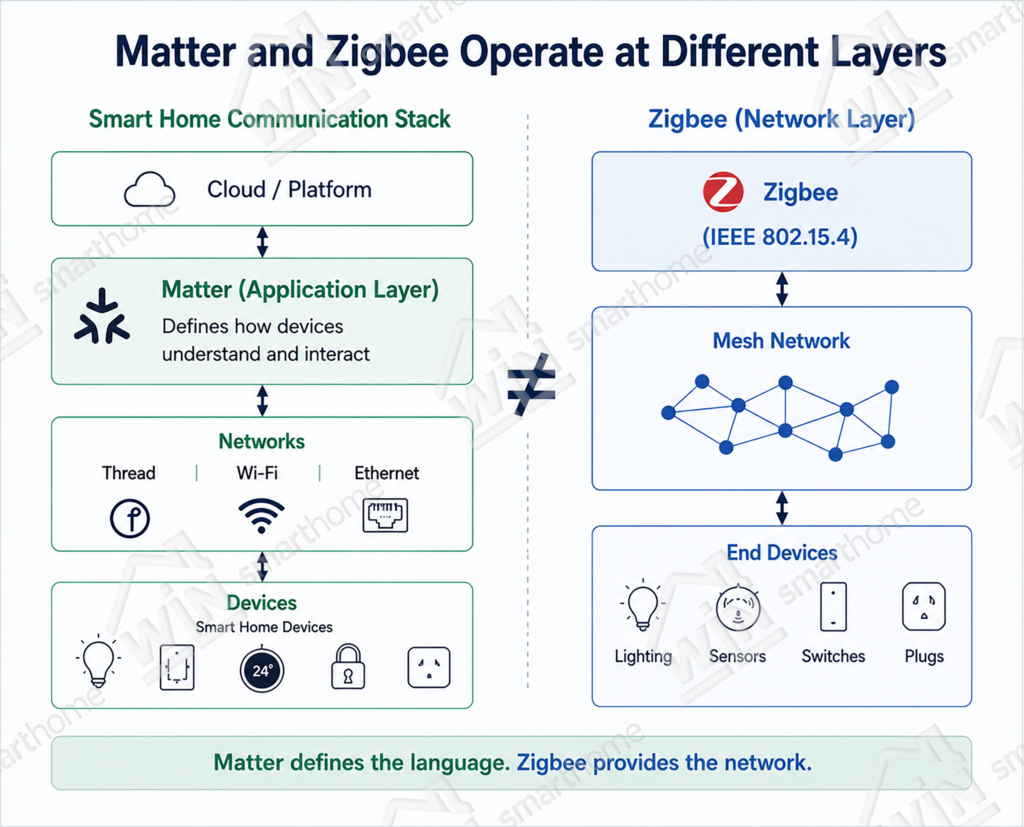
Matter is an application-layer interoperability standard developed by the Connectivity Standards Alliance (CSA).
Rather than defining how devices connect to each other, Matter defines how smart devices identify themselves, exchange information, and execute commands across different ecosystems.
Its goal is simple: allow devices from different manufacturers to work together more seamlessly.
Zigbee: A Reliable Wireless Communication Protocol
Zigbee is a low-power wireless communication protocol built on the IEEE 802.15.4 standard.
It creates a mesh network that allows smart devices to communicate reliably while consuming very little power.
Because of its stability and efficiency, Zigbee has become one of the most widely used networking technologies for smart lighting, sensors, switches, and home automation devices.
How Are They Different?
The easiest way to understand their relationship is to look at the smart home communication stack.
| Layer | Matter | Zigbee |
|---|---|---|
| Role | Defines how devices communicate | Connects devices through a wireless mesh network |
| Focus | Cross-brand interoperability | Reliable low-power connectivity |
| Runs On | Thread, Wi-Fi, Ethernet | IEEE 802.15.4 |
This explains why Matter and Zigbee are not direct competitors.
Matter defines how devices understand each other, while Zigbee defines how data travels between devices.
Can Matter Work with Zigbee?
Yes—but not directly.
Matter natively operates over Thread, Wi-Fi, and Ethernet, while existing Zigbee devices typically connect through a Matter Bridge, allowing them to appear as Matter-compatible devices inside platforms such as Apple Home, Google Home, or Amazon Alexa.
This approach protects existing Zigbee installations while bringing them into the Matter ecosystem, making interoperability possible without replacing every device.
The next question is therefore not what Matter is, but why Matter has gained industry-wide support when so many previous smart home standards failed.
Part 3 – Why Does Matter Succeed Where Previous Smart Home Standards Failed?
The smart home industry has been talking about a “universal standard“ for more than a decade. Several attempts have been made to unify smart home devices, but none achieved widespread adoption.
So why does Matter look different?
There are 3 key reasons.
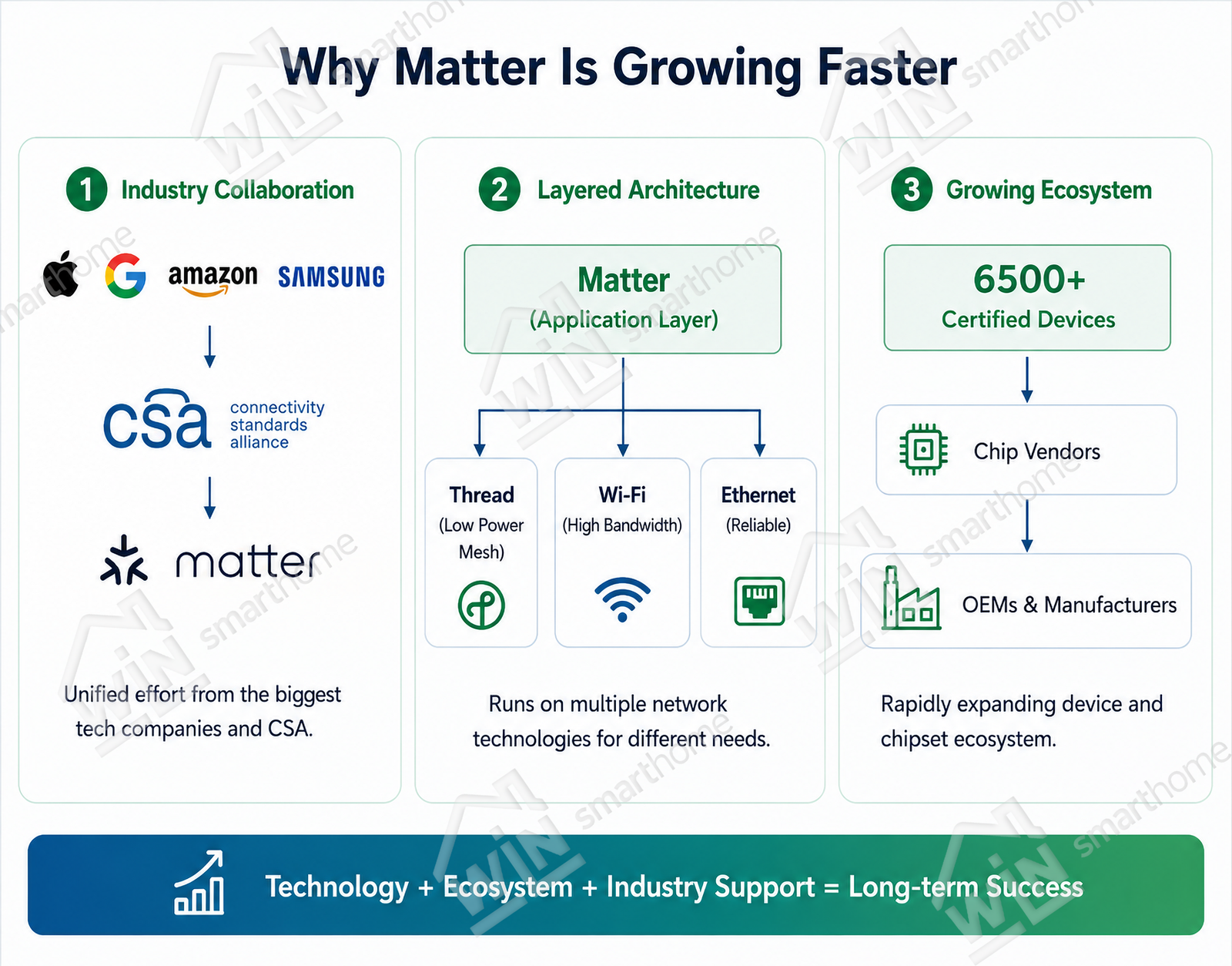
1. The Industry’s Biggest Players Are Finally Working Together
Apple, Google, Amazon, and Samsung used to build their own ecosystems. HomeKit, Google Home, Alexa, and SmartThings each created their own “walled gardens,” requiring manufacturers to develop and maintain separate integrations.
Today, these companies are working together to support Matter—not because they suddenly became competitors-turned-friends, but because closed ecosystems have started to limit market growth.
Consumers no longer want to be locked into a single platform, and manufacturers don’t want to build the same product four different times. When the cost of maintaining separate ecosystems becomes higher than the benefit, collaboration becomes the logical choice.
2. Matter Separates Interoperability from Connectivity
One of Matter’s biggest strengths is its layered architecture.
Instead of replacing existing communication technologies, Matter separates the application layer from the network layer. Manufacturers are free to choose the most suitable networking technology for each product:
| Device Type | Recommended Network | Reason |
|---|---|---|
| Battery-powered devices (sensors, door locks) | Thread | Ultra-low power consumption |
| Mains-powered devices (lights, smart plugs) | Wi-Fi | Lower cost and higher bandwidth |
| Existing Zigbee devices | Matter Bridge | Preserves existing installations while enabling Matter interoperability |
This architecture allows manufacturers to develop a Matter-compatible product without being locked into a single networking technology. They only need to implement Matter once, while selecting the underlying network based on the requirements of each product.
3. The Ecosystem Is Reaching Critical Mass
Technology alone is not enough. A successful standard also requires a mature ecosystem.
By Q1 2026, the number of Matter-certified products had exceeded 6,500, with more than 600 new certifications added in a single quarter. Early adoption was driven mainly by smart lighting and smart plugs, while major home appliances such as air conditioners and refrigerators gained momentum in 2024. In 2025, smart security cameras became one of the fastest-growing product categories.
The hardware ecosystem has also matured rapidly. Manufacturers can now choose from a wide range of Matter-ready chipsets, including the Espressif ESP32-C6 for cost-sensitive applications, the Silicon Labs MG24 for low-power Thread devices, and the NXP RW612 for security-focused designs.
The standard is ready. The chipsets are available. The products are already on the market.
This combination makes Matter fundamentally different from previous attempts at smart home standardization.
Part 4 – Matter vs Zigbee: Which Performs Better in Real-World Projects?
Choosing between Matter and Zigbee is not simply a matter of comparing specifications.
Although they often appear side by side, they were designed for different purposes. The better choice depends on your project requirements, existing infrastructure, and long-term deployment strategy.
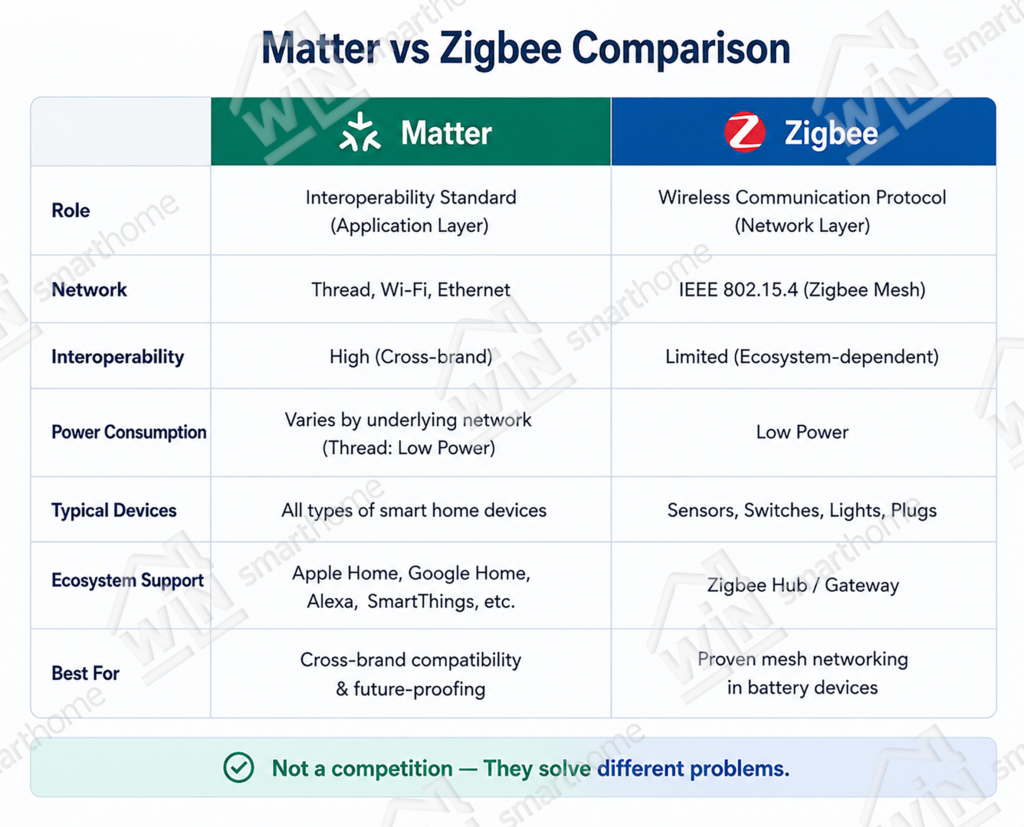
The following comparison highlights the most important differences.
| Feature | Matter | Zigbee |
|---|---|---|
| Primary Role | Interoperability standard | Wireless communication protocol |
| Network | Thread, Wi-Fi, Ethernet | Zigbee Mesh |
| Interoperability | Excellent | Limited to Zigbee ecosystem |
| Device Compatibility | Cross-brand | Brand-dependent |
| Existing Device Base | Growing rapidly | Very mature |
| Typical Applications | New smart home ecosystems | Lighting, sensors, automation |
Which Protocol Offers Better Device Compatibility?
If compatibility across different brands is your priority, Matter has a clear advantage.
Matter allows certified devices from different manufacturers to work together within the same ecosystem. A Matter-enabled smart plug, sensor, and lighting controller can be managed through major platforms such as Apple Home, Google Home, Amazon Alexa, and Samsung SmartThings.
Zigbee devices, on the other hand, often depend on the capabilities of the hub or gateway. While Zigbee is widely supported, cross-brand compatibility is not always guaranteed.
For projects involving products from multiple vendors, Matter generally provides a simpler user experience.
Which Is Better for Battery-Powered Devices?
For battery-powered products, Zigbee still performs extremely well.
Its low-power mesh networking has been proven over many years in sensors, switches, and door locks.
Matter itself does not define power consumption because it is not a networking protocol. When Matter operates over Thread, battery performance is comparable to modern Thread devices, making it an excellent choice for low-power applications as well.
In practice, battery life depends more on the underlying network technology than on Matter itself.
Which Is Easier to Expand in the Future?
Matter was designed with long-term interoperability in mind.
As more manufacturers adopt the standard, adding new devices from different brands becomes easier without replacing the existing ecosystem.
Zigbee remains an excellent choice for stable installations, particularly where a large number of Zigbee products are already deployed. However, expanding across multiple ecosystems may require additional gateways or platform-specific integrations.
For new projects, Matter generally offers greater flexibility for future expansion.
Should Existing Zigbee Systems Be Replaced?
In most cases, no.
Many existing Zigbee installations are reliable and continue to perform well. Replacing every device simply to adopt Matter would rarely be cost-effective.
Instead, many projects now use Matter Bridges to integrate existing Zigbee devices into Matter-compatible ecosystems. This approach protects previous investments while providing access to newer Matter-enabled platforms.
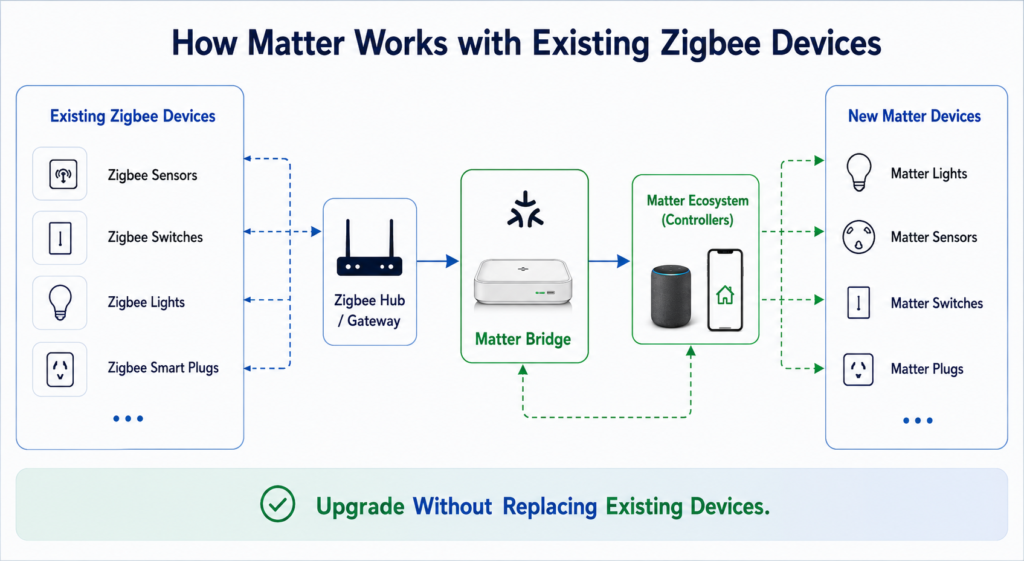
For both homeowners and system integrators, gradual migration is usually the more practical strategy.
WinSmartHome Recommendation
Matter is the better choice for new ecosystems that prioritize interoperability across multiple brands. Zigbee remains an excellent solution for proven, large-scale mesh networking. For many commercial and residential projects, the most practical approach is not choosing one over the other—but combining both through Matter Bridges.
This naturally leads to the final question:
Which protocol should you choose for your specific smart home project?
Frequently Asked Questions
Q1: Can Matter Replace Zigbee Completely?
No. Matter and Zigbee are designed for different purposes.
Matter is an interoperability standard, while Zigbee is a wireless communication protocol. Existing Zigbee devices can continue to operate through a Matter Bridge, allowing users to add Matter-compatible products without replacing their current installation.
Q2: Does Matter Require Thread?
No. Matter can run over Thread, Wi-Fi, or Ethernet.
Thread is commonly used for battery-powered devices such as sensors and door locks, while Wi-Fi and Ethernet are better suited to products that require higher bandwidth, including smart speakers, cameras, and home appliances.
Q3: Is Zigbee Still Worth Choosing in 2026?
Yes. Zigbee remains one of the most reliable mesh networking technologies for smart homes.
It continues to be widely used in lighting, sensors, switches, and building automation. For existing Zigbee installations, adding Matter compatibility through a bridge is usually more cost-effective than replacing every device.
Q4: Which Is Better for a New Smart Home Project?
It depends on your priorities.
Choose Matter if cross-brand compatibility is your primary concern. Choose Zigbee if you need a mature, proven mesh network. In many projects, using both technologies together provides the best balance between interoperability and reliability.
Q5: Can Matter Control Existing Zigbee Devices?
Yes, through a Matter Bridge.
Although Matter does not communicate directly over Zigbee, a compatible bridge can expose Zigbee devices as Matter devices, allowing them to be managed from platforms such as Apple Home, Google Home, Amazon Alexa, and Samsung SmartThings.
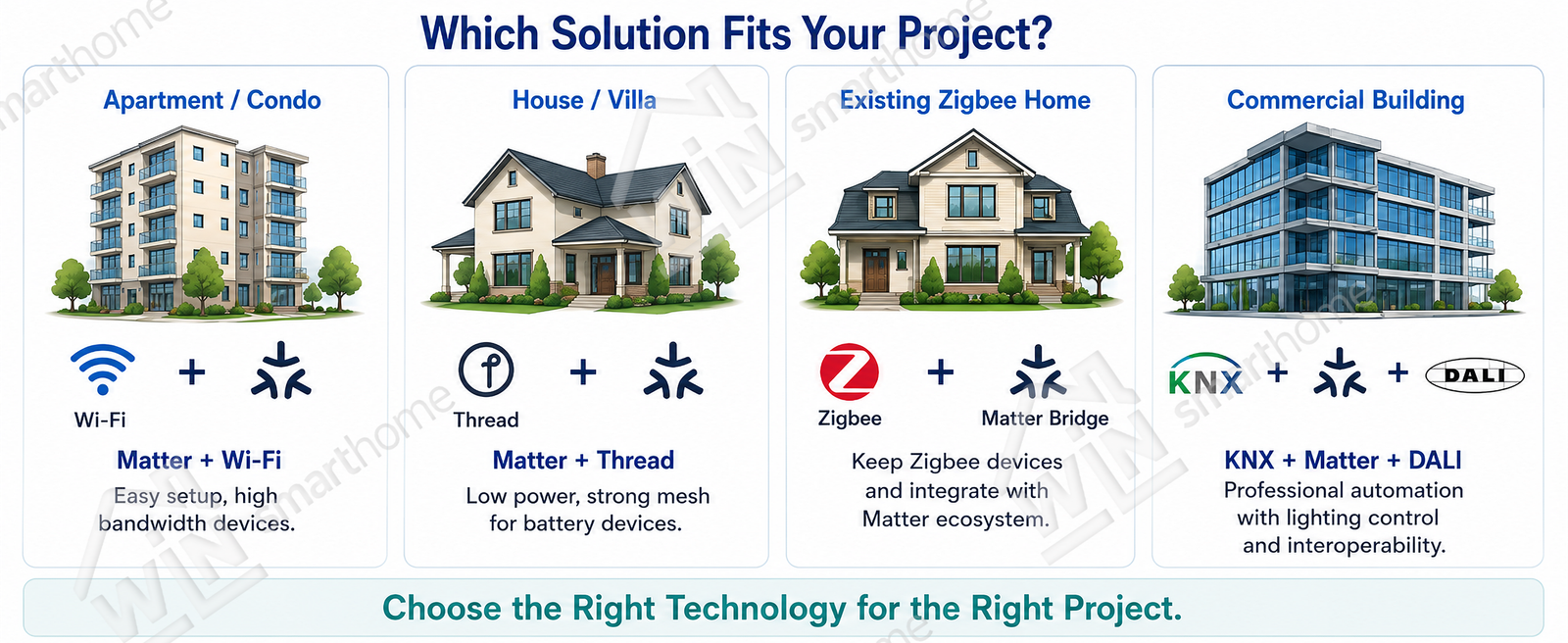
Planning a Smart Hotel, Villa, or Smart Building Project?
WinSmartHome supports developers, distributors, hotel automation companies, and system integrators with:
- KNX smart home product sourcing
- Matter-compatible smart home products
- Smart hotel and villa automation planning
- HVAC control and thermostat selection
- Lighting control and dimming solutions
- Multi-protocol system integration
- OEM / ODM smart home product support
Request Technical Consultation